Narayan Thapa – författare
Visar alla böcker från författaren Narayan Thapa. Handla med fri frakt och snabb leverans.
3 produkter
3 produkter
E-bok
PDF, 20184 351 kr
Läs direkt efter köp
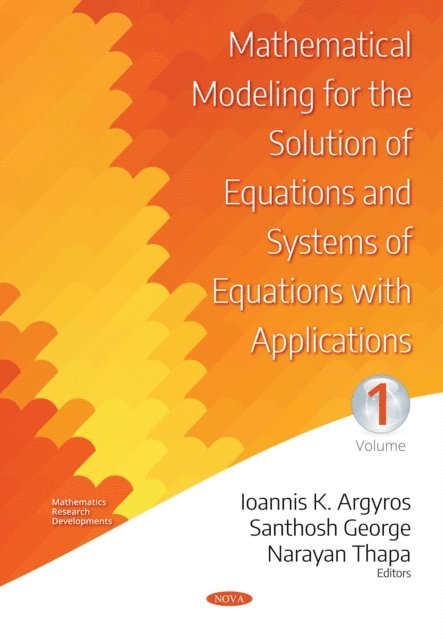
This book is dedicated to the approximation of solutions of nonlinear equations using iterative methods. The study about convergence matter of iterative methods is usually based on two categories: semi-local and local convergence analysis. The semi-local convergence category is, based on the information around an initial point, to provide criteria ensuring the convergence of the method; while the local one is, based on the information around a solution, to find estimates of the radii of the convergence balls. The book is divided into two volumes. The chapters in each volume are self-contained so they can be read independently. Each chapter contains semi-local and local convergence results for single, multi-step and multi-point old and new contemporary iterative methods involving Banach, Hilbert or Euclidean valued operators. These methods are used to generate a sequence defined on the aforementioned spaces that converges with a solution of a nonlinear equation, an inverse problem or an ill-posed problem. It is worth mentioning that most problems in computational and related disciplines can be brought in the form of an equation using mathematical modelling. The solutions of equations can be found in analytical form only in special cases. Hence, it is very important to study the convergence of iterative methods. The book is a valuable tool for researchers, practitioners, graduate students, and can also be used as a textbook for seminars in all computational and related disciplines.
Inbunden, Engelska, 2020
1 832 kr
Skickas
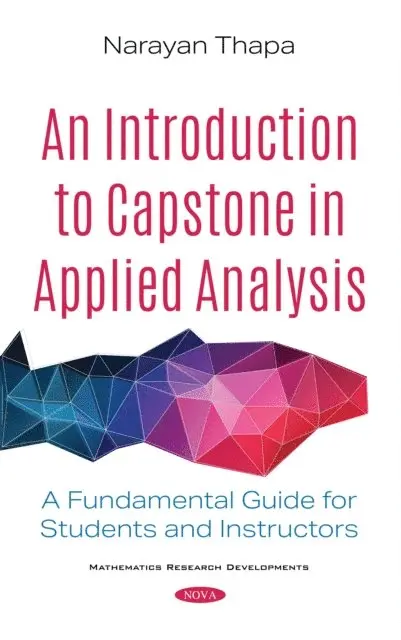
Inverse problems are one of the oldest, most important mathematical problems in science and engineering. However, the field of inverse problems has undergone rapid development in the last two decades due to the massive increase in computing power and the development of powerful numerical techniques such as finite difference method, finite element method, finite volume method and spectral method. Because of their applications in medical imaging, underground prospecting, nondestructive testing, astronomical imaging, image processing, remote sensing, and data mining, the Business, Industry and Government (BIG) sectors are very interested in applied inverse problems. Despite its great importance and demand, there is no project oriented applied and computational inverse problem book that can be adapted as a text for senior undergraduates as their capstone experience and pathway to research in applied analysis. The goal of this book is to fill this gap and provide opportunity to students, professors and researchers in biosciences, applied sciences, applied-computational mathematics, engineering, mathematical programming, mathematical economics, mathematical biology and optimization via applied and computational inverse problem projects. This book is sequenced as three major parts. The part of the book that includes chapters 1, 2 and 3 highlights major concepts including results in applied analysis. The second part of the book that includes chapters 4 and 5 displays the key numerical methods and programming in MATLAB. The final part of the book that includes chapters 6, 7, 8, 9, 10, 11 and 12 showcases several inverse-problem-related projects done with students.
E-bok
PDF, Engelska, 20202 532 kr
Läs direkt efter köp
Inverse problems are one of the oldest, most important mathematical problems in science and engineering. However, the field of inverse problems has undergone rapid development in the last two decades due to the massive increase in computing power and the development of powerful numerical techniques such as finite difference method, finite element method, finite volume method and spectral method. Because of their applications in medical imaging, underground prospecting, nondestructive testing, astronomical imaging, image processing, remote sensing, and data mining, the Business, Industry and Government (BIG) sectors are very interested in applied inverse problems. Despite its great importance and demand, there is no project oriented applied and computational inverse problem book that can be adapted as a text for senior undergraduates as their capstone experience and pathway to research in applied analysis. The goal of this book is to fill this gap and provide opportunity to students, professors and researchers in biosciences, applied sciences, applied-computational mathematics, engineering, mathematical programming, mathematical economics, mathematical biology and optimization via applied and computational inverse problem projects. This book is sequenced as three major parts. The part of the book that includes chapters 1, 2 and 3 highlights major concepts including results in applied analysis. The second part of the book that includes chapters 4 and 5 displays the key numerical methods and programming in MATLAB. The final part of the book that includes chapters 6, 7, 8, 9, 10, 11 and 12 showcases several inverse-problem-related projects done with students.