Nassif Ghoussoub - Böcker
Visar alla böcker från författaren Nassif Ghoussoub. Handla med fri frakt och snabb leverans.
4 produkter
4 produkter
536 kr
Skickas inom 10-15 vardagar
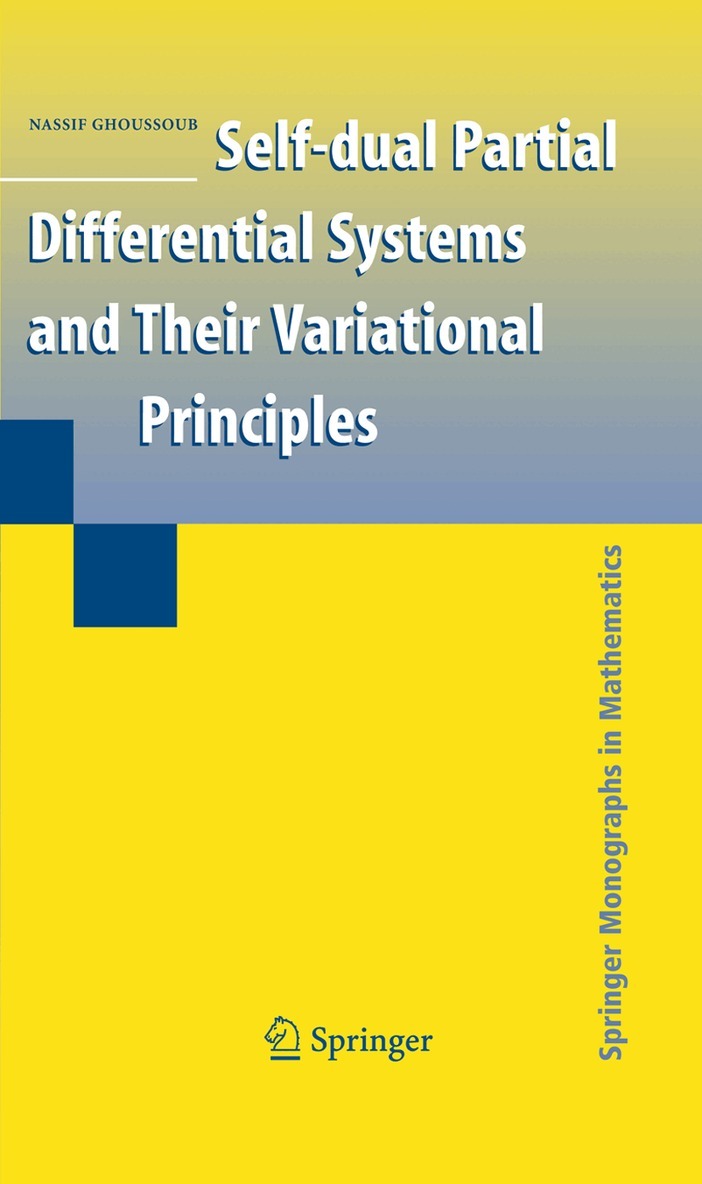
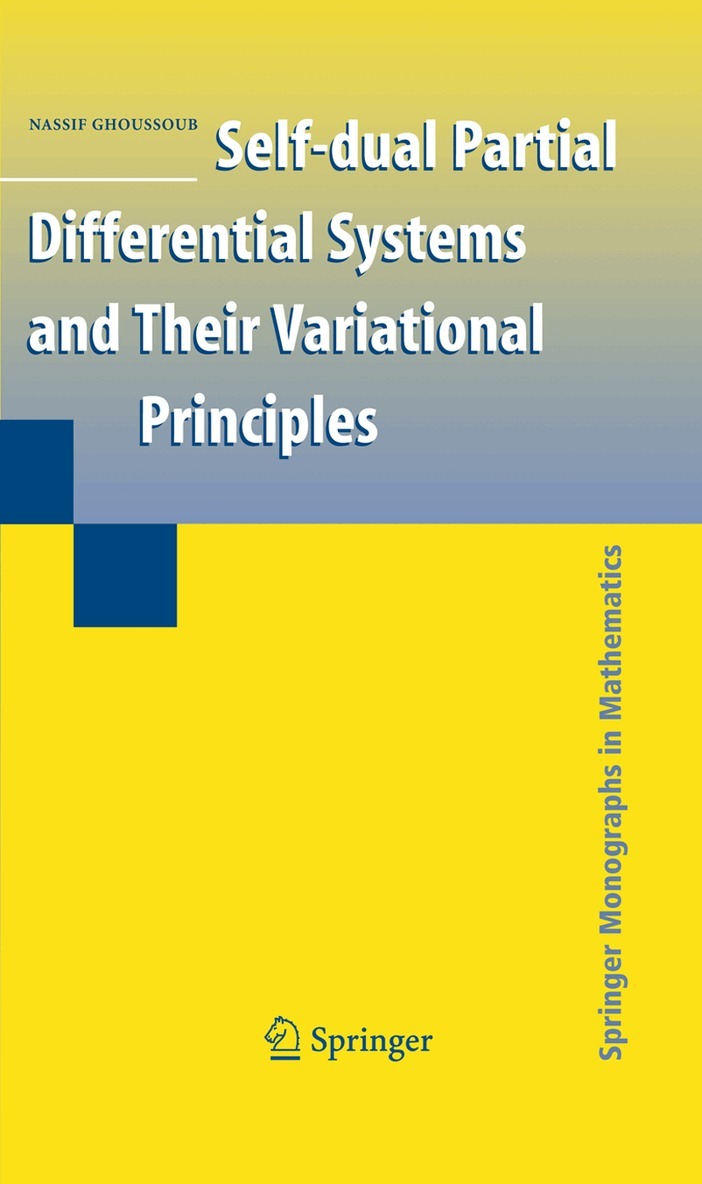
How to solve partial differential systems by completing the square. This could well have been the title of this monograph as it grew into a project to develop a s- tematic approach for associating suitable nonnegative energy functionals to a large class of partial differential equations (PDEs) and evolutionary systems. The minima of these functionals are to be the solutions we seek, not because they are critical points (i. e. , from the corresponding Euler-Lagrange equations) but from also - ing zeros of these functionals. The approach can be traced back to Bogomolnyi's trick of "completing squares" in the basic equations of quantum eld theory (e. g. , Yang-Mills, Seiberg-Witten, Ginzburg-Landau, etc. ,), which allows for the deri- tion of the so-called self (or antiself) dual version of these equations. In reality, the "self-dual Lagrangians" we consider here were inspired by a variational - proach proposed - over 30 years ago - by Brezis ' and Ekeland for the heat equation and other gradient ows of convex energies. It is based on Fenchel-Legendre - ality and can be used on any convex functional - not just quadratic ones - making them applicable in a wide range of problems.In retrospect, we realized that the "- ergy identities" satis ed by Leray's solutions for the Navier-Stokes equations are also another manifestation of the concept of self-duality in the context of evolution equations.
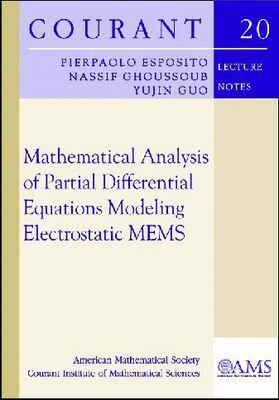
Mathematical Analysis of Partial Differential Equations Modelling Electrostatic MEMS
Häftad, Engelska, 2010
661 kr
Skickas
Micro- and nanoelectromechanical systems (MEMS and NEMS), which combine electronics with miniature-size mechanical devices, are essential components of modern technology. It is the mathematical model describing 'electrostatically actuated' MEMS that is addressed in this monograph. Even the simplified models that the authors deal with still lead to very interesting second- and fourth-order nonlinear elliptic equations (in the stationary case) and to nonlinear parabolic equations (in the dynamic case). While nonlinear eigenvalue problems - where the stationary MEMS models fit - are a well-developed field of PDEs, the type of inverse square nonlinearity that appears here helps shed a new light on the class of singular supercritical problems and their specific challenges. Besides the practical considerations, the model is a rich source of interesting mathematical phenomena. Numerics, formal asymptotic analysis, and ODE methods give lots of information and point to many conjectures. However, even in the simplest idealized versions of electrostatic MEMS, one essentially needs the full available arsenal of modern PDE techniques to do the required rigorous mathematical analysis, which is the main objective of this volume. This monograph could therefore be used as an advanced graduate text for a motivational introduction to many recent methods of nonlinear analysis and PDEs through the analysis of a set of equations that have enormous practical significance.
1 677 kr
Skickas inom 11-20 vardagar
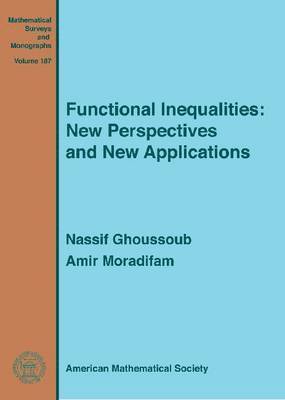
The book describes how functional inequalities are often manifestations of natural mathematical structures and physical phenomena, and how a few general principles validate large classes of analytic/geometric inequalities, old and new. This point of view leads to ""systematic"" approaches for proving the most basic inequalities, but also for improving them, and for devising new ones--sometimes at will--and often on demand. These general principles also offer novel ways for estimating best constants and for deciding whether these are attained in appropriate function spaces.As such, improvements of Hardy and Hardy-Rellich type inequalities involving radially symmetric weights are variational manifestations of Sturm's theory on the oscillatory behavior of certain ordinary differential equations. On the other hand, most geometric inequalities, including those of Sobolev and Log-Sobolev type, are simply expressions of the convexity of certain free energy functionals along the geodesics on the Wasserstein manifold of probability measures equipped with the optimal mass transport metric. Caffarelli-Kohn-Nirenberg and Hardy-Rellich-Sobolev type inequalities are then obtained by interpolating the above two classes of inequalities via the classical ones of Hölder. The subtle Moser-Onofri-Aubin inequalities on the two-dimensional sphere are connected to Liouville type theorems for planar mean field equations.
536 kr
Skickas inom 10-15 vardagar
How to solve partial differential systems by completing the square. This could well have been the title of this monograph as it grew into a project to develop a s- tematic approach for associating suitable nonnegative energy functionals to a large class of partial differential equations (PDEs) and evolutionary systems. The minima of these functionals are to be the solutions we seek, not because they are critical points (i. e. , from the corresponding Euler-Lagrange equations) but from also - ing zeros of these functionals. The approach can be traced back to Bogomolnyi's trick of "completing squares" in the basic equations of quantum eld theory (e. g. , Yang-Mills, Seiberg-Witten, Ginzburg-Landau, etc. ,), which allows for the deri- tion of the so-called self (or antiself) dual version of these equations. In reality, the "self-dual Lagrangians" we consider here were inspired by a variational - proach proposed - over 30 years ago - by Brezis ' and Ekeland for the heat equation and other gradient ows of convex energies. It is based on Fenchel-Legendre - ality and can be used on any convex functional - not just quadratic ones - making them applicable in a wide range of problems.In retrospect, we realized that the "- ergy identities" satis ed by Leray's solutions for the Navier-Stokes equations are also another manifestation of the concept of self-duality in the context of evolution equations.