Natalie Hevener Kaufman – författare
Visar alla böcker från författaren Natalie Hevener Kaufman. Handla med fri frakt och snabb leverans.
8 produkter
8 produkter
Inbunden, Engelska, 1999
1 041 kr
Skickas inom 10-15 vardagar
The human right to survive and develop, a fundamental premise of the U.N. Convention on the Rights of the Child, can be attained only if adequate living conditions are secured for the child. This book reviews the significance of the physical, mental, spiritual, moral, and social aspects of holistic child development called for by Article 27 of the Convention. The editors share a vision of childhood wherein the child is accorded dignity, and opportunities exist to promote advancement of human potential. Contributors from several nations and a variety of disciplines, including psychology, law, social work, medicine, economics, and international studies, address the challenge of identifying adequate living conditions across cultures and discuss issues affecting communities and governments as they attempt to fulfill their responsibilities to children and their families. Key themes throughout the book are the significance of the child's perspective, the primacy of the family environment, the need to balance the interests of diverse cultures while reducing historical inequities, and the ecological interdependence of children, families, communities, and nations. The editors and contributors call for organized social and political action to realize the child's right to develop, including ways to measure and monitor children's well-being beyond survival.
Inbunden, Engelska, 2002
1 090 kr
Skickas inom 10-15 vardagar
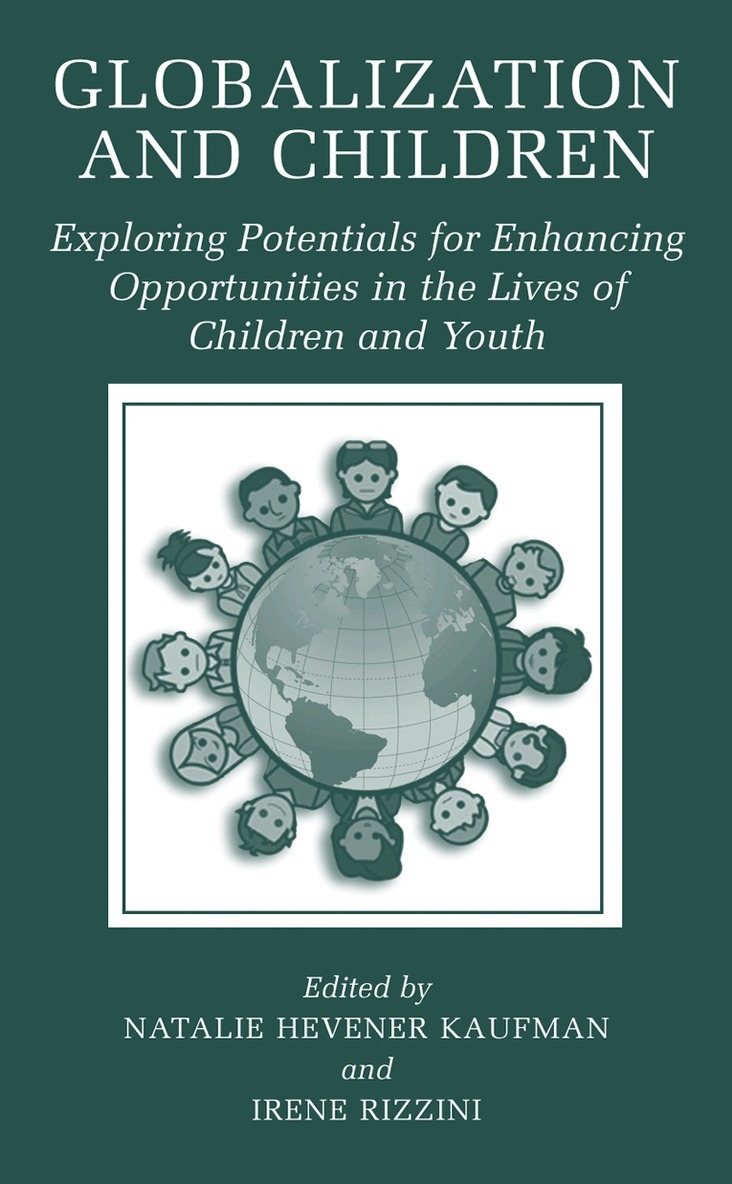
ALLISON JAMES Globalization seems to be the word on everyone’s lips, with politicians as much as academics extolling its benefits as well as its contradictions. For some, globali- tion means, in practice, that whether in Bangkok or Boston, in London or Rio, as travelers from wealthy countries they can be sure to find the beer, the pizzas, and the jeans that they can at home; they can be both at home and away simulta- ously. For others, though, globalization has had rather different, often less bene- cial, consequences. In their everyday lives people have come to find themselves tied in, albeit in often unseen ways, into larger economic and political systems over which they have no control; yet these systems cause radical changes—often for the worse rather than the better—in the pattern of their daily lives. And it is those who have least voice whose lives are usually affected the most. In this book attention is drawn systematically—really for the first time—to a consideration of how processes of globalization variously impact upon the lives of children. Such an approach is not only most welcome in the field of childhood studies, but also long overdue. It will, at last, enable us to begin to contextualize in a broader framework some of the many issues to do with ch- dren’s rights and participation which have long been discussed as separate and discrete issues within childhood studies.
E-bok
PDF, Engelska, 20071 328 kr
Läs direkt efter köp
ALLISON JAMES Globalization seems to be the word on everyone’s lips, with politicians as much as academics extolling its benefits as well as its contradictions. For some, globali- tion means, in practice, that whether in Bangkok or Boston, in London or Rio, as travelers from wealthy countries they can be sure to find the beer, the pizzas, and the jeans that they can at home; they can be both at home and away simulta- ously. For others, though, globalization has had rather different, often less bene- cial, consequences. In their everyday lives people have come to find themselves tied in, albeit in often unseen ways, into larger economic and political systems over which they have no control; yet these systems cause radical changes—often for the worse rather than the better—in the pattern of their daily lives. And it is those who have least voice whose lives are usually affected the most. In this book attention is drawn systematically—really for the first time—to a consideration of how processes of globalization variously impact upon the lives of children. Such an approach is not only most welcome in the field of childhood studies, but also long overdue. It will, at last, enable us to begin to contextualize in a broader framework some of the many issues to do with ch- dren’s rights and participation which have long been discussed as separate and discrete issues within childhood studies.
Del 7 - Social Indicators Research Series
Measuring and Monitoring Children’s Well-Being
Inbunden, Engelska, 2001
1 090 kr
Skickas inom 10-15 vardagar
Today, any regular newspaper reader is likely to be exposed to reports on manifold forms of (physical, emotional, sexual) child abuse on the one hand, and abnormal behavior, misconduct or offences of children and minors on the other hand. Occasionally reports on children as victims and children as offenders may appear on the same issue or even the same page. Rather seldom the more complex and largely hidden phenomena of structural hostility or indifference of society with a view to children are being dealt with in the press. Such fragmentary, ambiguous, incoherent or even contradictory perception of children in modem society indicates that, firstly, there is a lack of reliable information on modem childhood, and secondly, children are still treated as a comparatively irrelevant population group in society. This conclusion may be surprising in particular when drawn at the end of The Century of the Child proclaimed by Ellen Key as early as 1902. Actually, there exist unclarities and ambiguities about the evolution of childhood in the last century not only in public opinion, but also in scientific literature. While De Mause with his psycho-historic model of the evolution of childhood, comprising different stages from infanticide, abandonment, ambivalence, intrusion, socialisation to support, underlines the continuous improvement of the condition of childhood throughout history and thus rather confirms Key's expectations, Aries, with his social history of childhood, seems to hold a more culturally pessimistic view.
Häftad, Engelska, 2011
548 kr
Skickas inom 10-15 vardagar
The US has declined to approve most human rights treaties, despite widespread support for such treaties among other Western democracies. This study explores the legacy of the 1950s, when opposition to the treaties was articulated, and the residual strength of that opposition in contemporary deliberations. Originally published in 1990. A UNC Press Enduring Edition -- UNC Press Enduring Editions use the latest in digital technology to make available again books from our distinguished backlist that were previously out of print. These editions are published unaltered from the original, and are presented in affordable paperback formats, bringing readers both historical and cultural value.
Häftad, Engelska, 2013
1 061 kr
Skickas inom 10-15 vardagar
ALLISON JAMES Globalization seems to be the word on everyone’s lips, with politicians as much as academics extolling its benefits as well as its contradictions. In their everyday lives people have come to find themselves tied in, albeit in often unseen ways, into larger economic and political systems over which they have no control;
Del 7 - Social Indicators Research Series
Measuring and Monitoring Children’s Well-Being
Häftad, Engelska, 2010
1 124 kr
Skickas inom 10-15 vardagar
Today, any regular newspaper reader is likely to be exposed to reports on manifold forms of (physical, emotional, sexual) child abuse on the one hand, and abnormal behavior, misconduct or offences of children and minors on the other hand. Occasionally reports on children as victims and children as offenders may appear on the same issue or even the same page. Rather seldom the more complex and largely hidden phenomena of structural hostility or indifference of society with a view to children are being dealt with in the press. Such fragmentary, ambiguous, incoherent or even contradictory perception of children in modem society indicates that, firstly, there is a lack of reliable information on modem childhood, and secondly, children are still treated as a comparatively irrelevant population group in society. This conclusion may be surprising in particular when drawn at the end of The Century of the Child proclaimed by Ellen Key as early as 1902. Actually, there exist unclarities and ambiguities about the evolution of childhood in the last century not only in public opinion, but also in scientific literature. While De Mause with his psycho-historic model of the evolution of childhood, comprising different stages from infanticide, abandonment, ambivalence, intrusion, socialisation to support, underlines the continuous improvement of the condition of childhood throughout history and thus rather confirms Key's expectations, Aries, with his social history of childhood, seems to hold a more culturally pessimistic view.
E-bok
PDF, Engelska, 20131 257 kr
Läs direkt efter köp
Today, any regular newspaper reader is likely to be exposed to reports on manifold forms of (physical, emotional, sexual) child abuse on the one hand, and abnormal behavior, misconduct or offences of children and minors on the other hand. Occasionally reports on children as victims and children as offenders may appear on the same issue or even the same page. Rather seldom the more complex and largely hidden phenomena of structural hostility or indifference of society with a view to children are being dealt with in the press. Such fragmentary, ambiguous, incoherent or even contradictory perception of children in modem society indicates that, firstly, there is a lack of reliable information on modem childhood, and secondly, children are still treated as a comparatively irrelevant population group in society. This conclusion may be surprising in particular when drawn at the end of The Century of the Child proclaimed by Ellen Key as early as 1902. Actually, there exist unclarities and ambiguities about the evolution of childhood in the last century not only in public opinion, but also in scientific literature. While De Mause with his psycho-historic model of the evolution of childhood, comprising different stages from infanticide, abandonment, ambivalence, intrusion, socialisation to support, underlines the continuous improvement of the condition of childhood throughout history and thus rather confirms Key''s expectations, Aries, with his social history of childhood, seems to hold a more culturally pessimistic view.