Nathaniel Lichfield – författare
Visar alla böcker från författaren Nathaniel Lichfield. Handla med fri frakt och snabb leverans.
10 produkter
10 produkter
Häftad, Engelska, 2009
658 kr
Skickas inom 7-10 vardagar
The role of economics in urban conservation is relatively underdeveloped. Professor Lichfield has added to his other pioneering studies in this innovative and important exposition of approach, method and techniques for the systematic application of economics in the conservation of urban areas. In order to establish an appropriate base for the economic analysis and application in parts III, IV and V of the book, the opening sections provide essential background information about the management and planning for conservation in the urban system in general and examine the special place of the cultural built heritage: those building and objects chosen by society for particular protection. Written in a highly accessible style, Economics in Urban Conservation makes a major contribution to an understanding of how economics in conservation can help in achieving a sensible balance between continuity and change in the built environment.
Inbunden, Engelska, 1998
1 618 kr
Skickas inom 10-15 vardagar
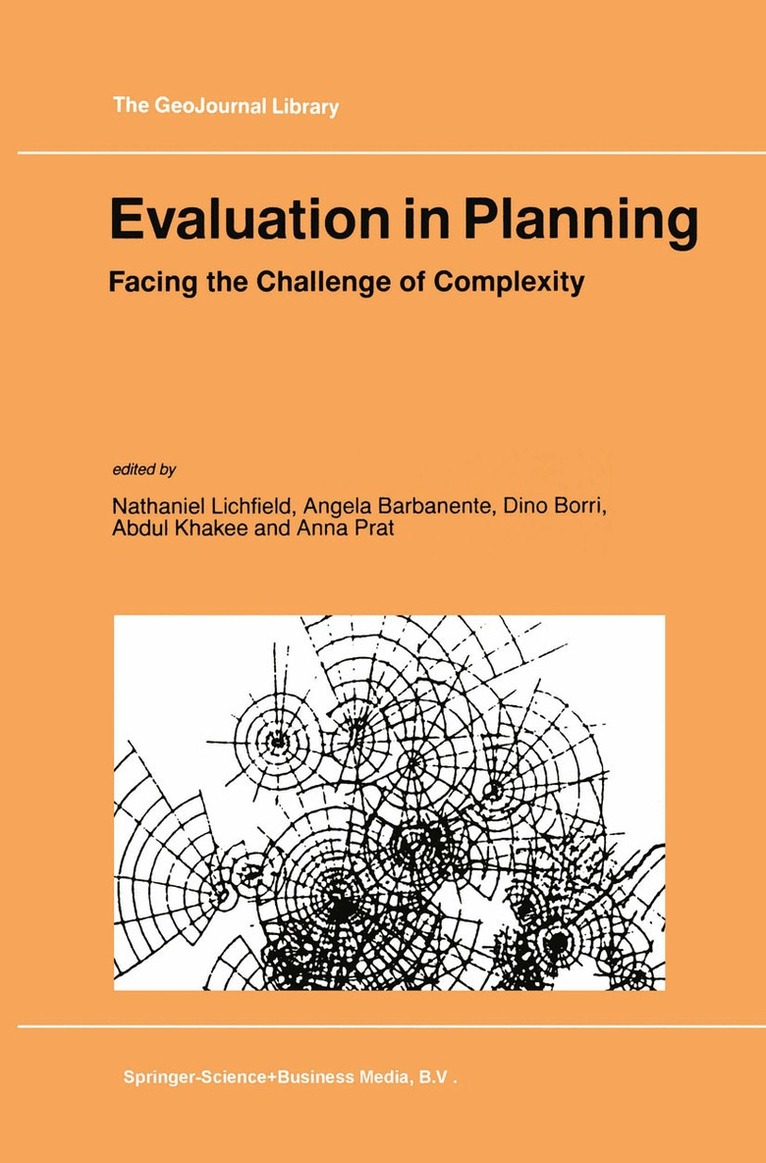
This text provides a comprehensive picture of the state of research in urban and regional planning evaluation, integrating contributions from key scholars in the field. The volume covers a variety of aspects, including methodological issues, analysis of practice, and epistemological and theoretical questions. Although different positions emerge, all authors share the common intention to link developments in planning theory with approaches to evaluation research - rising concerns for communicative planning, complexity, participation, sustainable development, conservation of the natural and built heritage, all challenge consolidated and institutionalized evaluation models and practice. The contributors face this challenge and offer an updated picture of a new identity for evaluation in planning. This book will be of interest to academics, researchers and practitioners in urban and regional planning evaluation, project appraisal, urban planning and policy, public sector management and policy analysis and environmental sciences.
E-bok
Engelska, 20051 143 kr
Läs direkt efter köp
This is a work summarizing in one volume the pioneering approach of the author to public-interest decision-taking in the field of urban & regional planning. This book is aimed at students, researchers and professionals in planning. Nathaniel Lichfield first introduced in his "Economics of Planned Development" the concept that, in any use and development of land, the traditional "development balance sheet" of the developers needed to be accompanied by a "planning balance sheet" prepared by the planning officer or planning authority. Over the forty years since this work was published, the author has brought to the operational level the "planning balance sheet", with many case studies, primarily for consultancy purposes. The present title reflects the incorporation during the 1970s of the then emerging field of environmental impact assessment.
E-bok
PDF, Engelska, 20051 143 kr
Läs direkt efter köp
This is a work summarizing in one volume the pioneering approach of the author to public-interest decision-taking in the field of urban & regional planning. This book is aimed at students, researchers and professionals in planning. Nathaniel Lichfield first introduced in his "Economics of Planned Development" the concept that, in any use and development of land, the traditional "development balance sheet" of the developers needed to be accompanied by a "planning balance sheet" prepared by the planning officer or planning authority. Over the forty years since this work was published, the author has brought to the operational level the "planning balance sheet", with many case studies, primarily for consultancy purposes. The present title reflects the incorporation during the 1970s of the then emerging field of environmental impact assessment.
E-bok
PDF, Engelska, 2016783 kr
Läs direkt efter köp
Evaluation in the Planning Process examines the role of evaluation in the overall planning process and the implications of evaluation for the organization and management of studies. Emphasis is placed on the nature of evaluation and the functions it should fulfill in the urban and regional planning process, as well as the interrelationships that should exist between evaluation and other planning activities. This book consists of 12 chapters organized into three sections. The first section focuses on principles governing the use of evaluation in the planning process and includes a model of general urban and regional planning. Various methods that are available for evaluating planning proposals are considered, with emphasis on the social cost-benefit approach and the planning balance sheet method. The chapters that follow explore the role of measurement in plan evaluation and review seven planning studies to critically examine UK experience in the application of evaluation methods to urban and regional planning problems. This book concludes by presenting the principles and guidelines for the short-listing of options and assessing the influence of various practical circumstances on the planning process. Some final recommendations on the organization and structure of the planning process, and the nature and role of evaluation within it, are offered. This book is intended for specialists, planners, and those who are engaged in the task of aiding decisions on urban and regional planning problems. This text will appeal especially to those who are concerned with formulating planning processes and with the management of studies.
E-bok
PDF, Engelska, 2013783 kr
Läs direkt efter köp
Evaluation in the Planning Process investigates how plan evaluation is integrated within the decision-making process in urban and regional planning in the United Kingdom. It also offers effective ways of formulating objectives and designing alternative proposals within the processes of decision-making in planning. Part I discusses the principles of evaluation and its role in the planning process. Part II examines recent UK studies in the use of evaluation in urban and regional planning problems. Part III summarizes the main findings and offers recommendations on how plan evaluation should be carried out in future plan-making processes. This book is helpful for those who are involved in decision-making processes on urban and regional planning problems.
Inbunden, Engelska, 1996
3 402 kr
Skickas inom 10-15 vardagar
This is a work summarizing in one volume the pioneering approach of the author to public-interest decision-taking in the field of urban & regional planning. This book is aimed at students, researchers and professionals in planning. Nathaniel Lichfield first introduced in his "Economics of Planned Development" the concept that, in any use and development of land, the traditional "development balance sheet" of the developers needed to be accompanied by a "planning balance sheet" prepared by the planning officer or planning authority. Over the forty years since this work was published, the author has brought to the operational level the "planning balance sheet", with many case studies, primarily for consultancy purposes. The present title reflects the incorporation during the 1970s of the then emerging field of environmental impact assessment.
Häftad, Engelska, 1996
990 kr
Skickas inom 10-15 vardagar
This is a work summarizing in one volume the pioneering approach of the author to public-interest decision-taking in the field of urban & regional planning. This book is aimed at students, researchers and professionals in planning. Nathaniel Lichfield first introduced in his "Economics of Planned Development" the concept that, in any use and development of land, the traditional "development balance sheet" of the developers needed to be accompanied by a "planning balance sheet" prepared by the planning officer or planning authority. Over the forty years since this work was published, the author has brought to the operational level the "planning balance sheet", with many case studies, primarily for consultancy purposes. The present title reflects the incorporation during the 1970s of the then emerging field of environmental impact assessment.
Häftad, Engelska, 2010
1 618 kr
Skickas inom 10-15 vardagar
This book is the result of a three day workshop on "Evaluation in theory and practice in spatial planning" held in Ramsey Hall, University College London, in September 1996. Some 30 people from 8 different countries attended and 20 papers were presented. The majority of them now form the basis for this book. This occasion was the third on the topic, the two preceding having taken place in Umea in June 1992 and in Bari in 1994. Following these three meetings, we can now say that this small, industrious, international family really enjoy meeting up from time to time at each others places, in the presence of older members and new children, each one presenting his/her own recent experiences. It particularly enjoys exchanging views and arguing about the current state and the future of evaluation in spatial planning (all families have their vices ... ). It is also pleasing to see these experiences and discussions resulting in a book for those who could not attend and for the broader clan inthe field. Not long time ago, but ages in the accelerated academic time scale, evaluation in planning established its own role and distinct features as an instrument for helping the decision-making process. Now this role and these features are exposed to major challenges. First, the evolution of planning theory has lead to the conception of new planning paradigms, based on theories of complexity and communicative rationality.
E-bok
PDF, Engelska, 20132 049 kr
Läs direkt efter köp
This book is the result of a three day workshop on "Evaluation in theory and practice in spatial planning" held in Ramsey Hall, University College London, in September 1996. Some 30 people from 8 different countries attended and 20 papers were presented. The majority of them now form the basis for this book. This occasion was the third on the topic, the two preceding having taken place in Umea in June 1992 and in Bari in 1994. Following these three meetings, we can now say that this small, industrious, international family really enjoy meeting up from time to time at each others places, in the presence of older members and new children, each one presenting his/her own recent experiences. It particularly enjoys exchanging views and arguing about the current state and the future of evaluation in spatial planning (all families have their vices ... ). It is also pleasing to see these experiences and discussions resulting in a book for those who could not attend and for the broader clan inthe field. Not long time ago, but ages in the accelerated academic time scale, evaluation in planning established its own role and distinct features as an instrument for helping the decision-making process. Now this role and these features are exposed to major challenges. First, the evolution of planning theory has lead to the conception of new planning paradigms, based on theories of complexity and communicative rationality.