Neil K Komesar – författare
Visar alla böcker från författaren Neil K Komesar. Handla med fri frakt och snabb leverans.
4 produkter
4 produkter
Häftad, Engelska, 1997
314 kr
Skickas inom 5-8 vardagar
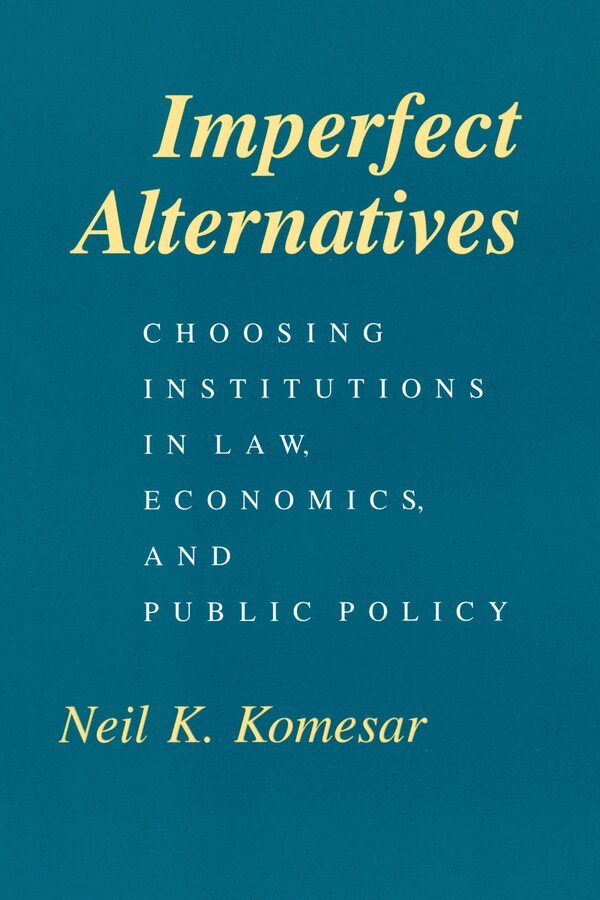
In this text Neil Komesar argues that the emphasis on goal choice in public policy and law ignores an essential element - institutional choice. Indeed, as important as determining our social goals is deciding which institution is best equipped to implement them - the market, the political process, or the adjucative process. Pointing out that all three institutions are massive, complex, and imperfect, Komesar develops a strategy for comparative institutional analysis that assesses variations in institutional ability. He then demonstrates the value of this analytical framework by using it to examine important contemporary issues ranging from tort reform to constitution-making.
E-bok
Engelska, 2023418 kr
Läs direkt efter köp
What is public interest law? How effective is it? What are the limits to litigation as a mechanism for conflict resolution? In this study, economists, lawyers, and sociologists evaluate an institutional form that is new to American society and, indeed, to the world--the public interest law (PIL) organization. The book introduces the reader to the structure, resources, and activities of this "nonprofit industry," and also to the factors that affect PIL firms in their choices of cases and methods of handling them. The authors examine PIL''s vast range of contemporary public policy concerns. These incude such general topics as the environment, consumerism, housing, employment discrimination, medical care, occupational health and safety, education finance, and taxation. A number of base studies are presented, and a method for economic analysis and evaluation is introduced and applied. The study points to PIL''s success in advocating under-represented interests, in winning courtroom decisions, and in translating legal victories into reallocations of resources. At the same time, it notes the bias of PIL towards test-case litigation, a propensity to focus on judicial victories rather than on real social change, and a tendency to use lawyers even when other types of professionals might be more effective. Many of these problems stem from uncertainty of funding and legal restrictions on "nonprofit" organizations. The result is a set of hurdles that distracts PIL firms from their principal goals. The authors do not limit themselves to PIL, but comment on the effectiveness of legal instruments as devices for social change, and on the behavior of the voluntary nonprofit sector, a little-studied portion of the economy. The book presents a fresh approach to the study of both collective-type economic problems and institutional setting in which public interest law works. What is public interest law? How effective is it? What are the limits to litigation as a mechanism for conflict resolution? In this study, economists, lawyers, and sociologists evaluate an institutional form that is new to American society and, indeed, to
Häftad, Engelska, 2001
448 kr
Skickas inom 7-10 vardagar
What law is can be determined by the character of the institutions that make, interpret and enforce law. The interaction of these institutions moulds the supply of, and demand for, law. Focusing on this interaction in the context of US property rights law and the debates about private property and the rule of law, Komesar paints an unconventional picture of law and rights shifting and cycling as systemic factors, such as increasing numbers and complexity. This strain produces tough institutional choices and unexpected combinations of goals and institutions. It also frustrates the hopes for courts, rights and law embodied in notions such as the rule of law and constitutionalism. Although there may be an important role for law, rights and courts both in the US and abroad, it cannot be easily defined. This 2002 book proposes a way to define that role and to reform legal education and legal analysis.
Inbunden, Engelska, 2001
1 271 kr
Skickas inom 7-10 vardagar
What law is can be determined by the character of the institutions that make, interpret and enforce law. The interaction of these institutions moulds the supply of, and demand for, law. Focusing on this interaction in the context of US property rights law and the debates about private property and the rule of law, Komesar paints an unconventional picture of law and rights shifting and cycling as systemic factors, such as increasing numbers and complexity. This strain produces tough institutional choices and unexpected combinations of goals and institutions. It also frustrates the hopes for courts, rights and law embodied in notions such as the rule of law and constitutionalism. Although there may be an important role for law, rights and courts both in the US and abroad, it cannot be easily defined. This 2002 book proposes a way to define that role and to reform legal education and legal analysis.