Nelson Goodman - Böcker
Visar alla böcker från författaren Nelson Goodman. Handla med fri frakt och snabb leverans.
7 produkter
7 produkter
259 kr
Skickas
Required reading at more than 100 colleges and universities throughout North America.
196 kr
Skickas inom 7-10 vardagar
Here, in a new edition, is Nelson Goodman’s provocative philosophical classic—a book that, according to Science, “raised a storm of controversy” when it was first published in 1954, and one that remains on the front lines of philosophical debate.How is it that we feel confident in generalizing from experience in some ways but not in others? How are generalizations that are warranted to be distinguished from those that are not? Goodman shows that these questions resist formal solution and his demonstration has been taken by nativists like Chomsky and Fodor as proof that neither scientific induction nor ordinary learning can proceed without an a priori, or innate, ordering of hypotheses.In his new foreword to this edition, Hilary Putnam forcefully rejects these nativist claims. The controversy surrounding these unsolved problems is as relevant to the psychology of cognitive development as it is to the philosophy of science. No serious student of either discipline can afford to misunderstand Goodman’s classic argument.
284 kr
Tillfälligt slut
"Like Dewey, he has revolted against the empiricist dogma and the Kantian dualisms which have compartmentalized philosophical thought. . . . Unlike Dewey, he has provided detailed incisive argumentation, and has shown just where the dogmas and dualisms break down." --Richard Rorty, The Yale Review
201 kr
Skickas inom 3-6 vardagar
234 kr
Skickas inom 3-6 vardagar
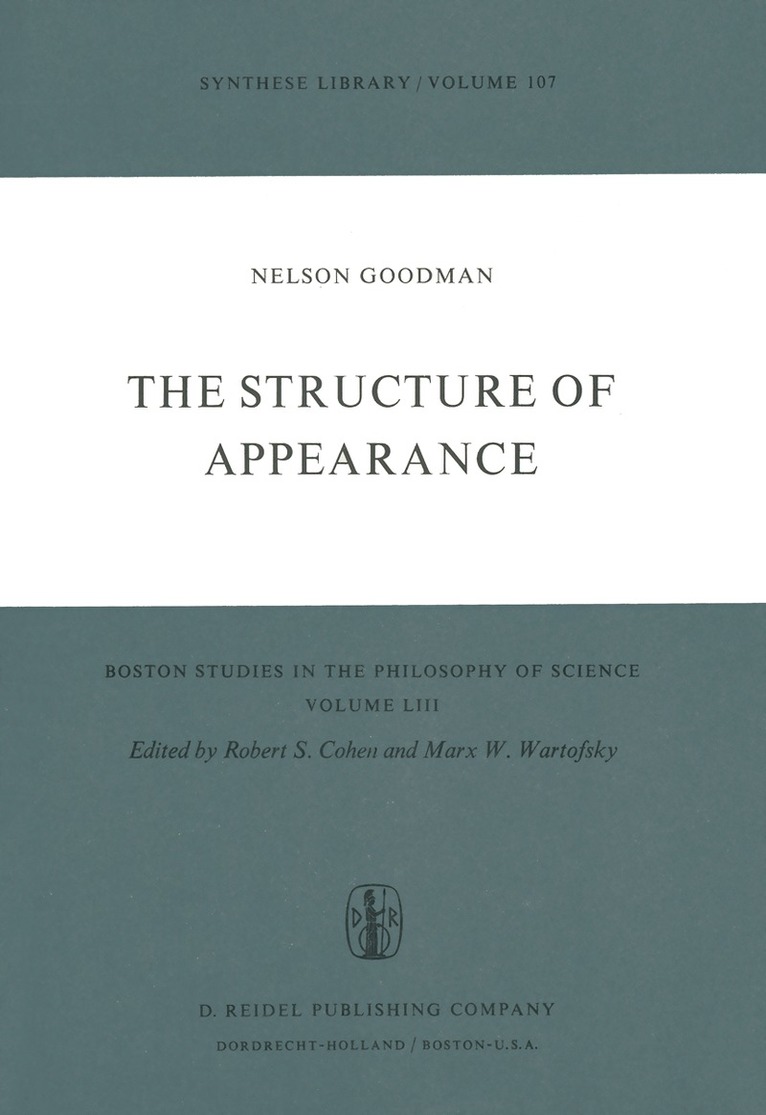
Del 53 - Boston Studies in the Philosophy and History of Science
Structure of Appearance
Inbunden, Engelska, 1977
2 432 kr
Skickas inom 10-15 vardagar
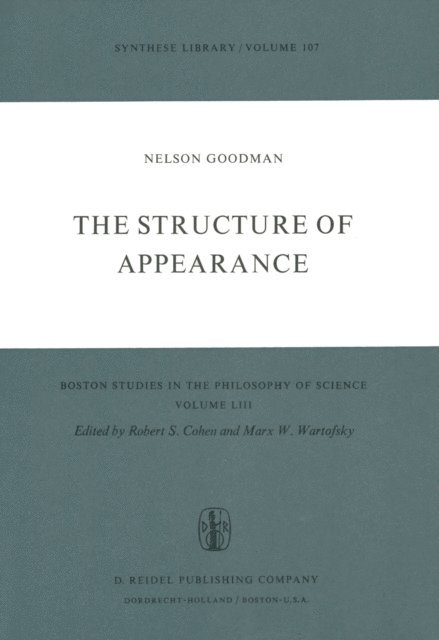
With this third edition of Nelson Goodman's The Structure of Appear ance, we are pleased to make available once more one of the most in fluential and important works in the philosophy of our times. Professor Geoffrey Hellman's introduction gives a sustained analysis and appreciation of the major themes and the thrust of the book, as well as an account of the ways in which many of Goodman's problems and projects have been picked up and developed by others. Hellman also suggests how The Structure of Appearance introduces issues which Goodman later continues in his essays and in the Languages of Art. There remains the task of understanding Good man's project as a whole; to see the deep continuities of his thought, as it ranges from logic to epistemology, to science and art; to see it therefore as a complex yet coherent theory of human cognition and practice. What we can only hope to suggest, in this note, is the b. road Significance of Goodman's apparently technical work for philosophers, scientists and humanists. One may say of Nelson Goodman that his bite is worse than his bark. Behind what appears as a cool and methodical analysis of the conditions of the construction of systems, there lurks a radical and disturbing thesis: that the world is, in itself, no more one way than another, nor are we. It depends on the ways in which we take it, and on what we do.
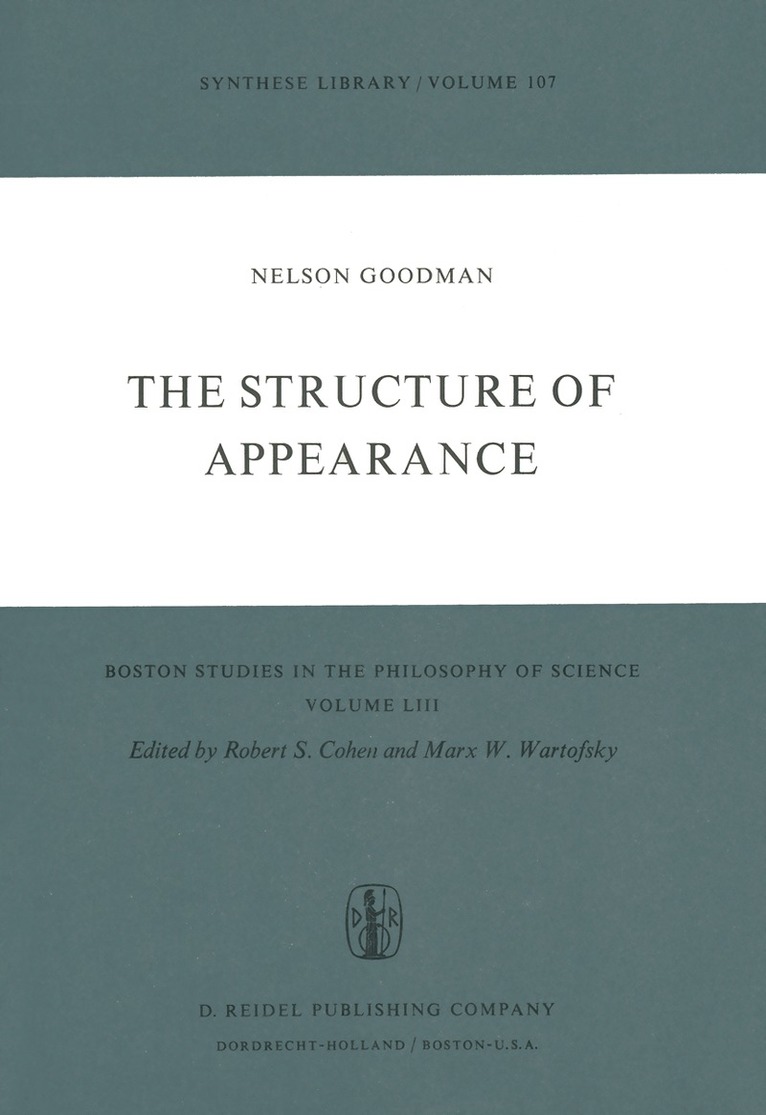
Del 53 - Boston Studies in the Philosophy and History of Science
Structure of Appearance
Häftad, Engelska, 1977
2 432 kr
Skickas inom 10-15 vardagar
With this third edition of Nelson Goodman's The Structure of Appear ance, we are pleased to make available once more one of the most in fluential and important works in the philosophy of our times. Professor Geoffrey Hellman's introduction gives a sustained analysis and appreciation of the major themes and the thrust of the book, as well as an account of the ways in which many of Goodman's problems and projects have been picked up and developed by others. Hellman also suggests how The Structure of Appearance introduces issues which Goodman later continues in his essays and in the Languages of Art. There remains the task of understanding Good man's project as a whole; to see the deep continuities of his thought, as it ranges from logic to epistemology, to science and art; to see it therefore as a complex yet coherent theory of human cognition and practice. What we can only hope to suggest, in this note, is the b. road Significance of Goodman's apparently technical work for philosophers, scientists and humanists. One may say of Nelson Goodman that his bite is worse than his bark. Behind what appears as a cool and methodical analysis of the conditions of the construction of systems, there lurks a radical and disturbing thesis: that the world is, in itself, no more one way than another, nor are we. It depends on the ways in which we take it, and on what we do.