Nicholas A. Scoville – författare
Visar alla böcker från författaren Nicholas A. Scoville. Handla med fri frakt och snabb leverans.
2 produkter
2 produkter
Häftad, Engelska, 2019
701 kr
Skickas inom 5-8 vardagar
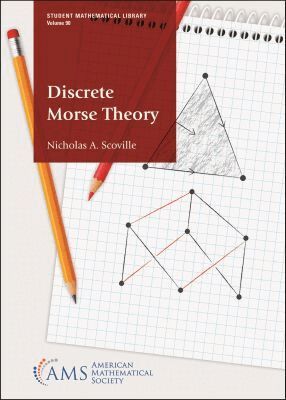
Discrete Morse theory is a powerful tool combining ideas in both topology and combinatorics. Invented by Robin Forman in the mid 1990s, discrete Morse theory is a combinatorial analogue of Marston Morse's classical Morse theory. Its applications are vast, including applications to topological data analysis, combinatorics, and computer science.This book, the first one devoted solely to discrete Morse theory, serves as an introduction to the subject. Since the book restricts the study of discrete Morse theory to abstract simplicial complexes, a course in mathematical proof writing is the only prerequisite needed. Topics covered include simplicial complexes, simple homotopy, collapsibility, gradient vector fields, Hasse diagrams, simplicial homology, persistent homology, discrete Morse inequalities, the Morse complex, discrete Morse homology, and strong discrete Morse functions. Students of computer science will also find the book beneficial as it includes topics such as Boolean functions, evasiveness, and has a chapter devoted to some computational aspects of discrete Morse theory. The book is appropriate for a course in discrete Morse theory, a supplemental text to a course in algebraic topology or topological combinatorics, or an independent study.
Häftad, Engelska, 2023
769 kr
Skickas inom 5-8 vardagar
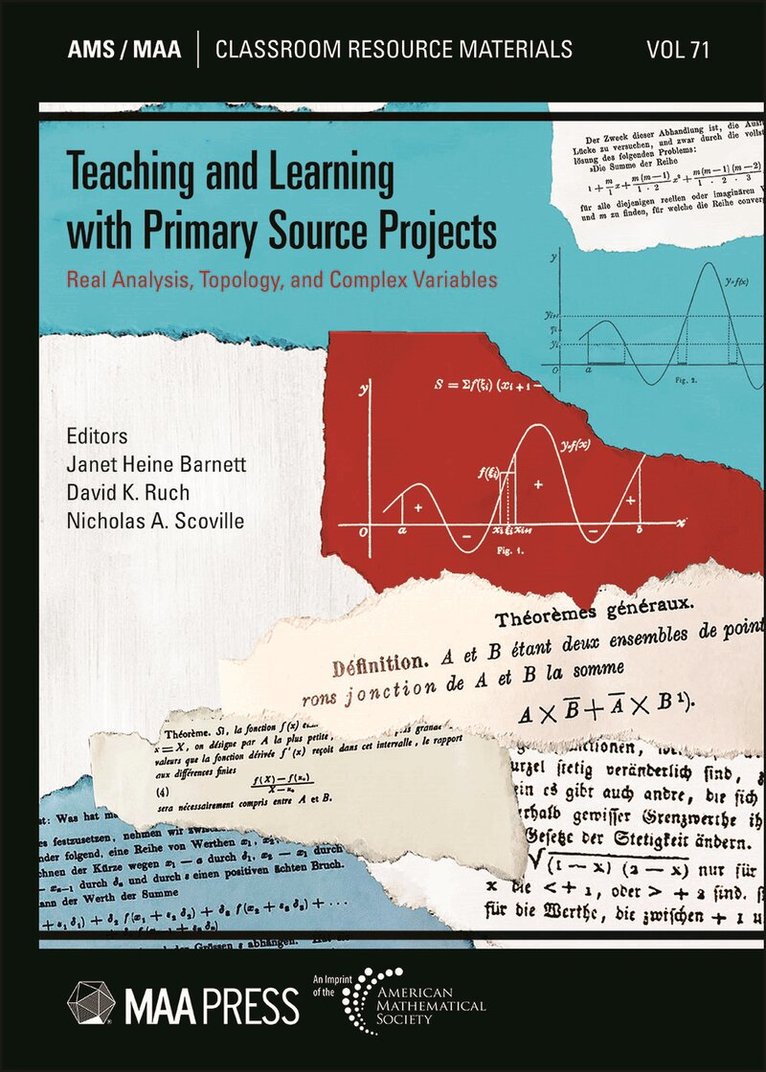
It appears to me that if one wants to make progress in mathematics one should study the masters and not the pupils."" —Niels Henrik Abel Recent pedagogical research has supported Abel's claim of the effectiveness of reading the masters. Students exposed to historically based pedagogy see mathematics not as a monolithic assemblage of facts but as a collection of mental processes and an evolving cultural construct built to solve actual problems. Exposure to the immediacy of the original investigations can inspire an inquiry mindset in students and lead to an appreciation of mathematics as a living intellectual activity. TRIUMPHS (TRansforming Instruction in Undergraduate Mathematics via Primary Historical Sources) is an NSF-funded initiative to design materials that effectively harness the power of reading primary historical documents in undergraduate mathematics instruction. Teaching and Learning with Primary Source Projects is a collection of 24 classroom modules (PSPs) produced by TRIUMPHS that incorporate the reading of primary source excerpts to teach core mathematical topics. The selected excerpts are intertwined with thoughtfully designed student tasks that prompt students to actively engage with and explore the source material. Rigorously classroom tested and scrupulously edited to comply with the standards developed by the TRIUMPHS project, each of the PSPs in this volume can be inserted directly into a course in real analysis, complex variables, or topology and used to replace a standard textbook treatment of core course content. The volume also contains a comprehensive historical overview of the sociocultural and mathematical contexts within which the three subjects developed, along with extensive implementation guidance. Students and faculty alike are afforded a deeper classroom experience as they heed Abel's advice by studying today's mathematics through the words of the masters who brought that mathematics to life. Primary sources provide motivation in the words of the original discoverers of new mathematics, draw attention to subtleties, encourage reflection on today's paradigms, and enhance students' ability to participate equally, regardless of their background. These beautifully written primary source projects that adopt an ``inquiry'' approach are rich in features lacking in modern textbooks. Prompted by the study of historical sources, students will grapple with uncertainties, ask questions, interpret, conjecture, and compare multiple perspectives, resulting in a unique and vivid guided learning experience. --David Pengelley, Oregon State University