Nicholas Constas – författare
Visar alla böcker från författaren Nicholas Constas. Handla med fri frakt och snabb leverans.
3 produkter
3 produkter
Del 28 - Dumbarton Oaks Medieval Library
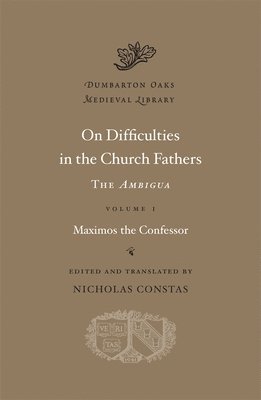
On Difficulties in the Church Fathers: The Ambigua
Inbunden, Engelska, 2014
347 kr
Skickas inom 5-8 vardagar
Maximos the Confessor (580–662) occupies a unique position in the history of Byzantine philosophy, theology, and spirituality. His profound spiritual experiences and penetrating theological vision found complex and often astonishing expression in his unparalleled command of Greek philosophy, making him one of the most challenging and original Christian thinkers of all time. So thoroughly did his thought come to influence the Byzantine theological tradition that it is impossible to trace the subsequent history of Orthodox Christianity without knowledge of his work.The Ambigua (or “Book of Difficulties”) is Maximos’s greatest philosophical and doctrinal work, in which his daring originality, prodigious talent for speculative thinking, and analytical acumen are on lavish display. In the Ambigua, a broad range of theological topics—cosmology, anthropology, the philosophy of mind and language, allegory, asceticism, and metaphysics—are transformed in a synthesis of Aristotelian logic, Platonic metaphysics, Stoic psychology, and the arithmetical philosophy of a revived Pythagoreanism. The result is a labyrinthine map of the mind’s journey to God that figured prominently in the Neoplatonic revival of the Komnenian Renaissance and the Hesychast Controversies of the Late Byzantine period.This remarkable work has never before been available in a critically-based edition or English translation.
Del 29 - Dumbarton Oaks Medieval Library
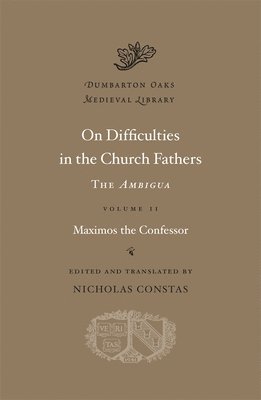
On Difficulties in the Church Fathers: The Ambigua
Inbunden, Engelska, 2014
347 kr
Skickas inom 5-8 vardagar
Maximos the Confessor (580–662) occupies a unique position in the history of Byzantine philosophy, theology, and spirituality. His profound spiritual experiences and penetrating theological vision found complex and often astonishing expression in his unparalleled command of Greek philosophy, making him one of the most challenging and original Christian thinkers of all time. So thoroughly did his thought come to influence the Byzantine theological tradition that it is impossible to trace the subsequent history of Orthodox Christianity without knowledge of his work.The Ambigua (or “Book of Difficulties”) is Maximos’s greatest philosophical and doctrinal work, in which his daring originality, prodigious talent for speculative thinking, and analytical acumen are on lavish display. In the Ambigua, a broad range of theological topics—cosmology, anthropology, the philosophy of mind and language, allegory, asceticism, and metaphysics—are transformed in a synthesis of Aristotelian logic, Platonic metaphysics, Stoic psychology, and the arithmetical philosophy of a revived Pythagoreanism. The result is a labyrinthine map of the mind’s journey to God that figured prominently in the Neoplatonic revival of the Komnenian Renaissance and the Hesychast Controversies of the Late Byzantine period.This remarkable work has never before been available in a critically-based edition or English translation.
Del 66 - Vigiliae Christianae, Supplements
Proclus of Constantinople and the Cult of the Virgin in Late Antiquity
Homilies 1-5, Texts and Translations
Inbunden, Engelska, 2002
2 913 kr
Skickas inom 5-8 vardagar
Proclus of Constantinople was an outstanding pulpit orator who established the rhetoric and rationale for the Byzantine devotion to the Mother of God. In this book, the critical editions of Proclus' most celebrated Marian sermons (Homilies 1-5) provide the point of departure for a far-reaching study of the rise of the Virgin's cult in Late Antiquity. The homilies are supported by a historical introduction to the life and work of Proclus, situating him within the larger religious culture of fifth-century Constantinople. Richly documented chapters explore the symbolism of the incarnation and virgin birth, including the notion of virginal "conception through hearing," and the image of Mary's womb as a textile loom wich weaves a veil of flesh the bodiless divinity.