Nicolas Baumard – författare
Visar alla böcker från författaren Nicolas Baumard. Handla med fri frakt och snabb leverans.
5 produkter
5 produkter
Inbunden, Engelska, 2016
1 172 kr
Skickas inom 5-8 vardagar
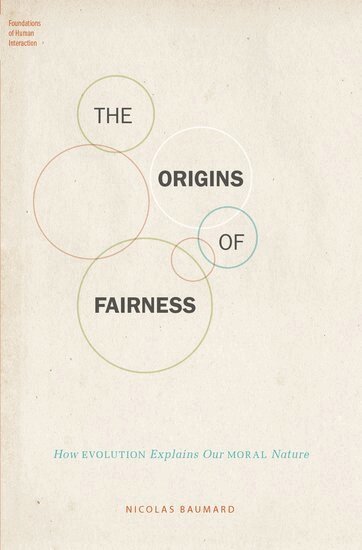
In order to describe the logic of morality, "contractualist " philosophers have studied how individuals behave when they choose to follow their moral intuitions. These individuals, contractualists note, often act as if they have bargained and thus reached an agreement with others about how to distribute the benefits and burdens of mutual cooperation. Using this observation, such philosophers argue that the purpose of morality is to maximize the benefits of human interaction. The resulting "contract " analogy is both insightful and puzzling. On one hand, it captures the pattern of moral intuitions, thus answering questions about human cooperation: why do humans cooperate? Why should the distribution of benefits be proportionate to each person's contribution? Why should the punishment be proportionate to the crime? Why should the rights be proportionate to the duties? On the other hand, the analogy provides a mere as-if explanation for human cooperation, saying that cooperation is "as if " people have passed a contract-but since they didn't, why should it be so? To evolutionary thinkers, the puzzle of the missing contract is immediately reminiscent of the puzzle of the missing "designer " of life-forms, a puzzle that Darwin's theory of natural selection essentially resolved. Evolutionary and contractualist theory originally intersected at the work of philosophers John Rawls and David Gauthier, who argued that moral judgments are based on a sense of fairness that has been naturally selected. In this book, Nicolas Baumard further explores the theory that morality was originally an adaptation to the biological market of cooperation, an arena in which individuals competed to be selected for cooperative interactions. In this environment, Baumard suggests, the best strategy was to treat others with impartiality and to share the costs and benefits of cooperation in a fair way, so that those who offered less than others were left out of cooperation while those who offered more were exploited by their partners. It is with this evolutionary approach that Baumard ultimately accounts for the specific structure of human morality.
E-bok
PDF, Engelska, 20161 086 kr
Läs direkt efter köp
In order to describe the logic of morality, “contractualist” philosophers have studied how individuals behave when they choose to follow their moral intuitions. These individuals, contractualists note, often act as if they have bargained and thus reached an agreement with others about how to distribute the benefits and burdens of mutual cooperation. Using this observation, such philosophers argue that the purpose of morality is to maximize the benefits of human interaction. The resulting “contract” analogy is both insightful and puzzling. On one hand, it captures the pattern of moral intuitions, thus answering questions about human cooperation: why do humans cooperate? Why should the distribution of benefits be proportionate to each person''s contribution? Why should the punishment be proportionate to the crime? Why should the rights be proportionate to the duties? On the other hand, the analogy provides a mere as-if explanation for human cooperation, saying that cooperation is “as if” people have passed a contract-but since they didn''t, why should it be so? To evolutionary thinkers, the puzzle of the missing contract is immediately reminiscent of the puzzle of the missing “designer” of life-forms, a puzzle that Darwin''s theory of natural selection essentially resolved. Evolutionary and contractualist theory originally intersected at the work of philosophers John Rawls and David Gauthier, who argued that moral judgments are based on a sense of fairness that has been naturally selected. In this book, Nicolas Baumard further explores the theory that morality was originally an adaptation to the biological market of cooperation, an arena in which individuals competed to be selected for cooperative interactions. In this environment, Baumard suggests, the best strategy was to treat others with impartiality and to share the costs and benefits of cooperation in a fair way, so that those who offered less than others were left out of cooperation while those who offered more were exploited by their partners. It is with this evolutionary approach that Baumard ultimately accounts for the specific structure of human morality.
E-bok
Engelska, 20161 048 kr
Läs direkt efter köp
In order to describe the logic of morality, “contractualist” philosophers have studied how individuals behave when they choose to follow their moral intuitions. These individuals, contractualists note, often act as if they have bargained and thus reached an agreement with others about how to distribute the benefits and burdens of mutual cooperation. Using this observation, such philosophers argue that the purpose of morality is to maximize the benefits of human interaction. The resulting “contract” analogy is both insightful and puzzling. On one hand, it captures the pattern of moral intuitions, thus answering questions about human cooperation: why do humans cooperate? Why should the distribution of benefits be proportionate to each person''s contribution? Why should the punishment be proportionate to the crime? Why should the rights be proportionate to the duties? On the other hand, the analogy provides a mere as-if explanation for human cooperation, saying that cooperation is “as if” people have passed a contract-but since they didn''t, why should it be so? To evolutionary thinkers, the puzzle of the missing contract is immediately reminiscent of the puzzle of the missing “designer” of life-forms, a puzzle that Darwin''s theory of natural selection essentially resolved. Evolutionary and contractualist theory originally intersected at the work of philosophers John Rawls and David Gauthier, who argued that moral judgments are based on a sense of fairness that has been naturally selected. In this book, Nicolas Baumard further explores the theory that morality was originally an adaptation to the biological market of cooperation, an arena in which individuals competed to be selected for cooperative interactions. In this environment, Baumard suggests, the best strategy was to treat others with impartiality and to share the costs and benefits of cooperation in a fair way, so that those who offered less than others were left out of cooperation while those who offered more were exploited by their partners. It is with this evolutionary approach that Baumard ultimately accounts for the specific structure of human morality.
Häftad, Franska, 2010
591 kr
Skickas inom 3-6 vardagar
202 kr
Läs direkt efter köp
Qu’est-ce que la morale ? Pourquoi agissons-nous de manière morale ? D’où viennent nos idées sur le bien et le mal ?Face à ces questions, les philosophes ont longtemps développé deux stratégies. Certains ont cherché à ramener nos jugements moraux à quelques principes : l’équité, le bien-être, la vertu, etc. Nous agirions ainsi de manière équitable, comme si nous avions passé un contrat avec autrui. D’autres se sont penchés sur les origines de nos jugements moraux. Constatant que la morale ne résulte pas d’un calcul égoïste, ils ont postulé l’existence d’un sens moral inné. Pour eux, nous serions moraux de la même façon que nous avons deux bras et deux jambes. Ces deux stratégies demeurent insatisfaisantes : d’où vient ce contrat imaginaire que nous semblons respecter ? Pourquoi sommes-nous équipés d’un sens moral ?Jusqu’à présent, la controverse était restée théorique. Mais voilà que de nombreuses recherches ont démontré l’existence d’une disposition naturelle à se comporter moralement. Encore faut-il expliquer pourquoi la morale adopte la « logique de l’équité » qui semble être la sienne. C’est ce que propose ce livre. Chercheur en psychologie, en anthropologie et en philosophie, Nicolas Baumard est attaché à l’Université d’Oxford.