Nicole St-Louis – författare
Visar alla böcker från författaren Nicole St-Louis. Handla med fri frakt och snabb leverans.
3 produkter
3 produkter
Häftad, Engelska, 2013
540 kr
Skickas inom 10-15 vardagar
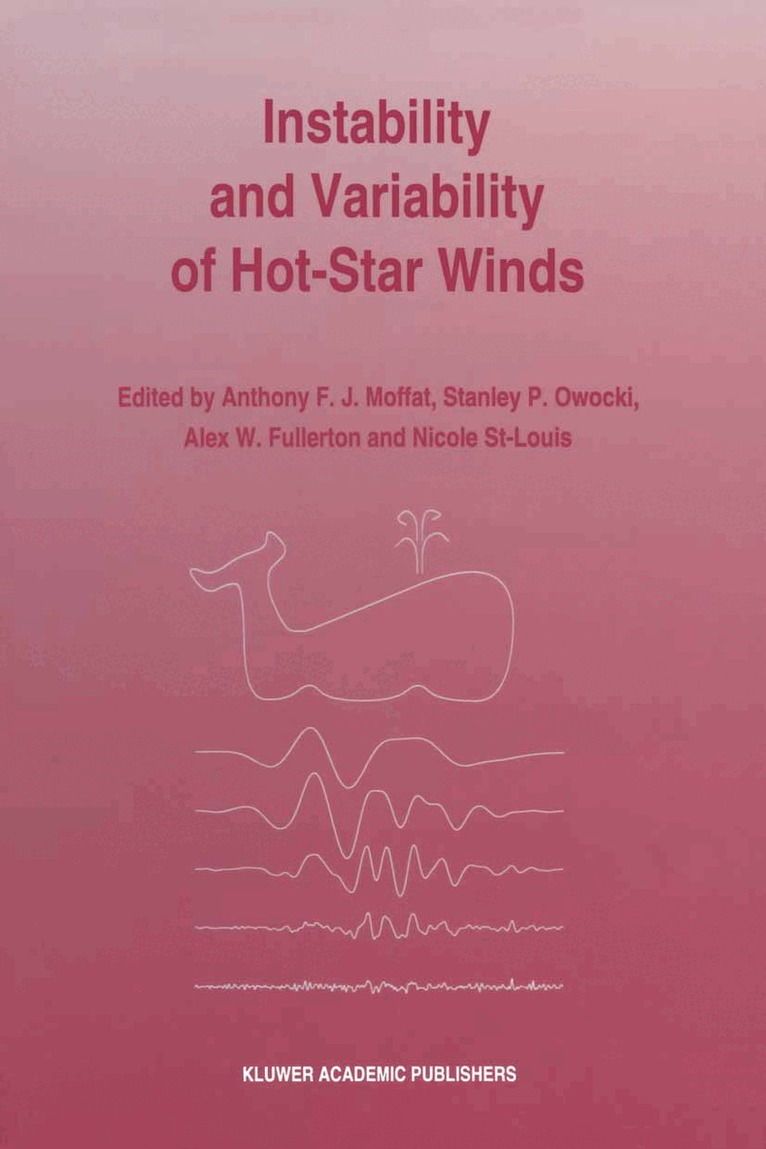
This specialized workshop was conceived during the workshop on "Non isotropic and Variable Outflows from Stars", which was held at the Space Telescope Science Institute in October, 1991. At that meeting, the four of us collectively decided that the time was ripe for an even more focussed discussion of the basic issues in the area of hot-star wind instability and its observable manifestations. Not that the big problems have been solved! Rather, we are currently in a phase of rapid development, both with regard to the models and to the observations. The key issue at this new workshop would be to decide how the time-dependent structures observed in hot-star winds (e. g. , NACs, DACs, blobs, clumps, filaments, shells, puffs, jets, etc. ) relate to radiative and other instabilities. Further questions concern the role of turbulence and the nature of its driver, and the effect of stellar rotation, pulsation, and magnetic fields on time-dependent phenomena in hot-star winds. Of no less importance is the impact of stellar wind variability on the derivation of mass-loss rates, on stellar evolution, and on momentum/energy deposition in the interstellar medium. To attain our goal of maximum confrontation (in the positive sense!) we decided: (1) to limit the workshop to the observers and theoreticians most active in this field in the world; (2) to insist that virtually all participants present a talk, thereby avoiding the distraction of poster sessions; and (3) to allocate approximately half of the allotted time to discussion.
E-bok
PDF, Engelska, 2012687 kr
Läs direkt efter köp
This specialized workshop was conceived during the workshop on "Non isotropic and Variable Outflows from Stars", which was held at the Space Telescope Science Institute in October, 1991. At that meeting, the four of us collectively decided that the time was ripe for an even more focussed discussion of the basic issues in the area of hot-star wind instability and its observable manifestations. Not that the big problems have been solved! Rather, we are currently in a phase of rapid development, both with regard to the models and to the observations. The key issue at this new workshop would be to decide how the time-dependent structures observed in hot-star winds (e. g. , NACs, DACs, blobs, clumps, filaments, shells, puffs, jets, etc. ) relate to radiative and other instabilities. Further questions concern the role of turbulence and the nature of its driver, and the effect of stellar rotation, pulsation, and magnetic fields on time-dependent phenomena in hot-star winds. Of no less importance is the impact of stellar wind variability on the derivation of mass-loss rates, on stellar evolution, and on momentum/energy deposition in the interstellar medium. To attain our goal of maximum confrontation (in the positive sense!) we decided: (1) to limit the workshop to the observers and theoreticians most active in this field in the world; (2) to insist that virtually all participants present a talk, thereby avoiding the distraction of poster sessions; and (3) to allocate approximately half of the allotted time to discussion.
Inbunden, Engelska, 2024
1 564 kr
Tillfälligt slut
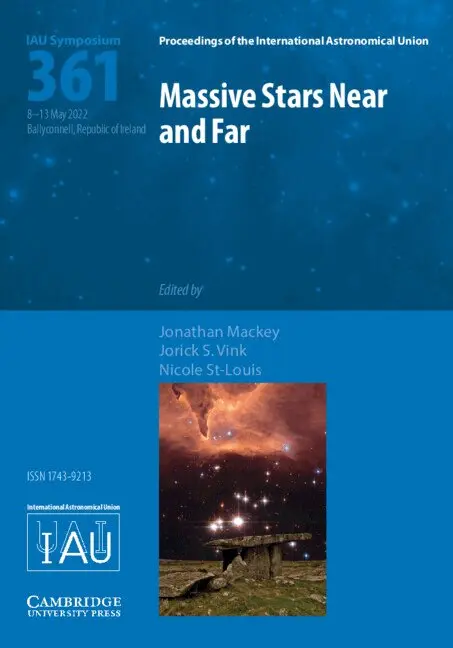
IAU Symposium 361 brought together observational and theoretical astrophysicists to discuss all aspects of massive stars: their formation, evolution, demise as supernovae and GRBs, and gravitational waves from mergers of stellar-remnant neutron stars and black holes. The special focus was on massive stars in the early Universe, how they compare with massive stars in our Galaxy and with low-metallicity galaxies in the local Universe, anticipating new results from HST's ULLYSES and JWST. The volume includes contributions from the virtual preview meeting (May 2021) held online due to COVID-19 restrictions, and the in-person meeting (May 2022) held in Ballyconnell, Co. Cavan, Ireland. More than 200 participants from 32 countries contributed through highlight talks on exciting new results and wide-ranging contributed talks and posters covering the latest research from cool supergiants to hot Wolf-Rayet stars.