Niuscha Bassiri – författare
1 612 kr
Läs direkt efter köp
3 321 kr
Läs direkt efter köp
Despite the obvious advantages accruing from its central location and the presence of the EU institutions in its capital city Brussels, Belgium has never fully fulfilled its potential to emerge as an attractive jurisdiction for international arbitration. Now, however, with the adoption in 2013 of an entirely new arbitration law, and the accompanying overhaul of the rules of CEPANI, the Belgian Centre for Arbitration and Mediation, Brussels is poised to progress rapidly towards the top rank of European and global seats of arbitration. This is the first comprehensive treatise in English to provide practical guidance to arbitration practitioners, in-house counsel, and judges on how to conduct arbitrations in Belgium. To facilitate its use, it is structured as an article-by-article commentary on the 2013 Law addressing the following aspects of each article:
• the purpose of the provision;• comparison with the UNCITRAL Model Law on Commercial Arbitration;• party autonomy;• issues of costs; and• interplay with the rules of other major arbitration institutions and the New York Convention.The core of each article commentary is an in-depth analysis that provides recommendations to practitioners and judges. The analysis goes beyond the contents of the commented article and deals with related issues that are not addressed expressly in the Law but may be of relevance for the issues covered in the provision in question. Arbitration professionals will find here convincing evidence of the liberal system for arbitration now prevailing in Belgium, along with rules that reflect the most recent trends in international practice. The description and analysis offered are sure to contribute to the recognition of Belgium as a global arbitral jurisdiction.
3 321 kr
Läs direkt efter köp
Despite the obvious advantages accruing from its central location and the presence of the EU institutions in its capital city Brussels, Belgium has never fully fulfilled its potential to emerge as an attractive jurisdiction for international arbitration. Now, however, with the adoption in 2013 of an entirely new arbitration law, and the accompanying overhaul of the rules of CEPANI, the Belgian Centre for Arbitration and Mediation, Brussels is poised to progress rapidly towards the top rank of European and global seats of arbitration. This is the first comprehensive treatise in English to provide practical guidance to arbitration practitioners, in-house counsel, and judges on how to conduct arbitrations in Belgium. To facilitate its use, it is structured as an article-by-article commentary on the 2013 Law addressing the following aspects of each article:
• the purpose of the provision;• comparison with the UNCITRAL Model Law on Commercial Arbitration;• party autonomy;• issues of costs; and• interplay with the rules of other major arbitration institutions and the New York Convention.The core of each article commentary is an in-depth analysis that provides recommendations to practitioners and judges. The analysis goes beyond the contents of the commented article and deals with related issues that are not addressed expressly in the Law but may be of relevance for the issues covered in the provision in question. Arbitration professionals will find here convincing evidence of the liberal system for arbitration now prevailing in Belgium, along with rules that reflect the most recent trends in international practice. The description and analysis offered are sure to contribute to the recognition of Belgium as a global arbitral jurisdiction.
2 312 kr
Läs direkt efter köp
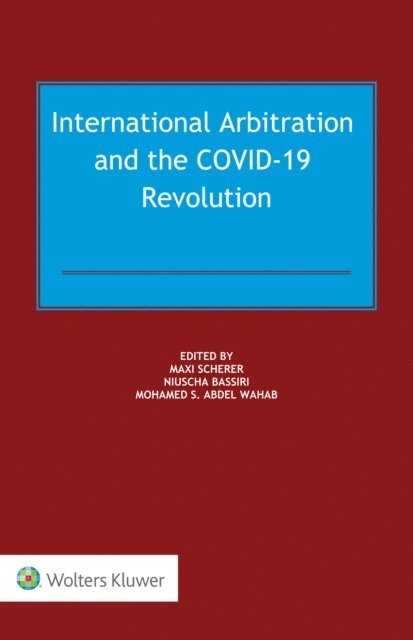
International Arbitration and the COVID-19 Revolution
Edited by Maxi Scherer, Niuscha Bassiri & Mohamed S. Abdel Wahab
The impact of the COVID-19 pandemic on all major economic sectors and industries has triggered profound and systemic changes in international arbitration. Moreover, the fact that entire proceedings are now being conducted remotely constitutes so significant a deviation from the norm as to warrant the designation ‘revolution’. This timely book is the first to describe and analyse how the COVID-19 crisis has redefined arbitral practice, with critical appraisal from well-known practitioners of the pandemic’s effects on substantive and procedural aspects from the commencement of proceedings until the enforcement of the award.
With practical guidance from a variety of perspectives – legal, practical, and sector-specific – on the conduct of international arbitration during the COVID-19 pandemic and beyond, the chapters present leading practitioners’ insights into the unprecedented and multifaceted issues that arise. They provide expert tips and challenges in such practical matters as the following:
preventing and resolving disputes of particular types – construction, energy, aviation, technology, media and telecommunication, finance and insurance; arbitrator appointments; issues of planning, preparation and sample procedural orders; witness preparation and cross-examination; e-signature of arbitral awards; setting aside and enforcement proceedings; and third-party funding.Also included are an empirical survey of users’ views and an overview of how the COVID-19 revolution has affected the arbitration rules of leading arbitral seats.
With this timely and practical book, arbitration practitioners and scholars will gain up-to-date knowledge of sector-specific challenges brought about by the COVID-19 pandemic and approach arbitration proceedings with an understanding of the most important legal and practical considerations during the crisis and beyond.
2 231 kr
Läs direkt efter köp
International Arbitration and the COVID-19 Revolution
Edited by Maxi Scherer, Niuscha Bassiri & Mohamed S. Abdel Wahab
The impact of the COVID-19 pandemic on all major economic sectors and industries has triggered profound and systemic changes in international arbitration. Moreover, the fact that entire proceedings are now being conducted remotely constitutes so significant a deviation from the norm as to warrant the designation ‘revolution’. This timely book is the first to describe and analyse how the COVID-19 crisis has redefined arbitral practice, with critical appraisal from well-known practitioners of the pandemic’s effects on substantive and procedural aspects from the commencement of proceedings until the enforcement of the award.
With practical guidance from a variety of perspectives – legal, practical, and sector-specific – on the conduct of international arbitration during the COVID-19 pandemic and beyond, the chapters present leading practitioners’ insights into the unprecedented and multifaceted issues that arise. They provide expert tips and challenges in such practical matters as the following:
preventing and resolving disputes of particular types – construction, energy, aviation, technology, media and telecommunication, finance and insurance; arbitrator appointments; issues of planning, preparation and sample procedural orders; witness preparation and cross-examination; e-signature of arbitral awards; setting aside and enforcement proceedings; and third-party funding.Also included are an empirical survey of users’ views and an overview of how the COVID-19 revolution has affected the arbitration rules of leading arbitral seats.
With this timely and practical book, arbitration practitioners and scholars will gain up-to-date knowledge of sector-specific challenges brought about by the COVID-19 pandemic and approach arbitration proceedings with an understanding of the most important legal and practical considerations during the crisis and beyond.
2 715 kr
Skickas inom 5-8 vardagar