Niva Elkin-Koren - Böcker
Visar alla böcker från författaren Niva Elkin-Koren. Handla med fri frakt och snabb leverans.
3 produkter
3 produkter
Law and Economics of Intellectual Property in the Digital Age
The Limits of Analysis
Inbunden, Engelska, 2012
1 990 kr
Skickas inom 10-15 vardagar
This book explores the economic analysis of intellectual property law, with a special emphasis on the Law and Economics of informational goods in light of the past decade’s technological revolution. In recent years there has been massive growth in the Law and Economics literature focusing on intellectual property, on both normative and positive levels of analysis. The economic approach to intellectual property is often described as a monolithic, coherent approach that may differ only as it is applied to a particular case. Yet the growing literature of Law and Economics in intellectual property does not speak in one voice. The economic discourse used in legal scholarship and in policy-making encompasses several strands, each reflecting a fundamentally different approach to the economics of informational works, and each grounded in a different ideology or methodological paradigm. This book delineates the various economic approaches taken and analyzes their tenets. It maps the fundamental concepts and the theoretical foundation of current economic analysis of intellectual property law, in order to fully understand the ramifications of using economic analysis of law in policy making. In so doing, one begins to appreciate the limitations of the current frameworks in confronting the challenges of the information revolution. The book addresses the fundamental adjustments in the methodology and underlying assumptions that must be employed in order for the economic approach to remain a useful analytical framework for addressing IPR in the information age.
Law and Economics of Intellectual Property in the Digital Age
The Limits of Analysis
Häftad, Engelska, 2015
616 kr
Skickas inom 10-15 vardagar
This book explores the economic analysis of intellectual property law, with a special emphasis on the Law and Economics of informational goods in light of the past decade’s technological revolution. In recent years there has been massive growth in the Law and Economics literature focusing on intellectual property, on both normative and positive levels of analysis. The economic approach to intellectual property is often described as a monolithic, coherent approach that may differ only as it is applied to a particular case. Yet the growing literature of Law and Economics in intellectual property does not speak in one voice. The economic discourse used in legal scholarship and in policy-making encompasses several strands, each reflecting a fundamentally different approach to the economics of informational works, and each grounded in a different ideology or methodological paradigm. This book delineates the various economic approaches taken and analyzes their tenets. It maps the fundamental concepts and the theoretical foundation of current economic analysis of intellectual property law, in order to fully understand the ramifications of using economic analysis of law in policy making. In so doing, one begins to appreciate the limitations of the current frameworks in confronting the challenges of the information revolution. The book addresses the fundamental adjustments in the methodology and underlying assumptions that must be employed in order for the economic approach to remain a useful analytical framework for addressing IPR in the information age.
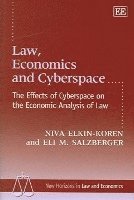
Law, Economics and Cyberspace
The Effects of Cyberspace on the Economic Analysis of Law
Inbunden, Engelska, 2004
1 508 kr
Skickas inom 7-10 vardagar
This book argues that the Internet revolution should exert a far more significant influence on economic thinking and on the perception of law. The authors acknowledge that the economic analysis of law provides a potentially powerful framework for evaluating regulatory approaches to the Internet. However, they question the capacity of traditional law and economics models to define the scope of legal intervention, both in cyberspace and in other more traditional markets which have also been influenced by the recent technological revolution.The book examines the conventional application of law and economics, and contends that the new reality of cyberspace transforms the basic theoretical tenets of this approach and requires fresh conceptual thinking. It challenges fundamental concepts such as the notion of work as linked to the workplace, the notion of community as linked to geographical space, the sources of law and their traditional connection with the state, the belief that proxies and representatives are indispensable for collective action and public decision-making processes, and the role of technology and its relationship with the law. It covers the analysis of both economic and non-economic markets, and includes a thorough examination of legislation, case law and the academic literature relating to cyberspace. The authors conclude that there is pressing need for re-evaluating the analytical tools used to study the information environment, and propose an innovative approach for the role of technology within the law and economics framework.This book represents a groundbreaking attempt to critically analyze the suitability of traditional law and economics for the new digital environment. Scholars and students working in the field of law and economics, and lawyers interested in technology, intellectual property, cyberlaw and governance will find this a stimulating and thought-provoking volume.