Noémie C. Combe – författare
Visar alla böcker från författaren Noémie C. Combe. Handla med fri frakt och snabb leverans.
3 produkter
3 produkter
Inbunden, Engelska, 2026
1 406 kr
Skickas inom 10-15 vardagar
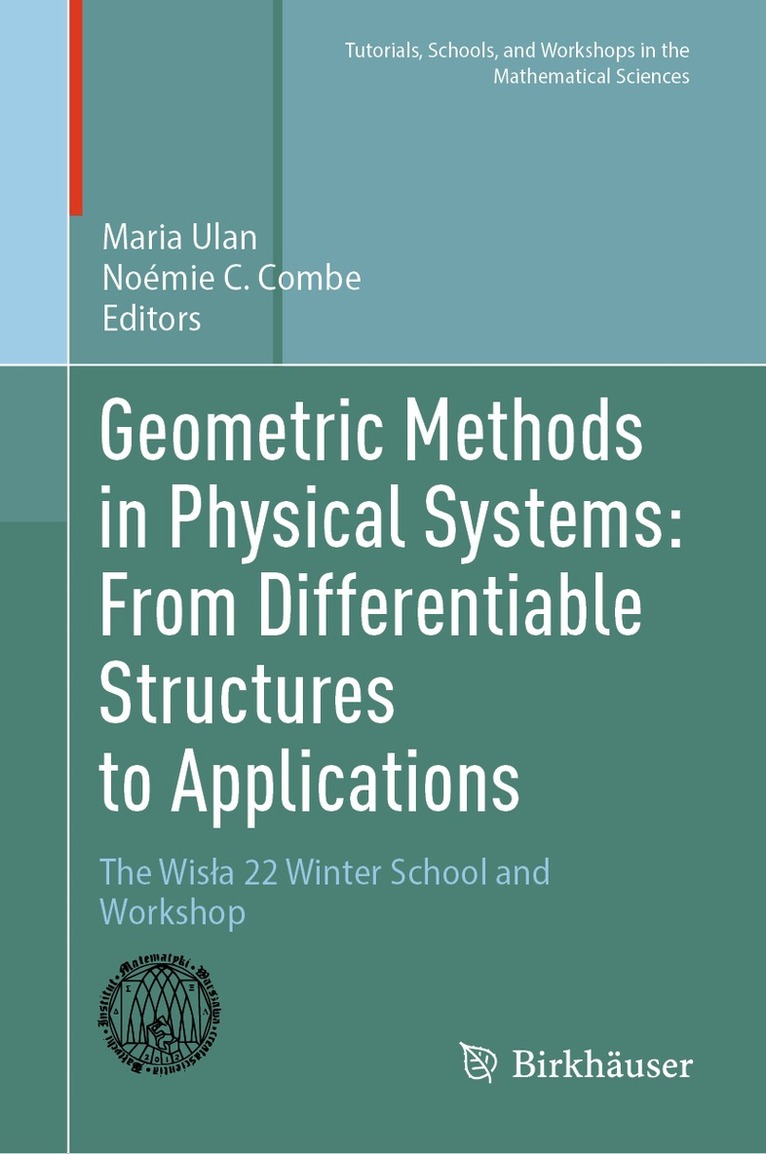
This book presents selected lectures from the Wisła 22 Winter School and Workshop organized by the Baltic Institute of Mathematics that illustrate the power of geometric methods in understanding complex physical systems. Chapters progress from foundational mathematical structures to concrete applications in fluid dynamics and mechanical systems, highlighting the profound connection between differential geometry and physical phenomena.The first chapter investigates differentiable structures on a non-Hausdorff line with two origins, setting the stage for the applications that follow. The next chapter transitions to fluid mechanics through a study of generalized geometry in two-dimensional incompressible fluid flows, establishing the mathematical framework needed for analyzing fluid systems through geometric lenses. Building on these foundations, the third chapter expands the perspective with a comprehensive treatment of nonlinear differential equations in fluid mechanics, utilizing concepts from contact and symplectic geometry to illuminate singular properties of fluid dynamics solutions. Finally, the fourth chapter demonstrates how geometric methods extend beyond fluid mechanics to mechanical systems with nonholonomic constraints, revealing how geometric formulations can address challenging phenomena like discontinuities, collisions, and the counterintuitive stabilization of inverted pendulums.Geometric Methods in Physical Systems is ideal for graduate students and researchers working in these areas. A basic understanding of differential geometry and mathematical analysis is assumed.
E-bok
Engelska, 20261 733 kr
Läs direkt efter köp
This book presents selected lectures from the Wisla 22 Winter School and Workshop organized by the Baltic Institute of Mathematics that illustrate the power of geometric methods in understanding complex physical systems. Chapters progress from foundational mathematical structures to concrete applications in fluid dynamics and mechanical systems, highlighting the profound connection between differential geometry and physical phenomena.The first chapter investigates differentiable structures on a non-Hausdorff line with two origins, setting the stage for the applications that follow. The next chapter transitions to fluid mechanics through a study of generalized geometry in two-dimensional incompressible fluid flows, establishing the mathematical framework needed for analyzing fluid systems through geometric lenses. Building on these foundations, the third chapter expands the perspective with a comprehensive treatment of nonlinear differential equations in fluid mechanics, utilizing concepts from contact and symplectic geometry to illuminate singular properties of fluid dynamics solutions. Finally, the fourth chapter demonstrates how geometric methods extend beyond fluid mechanics to mechanical systems with nonholonomic constraints, revealing how geometric formulations can address challenging phenomena like discontinuities, collisions, and the counterintuitive stabilization of inverted pendulums.Geometric Methods in Physical Systems is ideal for graduate students and researchers working in these areas. A basic understanding of differential geometry and mathematical analysis is assumed.
Häftad, Engelska, 2026
670 kr
Kommande
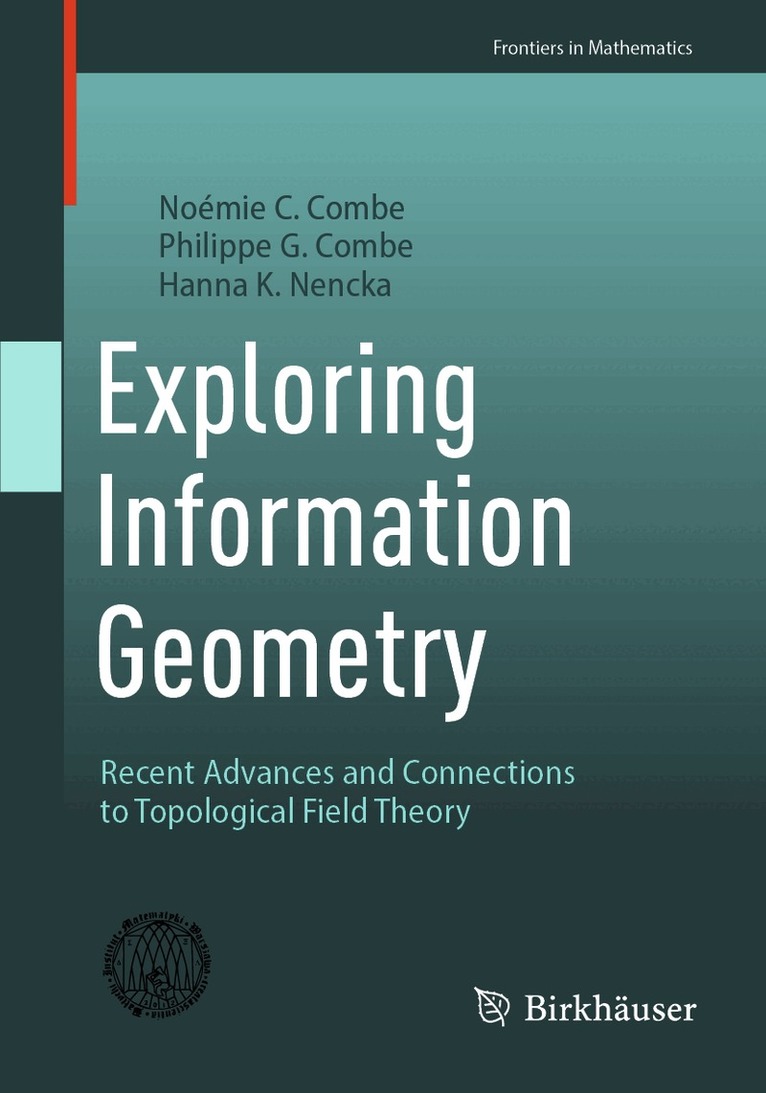
This book offers a clear and accessible pathway into information geometry for advanced undergraduate and graduate students. Readers will be guided from the fundamentals of topology and differentiable manifolds to the more advanced concepts of probability geometry and Frobenius manifolds in an intuitive manner, allowing them to build their knowledge gradually. Divided into three main parts, the first provides a concise introduction to differential topology and geometry, emphasizing the role of smooth manifolds, connections, and curvature in the formulation of geometric structures. Part II is then devoted to probability, measures, and statistics, where the notion of a probability space is refined into a geometric object, thus paving the way for a deeper mathematical understanding of statistical models. Finally, the third part introduces Frobenius manifolds, revealing their surprising connection to exponential families of probability distributions and, more broadly, their role in the geometry of information. Throughout all the chapters, there are exercises to test understanding, as well as solutions to some of the more challenging problems to aid learning.