Nuria Sebastian-Galles - Böcker
Visar alla böcker från författaren Nuria Sebastian-Galles. Handla med fri frakt och snabb leverans.
4 produkter
4 produkter
2 150 kr
Skickas inom 10-15 vardagar
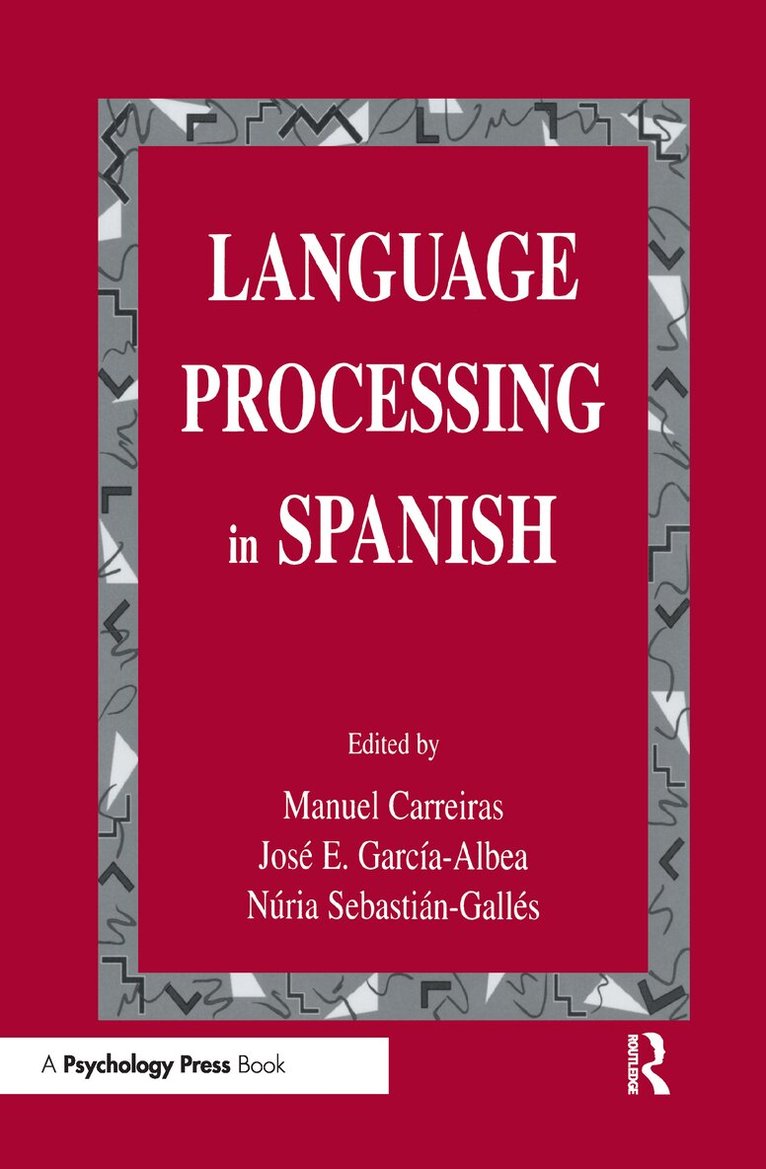
This book presents a set of contributions to the current flow of psycholinguistic research, with new and challenging data gathered from Spanish that may illuminate issues about the generality of language processing models. Although it is possible to find a considerable amount of papers on psycholinguistic research with the Spanish language published in English-speaking journals, unfortunately, the scientific community does not have access to an overview of psycholinguistics in Spain. This book overcomes these limitations because it brings together state-of-the-art descriptions of the research and theory of the different subareas of psycholinguistics currently being studied in Spain. Spanish, the third most widely-used language in the world, differs from English in a number of important respects. Since English has been predominant in psycholinguistic research, contrasting properties of Spanish may help to test the generality of language processing mechanisms and to refine their description. The set of contrasting features considered in this book includes acoustical and syllabic transparency, shallow orthography, a much richer morphology, flexibility in word order, less variability in intonational contours, and the existence of null pronominal subjects for inflected verbs. There are also interesting contrasts in the frequency of different linguistic units, whose impact on language processing is also evaluated. One of the main lines of argument throughout this book deals with the tension between universality and variation as a way of characterizing the functioning of language capacities and processes. The variety of topics covered by this book ranges from one end of the spectrum of language related behavior to the other: speech perception, lexical access in word recognition, relations between phonological and orthographic representations, sentence processing, discourse comprehension, and language production. All chapters focus on questions of general interest within each topic, and in most cases they appeal to one particular feature of the Spanish language that is relevant for a given question. Most chapters show the indisputable importance of crosslinguistic research in psycholinguistics to improve understanding on whether universal cognitive mechanisms and language specific routines underlie the ability of understanding and producing language.
565 kr
Skickas inom 11-20 vardagar
The contributions to this special issue were selected from a wealth of studies presented at the first Workshop on Infant Language Development held in Europe (Donostia, Spain) including keynote talks by such prominent infant researchers as Jenny Saffran, Marilyn Vihman, Krista Byers-Heinlin, and Dick Aslin. One of the many goals of this meeting was to bring together researchers who work on the acquisition of various languages. For this reason, research reported in this special issue includes experimental data from German, Japanese, Basque, Spanish, Italian, French, British, English, and American English infants. By investigating various abilities of infants from all these linguistic backgrounds, the articles published within this volume cover the research fields of speech perception development, cognitive development, and the development of word comprehension and production.
458 kr
Skickas inom 7-10 vardagar
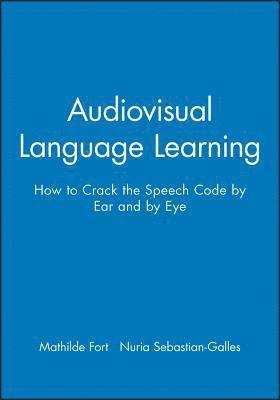
Findings related to language learning that are of interest to researchersThe topic of audiovisual speech perception is addressed in Audiovisual Language Learning: How to Crack the Speech Code by Ear and by Eye. The publication presents nine contributions on the perceptual system's reliance on visual speech to process and learn language. This learning is addressed in its various stages of development and in reference to typical and atypical language development. Insights are discussed in the areas of multimodelity, environmental constraints, brain maturation and visuo-attentional components.
705 kr
Skickas inom 10-15 vardagar
This book presents a set of contributions to the current flow of psycholinguistic research, with new and challenging data gathered from Spanish that may illuminate issues about the generality of language processing models. Although it is possible to find a considerable amount of papers on psycholinguistic research with the Spanish language published in English-speaking journals, unfortunately, the scientific community does not have access to an overview of psycholinguistics in Spain. This book overcomes these limitations because it brings together state-of-the-art descriptions of the research and theory of the different subareas of psycholinguistics currently being studied in Spain. Spanish, the third most widely-used language in the world, differs from English in a number of important respects. Since English has been predominant in psycholinguistic research, contrasting properties of Spanish may help to test the generality of language processing mechanisms and to refine their description. The set of contrasting features considered in this book includes acoustical and syllabic transparency, shallow orthography, a much richer morphology, flexibility in word order, less variability in intonational contours, and the existence of null pronominal subjects for inflected verbs. There are also interesting contrasts in the frequency of different linguistic units, whose impact on language processing is also evaluated. One of the main lines of argument throughout this book deals with the tension between universality and variation as a way of characterizing the functioning of language capacities and processes. The variety of topics covered by this book ranges from one end of the spectrum of language related behavior to the other: speech perception, lexical access in word recognition, relations between phonological and orthographic representations, sentence processing, discourse comprehension, and language production. All chapters focus on questions of general interest within each topic, and in most cases they appeal to one particular feature of the Spanish language that is relevant for a given question. Most chapters show the indisputable importance of crosslinguistic research in psycholinguistics to improve understanding on whether universal cognitive mechanisms and language specific routines underlie the ability of understanding and producing language.