O.F. Robinson – författare
Visar alla böcker från författaren O.F. Robinson. Handla med fri frakt och snabb leverans.
6 produkter
6 produkter
Inbunden, Engelska, 2007
2 248 kr
Skickas inom 10-15 vardagar
Using Roman literary and legal sources, this book assesses Roman penal policy through an in-depth examination of six high-profile criminal cases, ranging from the Bacchanalian trials in 186 BC to the trials for treason and magic in the fourth century. Identifying Roman attitudes to crime and punishment, this book brings out contrasts and developments in those attitudes. O.F. Robinson examines Roman criminal legislation (both that laid down by Justinian and that codified and confirmed by him) as well as Roman attitudes, both juristic and philosophical, to the purposes of punishment, including deterrence, retribution, reform, protection of the public and how they were modified over time. The author also discusses arguments for fixed as against flexible penalties, and the changes made in the actual punishments and in those to whom they were applied. This book is an essential tool for any specialist, student or researcher wishing to learn more about Roman values from their approach to crime and punishment
Häftad, Engelska, 2012
860 kr
Skickas inom 10-15 vardagar
Using Roman literary and legal sources, this book assesses Roman penal policy through an in-depth examination of six high-profile criminal cases, ranging from the Bacchanalian trials in 186 BC to the trials for treason and magic in the fourth century. Identifying Roman attitudes to crime and punishment, this book brings out contrasts and developments in those attitudes. O.F. Robinson examines Roman criminal legislation (both that laid down by Justinian and that codified and confirmed by him) as well as Roman attitudes, both juristic and philosophical, to the purposes of punishment, including deterrence, retribution, reform, protection of the public and how they were modified over time. The author also discusses arguments for fixed as against flexible penalties, and the changes made in the actual punishments and in those to whom they were applied. This book is an essential tool for any specialist, student or researcher wishing to learn more about Roman values from their approach to crime and punishment
Del 82 - Canterbury & York Society
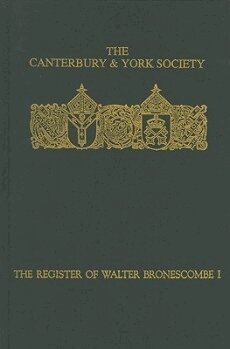
Register of Walter Bronescombe, Bishop of Exeter, 1258-1280: I
Inbunden, Engelska, 1995
321 kr
Skickas inom 5-8 vardagar
Introduction to and transcription of earliest surviving Exeter episcopal register, with modern translation.The earliest of the Exeter episcopal registers to survive, Bronescombe's is a general register with a single chronological sequence of letters and memoranda on many aspects of diocesan administration. It also contains copies of charters by, among others, king Henry III and his brother Richard, King of the Romans, in his capacity as Earl of Cornwall. Volume I of this edition (which supersedes the unsatisfactory one of 1889) contains a substantial introduction and a full transcription of the Latin text of folios 2-26, with a modern translation on the facing pages; it will therefore be of value to students of medieval Latin as well as ecclesiastical and legal historians. Two further volumes are to follow.O.F. ROBINSON is Douglas Professor of Roman Law at the University of Glasgow.
Del 94 - Canterbury & York Society
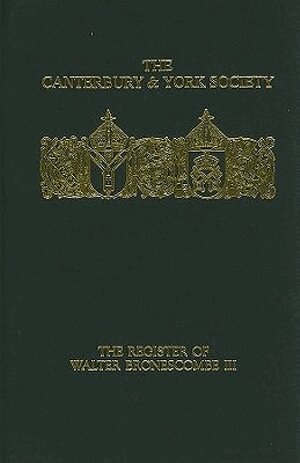
Register of Walter Bronescombe, Bishop of Exeter, 1258-80: III
Inbunden, Engelska, 2003
370 kr
Skickas inom 5-8 vardagar
Impressive...a significant contribution to the ecclesiastical history of Exeter and the English thirteenth century. CATHOLIC HISTORICAL REVIEW Third and final volume of early Exeter episcopal register; Introduction in Vol. I.The earliest of the Exeter episcopal registers to survive, Bronescombe's is a general register with a single chronological sequence of letters and memoranda on many aspects of diocesan administration. It also contains copies of charters by, among others, king Henry III and his brother Richard, King of the Romans, in his capacity as Earl of Cornwall. Volume one of this edition (which supersedes the unsatisfactory one of 1889) contains a substantial introduction and a full transcription of the Latin text of folios 2-26, with a modern translation on the facing pages; it will therefore be of value to students of medieval Latin as well as ecclesiastical and legal historians.O.F. ROBINSON is Douglas Professor of Roman Law at the University of Glasgow.
E-bok
Engelska, 20071 022 kr
Läs direkt efter köp
Using Roman literary and legal sources, this book assesses Roman penal policy through an in-depth examination of six high-profile criminal cases, ranging from the Bacchanalian trials in 186 BC to the trials for treason and magic in the fourth century. Identifying Roman attitudes to crime and punishment, this book brings out contrasts and developments in those attitudes. O.F. Robinson examines Roman criminal legislation (both that laid down by Justinian and that codified and confirmed by him) as well as Roman attitudes, both juristic and philosophical, to the purposes of punishment, including deterrence, retribution, reform, protection of the public and how they were modified over time. The author also discusses arguments for fixed as against flexible penalties, and the changes made in the actual punishments and in those to whom they were applied. This book is an essential tool for any specialist, student or researcher wishing to learn more about Roman values from their approach to crime and punishment.
E-bok
PDF, Engelska, 20071 022 kr
Läs direkt efter köp
Using Roman literary and legal sources, this book assesses Roman penal policy through an in-depth examination of six high-profile criminal cases, ranging from the Bacchanalian trials in 186 BC to the trials for treason and magic in the fourth century. Identifying Roman attitudes to crime and punishment, this book brings out contrasts and developments in those attitudes. O.F. Robinson examines Roman criminal legislation (both that laid down by Justinian and that codified and confirmed by him) as well as Roman attitudes, both juristic and philosophical, to the purposes of punishment, including deterrence, retribution, reform, protection of the public and how they were modified over time. The author also discusses arguments for fixed as against flexible penalties, and the changes made in the actual punishments and in those to whom they were applied. This book is an essential tool for any specialist, student or researcher wishing to learn more about Roman values from their approach to crime and punishment.