OLIVELLE - Böcker
Visar alla böcker från författaren OLIVELLE. Handla med fri frakt och snabb leverans.
3 produkter
3 produkter
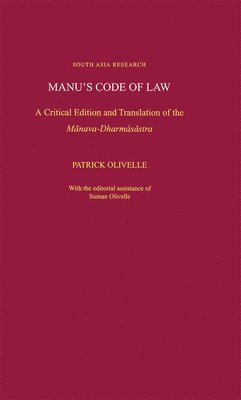
Manu's Code of Law
A Critical Edition and Translation of the Manava-Dharmasastra
Inbunden, Engelska, 2004
2 149 kr
Skickas inom 5-8 vardagar
Manu's Code of Law is one of the most important texts in the Sanskrit canon, indeed one of the most important surviving texts from any classical civilization. It paints an astoundingly detailed picture of ancient Indian life-covering everything from the constitution of the king's cabinet to the price of a ferry trip for a pregnant woman-and its doctrines have been central to Indian thought and practice for 2000 years. Despite its importance, however, until now no one has produced a critical edition of this text. As a result, for centuries scholars have been forced to accept clearly inferior editions of Sanskrit texts and to use those unreliable editions as the basis for constructing the history of classical India. In this volume, Patrick Olivelle has assembled the critical text of Manu, including a critical apparatus containing all the significant manuscript variants, along with a reliable and readable translation, copious explanatory notes, and a comprehensive introduction on the structure, content, and socio-political context of the treatise. The result is an outstanding scholarly achievement that will be an essential tool for any serious student of India.
2 079 kr
Skickas inom 5-8 vardagar
This volume is the result of an international conference organized by the South Asia Institute at the University of Texas. Patrick Olivelle has collected and edited the best papers to emerge from the conference. Part I of the book looks at what can be construed from archeological evidence. Part II concerns itself with the textual evidence for the period. Taken together, these essays offer an unprecedented look at Indian culture and society in this distant epoch.
2 890 kr
Skickas inom 5-8 vardagar
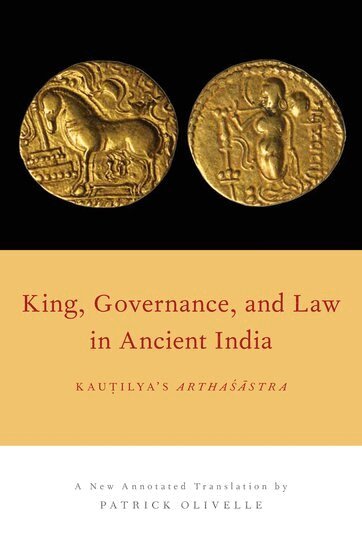
King, Governance, and Law in Ancient India presents an English translation of Kautilya's Arthashastra (AS.) along with detailed endnotes. When it was discovered in 1923, the Arthashastra was described as perhaps the most precious work in the whole range of Sanskrit literature, an assessment that still rings true. This new translation of this significant text, the first in close to half a century takes into account a number of important advances in our knowledge of the texts, inscriptions, and archeological and art historical remains from the period in Indian history to which the AS. belongs (2nd-3rd century CE, although parts of it may be much older). The text is what we would today call a scientific treatise. It codifies a body of knowledge handed down in expert traditions. It is specifically interested in two things: first, how a king can expand his territory, keep enemies at bay, enhance his external power, and amass riches; second, how a king can best organize his state bureaucracy to consolidate his internal power, to suppress internal enemies, to expand the economy, to enhance his treasury through taxes, duties, and entrepreneurial activities, to keep law and order, and to settle disputes among his subjects. The book is accordingly divided into two sections: the first encompassing Books 1-5 deals with internal matters, and the second spanning Books 6-14 deals with external relations and warfare. The AS. stands alone: there is nothing like it before it and there is nothing after it-if there were other textual productions within that genre they are now irretrievably lost. Even though we know of many authors who preceded Kautilya, none of their works have survived the success of the AS. Being "textually" unique makes it difficult to understand and interpret difficult passages and terms; we cannot look to parallels for help. The AS. is also unique in that, first, it covers such a vast variety of topics and, second, it presents in textual form expert traditions in numerous areas of human and social endeavors that were handed down orally. Expert knowledge in diverse fields communicated orally from teacher to pupil, from father to son, is here for the first time codified in text. These fields include: building practices of houses, forts, and cities; gems and gemology; metals and metallurgy; mining, forestry and forest management; agriculture; manufacture of liquor; animal husbandry, shipping, and the management of horses and elephants- and so on. Finally, it is also unique in presenting a viewpoint distinctly different from the Brahmanical "party line" we see in most ancient Indian documents.