Oren Tal – författare
Visar alla böcker från författaren . Handla med fri frakt och snabb leverans.
2 produkter
2 produkter
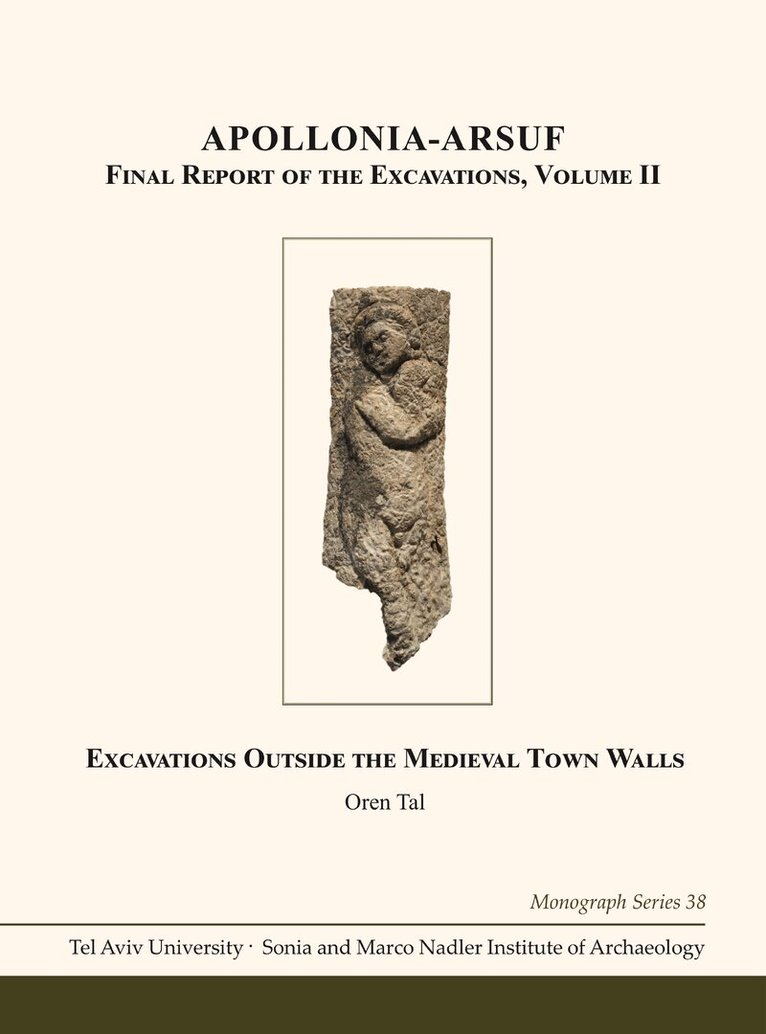
Del 38 - Monograph Series of the Sonia and Marco Nadler Institute of Archaeology
Apollonia-Arsuf: Final Report of the Excavations
Volume II: Excavations Outside the Medieval Town Walls
Inbunden, Engelska, 2020
531 kr
Skickas inom 5-8 vardagar
The second in a series of final publications of the Apollonia-Arsuf excavations, this volume reports the finds from the 1996, 2002, 2006, 2012, 2013, and 2017 seasons. The main topics are the excavation of areas to the east of the Apollonia National Park, outside the walled medieval town; the excavations carried out within and just outside the perimeter of the Park; skeletal remains; faunal remains; and a variety of finds, including pottery, glass, stone, metal, and bone objects as well as numerous coins.The analysis of the finds discussed in this report contribute to our understanding of the site during the Byzantine and early medieval occupation. Byzantine Apollonia, called Sozousa, was unwalled and extended over an area of some 280 dunams. Among its architectural remains are a church and industrial quarters with wine and oil presses, plastered pools, and raw glass furnaces. In the days of the Umayyad Caliph ‘Abd al-Malik (685–705), the site, at that point called Arsuf, was fortified by a wall that encompassed some seventy-seven dunams. By the end of the Early Islamic period, it became a ribbat (fort) where Muslim philosophers resided. In 1101, the site was conquered by the Crusaders. Towards the mid-twelfth century, ownership was transferred to a Crusader noble family, and the site became the center of a feudal seigneury. Construction of the castle in the northern sector began in 1241, and in 1261 administration of it, the town, and the seigneury of Arsur, as it was then called, passed to the Knights Hospitaller. By the end of the Mamluk siege in 1265, the town and castle were destroyed and never again settled.
Inbunden, Engelska, 2026
924 kr
Kommande
This two-volume monograph, A Corpus of Samarian Coinage from the Persian Period, is the definitive culmination of a major research program focused on the Samarian minting authority during the Persian period. This coinage represents one of the earliest and most varied official coinages produced in the southern Levant, likely being issued from the late fifth century BCE until after the Greco-Macedonian conquest.While building on earlier scholarship, this work offers a substantive re-evaluation of the field. It incorporates numerous newly identified coin types and establishes a robust, modern classification system essential for all future study. The data is based on an exhaustive, multi-year study of the entire corpus of known Samarian issues, involving the global examination of specimens in publications and in public and private collections.Volume I: Studies in Samarian Coinage provides historical and analytical framework and the crucial context for understanding this coinage within the socio-cultural and geopolitical environment of the Persian-period Levant. A comprehensive Appendix details the archaeometallurgical investigation (in collaboration with Dana Ashkenazi and Maayan Cohen), featuring the extensive results of hundreds of SEM-EDS analyses.Volume II: Catalogue of Samarian Coin Types presents the most significant numismatic contribution: a vastly expanded new typology and repertoire of Samarian issues organized into a new, authoritative typology. This critical classification system is divided into seven comprehensive categories to clarify the mint’s output and chronology.A Corpus of Samarian Coinage is indispensable for academics—archaeologists, historians, and numismatic researchers—as well as collectors and auction houses. The fully updated and revised analysis provides a powerful and essential tool for assessing the circulation and wider implications of this pivotal coinage in the ancient Levant.