P. Janich – författare
Visar alla böcker från författaren P. Janich. Handla med fri frakt och snabb leverans.
9 produkter
9 produkter
Inbunden, Engelska, 1992
1 084 kr
Skickas inom 10-15 vardagar
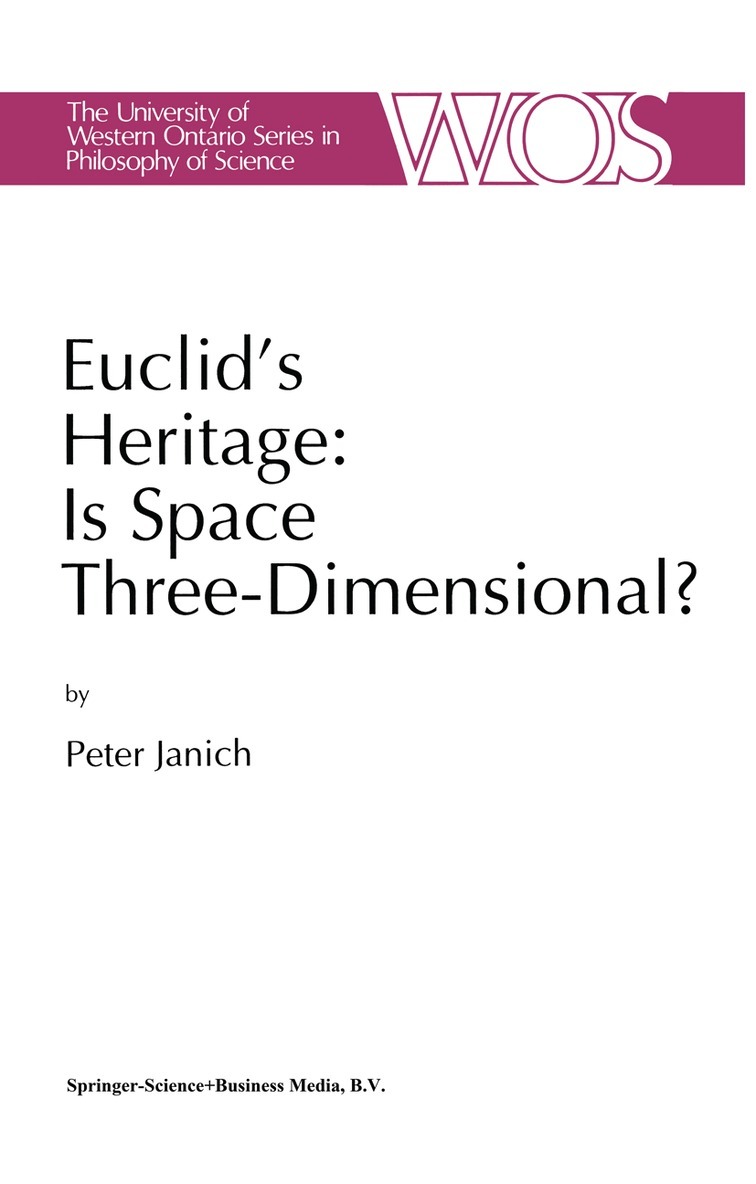
The three spatial characteristics of length, height and depth are used in the same unreflective way by laymen, technicians and scientists alike to describe the forms, positions and measure of bodies and hollow bodies. But how do we know that the space we live in has just three dimensions? This question has occupied philosophers and scientists since antiquity. The answers proposed have become ever more presumptuous and have increasingly lost sight of everyday intuitions and have sacrificed explanatory power. In this work, Peter Janich shows that all explanations of three-dimensionality hinge on an unreflective geometrical language which seems to accept the lack of an alternative for the three sorts of entities - lines, planes and solids. This is a Euclidean heritage in a dual sense. Euclid himself adopted a geometrical language from the art of figure drawing, and left a tradition of doing geometry as planimetry and of doing steremetry by rotating plane figures. The systematic approach offered here starts out from operational definitions of the spatial forms - plane, straight edge and perpendicularity - and proofs that only three planes can intersect pairwise orthogonally.This is the constructive solution in the frame theory of action, providing an unequivocal characterization of spatial relations in the physical world. The traditional order of geometric concepts turns out to be the most important obstacle to the methodical ordering of everyday scientific concepts.
Inbunden, Tyska, 2002
1 316 kr
Skickas inom 10-15 vardagar
Die interdisziplinär besetzte Projektgruppe Biodiversität der Europäischen Akademie Bad Neuenahr-Ahrweiler hat sich die Aufgabe gestellt, den wissenschaftlichen Sachstand aus den verschiedenen Disziplinen zusammenzutragen und die diversen, auf der Grundlage fachspezifischer Methoden entwickelten Konzepte gemeinsam zu untersuchen.In den in diesem Band versammelten Ergebnissen finden sich entsprechend neben den rein naturwissenschaftlichen auch relevante erkenntnis- und wissenschaftstheoretische Fragen sowie juristische und ökonomische Aspekte diskutiert. Damit bietet das Buch einen guten Überblick über den Diskussionsstand und eine solide Grundlage für die weitere wissenschaftliche Diskussion.
E-bok
PDF, Tyska, 20131 336 kr
Läs direkt efter köp
Die interdisziplinär besetzte Projektgruppe Biodiversität der Europäischen Akademie Bad Neuenahr-Ahrweiler hat sich die Aufgabe gestellt, den wissenschaftlichen Sachstand aus den verschiedenen Disziplinen zusammenzutragen und die diversen, auf der Grundlage fachspezifischer Methoden entwickelten Konzepte gemeinsam zu untersuchen.In den in diesem Band versammelten Ergebnissen finden sich entsprechend neben den rein naturwissenschaftlichen auch relevante erkenntnis- und wissenschaftstheoretische Fragen sowie juristische und ökonomische Aspekte diskutiert. Damit bietet das Buch einen guten Überblick über den Diskussionsstand und eine solide Grundlage für die weitere wissenschaftliche Diskussion.
Häftad, Tyska, 2012
1 122 kr
Skickas inom 5-8 vardagar
Die interdisziplinär besetzte Projektgruppe Biodiversität der Europäischen Akademie Bad Neuenahr-Ahrweiler hat sich die Aufgabe gestellt, den wissenschaftlichen Sachstand aus den verschiedenen Disziplinen zusammenzutragen und die diversen, auf der Grundlage fachspezifischer Methoden entwickelten Konzepte gemeinsam zu untersuchen.In den in diesem Band versammelten Ergebnissen finden sich entsprechend neben den rein naturwissenschaftlichen auch relevante erkenntnis- und wissenschaftstheoretische Fragen sowie juristische und ökonomische Aspekte diskutiert. Damit bietet das Buch einen guten Überblick über den Diskussionsstand und eine solide Grundlage für die weitere wissenschaftliche Diskussion.
Inbunden, Engelska, 1985
1 623 kr
Skickas inom 10-15 vardagar
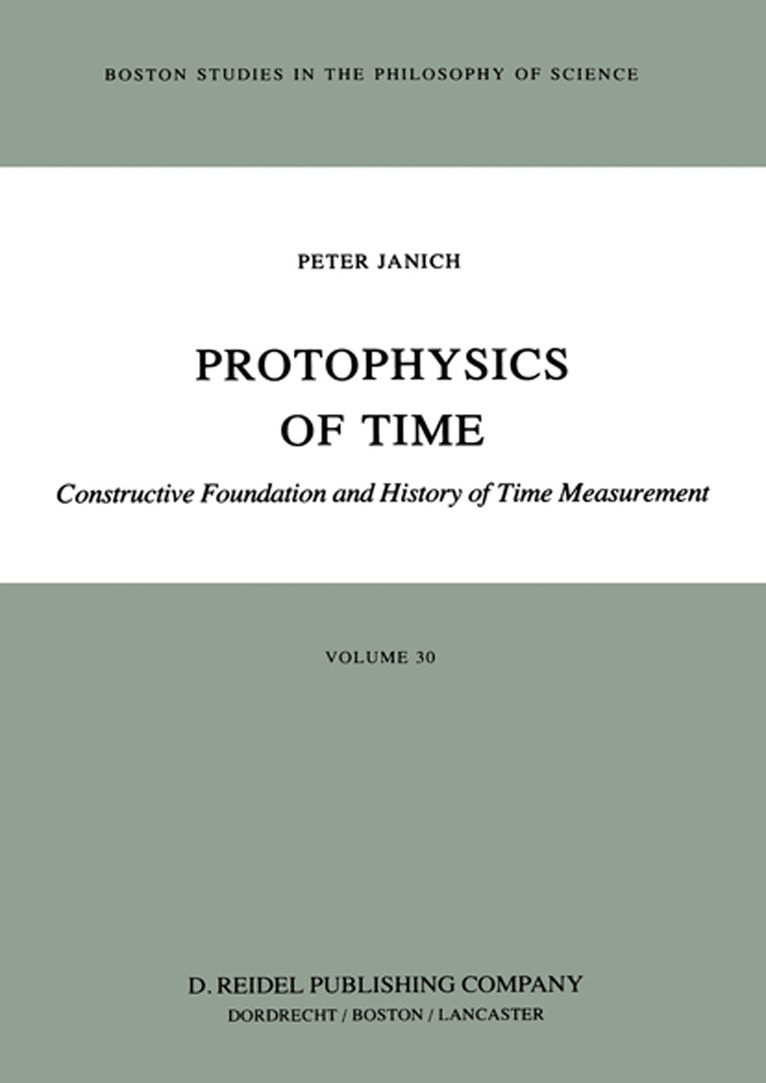
For protophysics, the fascinating and impressive constructive re-establish ment of the foundations of science by Professor Paul Lorenzen, working with his colleagues and students of the Erlangen School, no task is more central than to.furmulate a theoretical understanding of the practical art of measurement of time. We are pleased, therefore, to have a new third edition of Peter Janich's masterful monograph on the protophysics of time, available in this English translation within the Boston Studies. We also look forward to the Boston University Symposium on protophysics in april of this year within which the full program of protophysics will be critically examined by German and American physicists and philosophers, supporters and critics. We are also grateful to Paul Lorenzen for contributing his powerful instructive essay on the 'axiomatic and constructive method' which intro duces this book. March 1985 ROBERT S. COHEN Center for the Philosophy and History of Science Boston University MARX W. WARTOFSKY Department of Philosophy Barnch College City University of New York vii PAUL LORENZEN CONSTRUCTIVE AND AXIOM A TIC METHOD Mathematics is like a big building with many apartments. We have at least Arithmetic and Analysis, Algebra and Topology - and we have Geometry and Probability-Theory. Very often the tenants of these different apartments seem not to understand each other. The Bourbaki movement promised a new unity of Mathematics by admit ting only the axiomatic method of Hilbert as genuine mathematical.
Del 52 - Western Ontario Series in Philosophy of Science
Euclid's Heritage. Is Space Three-Dimensional?
Häftad, Engelska, 2010
1 084 kr
Skickas inom 10-15 vardagar
We live in a space, we get about in it. We also quantify it, we think of it as having dimensions. Ever since Euclid's ancient geometry, we have thought of bodies occupying parts of this space (including our own bodies), the space of our practical orientations (our 'moving abouts'), as having three dimensions. Bodies have volume specified by measures of length, breadth and height. But how do we know that the space we live in has just these three dimensions? It is theoreti cally possible that some spaces might exist that are not correctly described by Euclidean geometry. After all, there are the non Euclidian geometries, descriptions of spaces not conforming to the axioms and theorems of Euclid's geometry. As one might expect, there is a history of philosophers' attempts to 'prove' that space is three-dimensional. The present volume surveys these attempts from Aristotle, through Leibniz and Kant, to more recent philosophy. As you will learn, the historical theories are rife with terminology, with language, already tainted by the as sumed, but by no means obvious, clarity of terms like 'dimension', 'line', 'point' and others. Prior to that language there are actions, ways of getting around in the world, building things, being interested in things, in the more specific case of dimensionality, cutting things. It is to these actions that we must eventually appeal if we are to understand how science is grounded.
E-bok
PDF, Engelska, 20122 110 kr
Läs direkt efter köp
For protophysics, the fascinating and impressive constructive re-establish ment of the foundations of science by Professor Paul Lorenzen, working with his colleagues and students of the Erlangen School, no task is more central than to.furmulate a theoretical understanding of the practical art of measurement of time. We are pleased, therefore, to have a new third edition of Peter Janich''s masterful monograph on the protophysics of time, available in this English translation within the Boston Studies. We also look forward to the Boston University Symposium on protophysics in april of this year within which the full program of protophysics will be critically examined by German and American physicists and philosophers, supporters and critics. We are also grateful to Paul Lorenzen for contributing his powerful instructive essay on the ''axiomatic and constructive method'' which intro duces this book. March 1985 ROBERT S. COHEN Center for the Philosophy and History of Science Boston University MARX W. WARTOFSKY Department of Philosophy Barnch College City University of New York vii PAUL LORENZEN CONSTRUCTIVE AND AXIOM A TIC METHOD Mathematics is like a big building with many apartments. We have at least Arithmetic and Analysis, Algebra and Topology - and we have Geometry and Probability-Theory. Very often the tenants of these different apartments seem not to understand each other. The Bourbaki movement promised a new unity of Mathematics by admit ting only the axiomatic method of Hilbert as genuine mathematical.
Del 30 - Boston Studies in the Philosophy and History of Science
Protophysics of Time
Constructive Foundation and History of Time Measurement
Häftad, Engelska, 2011
1 671 kr
Skickas inom 10-15 vardagar
For protophysics, the fascinating and impressive constructive re-establish ment of the foundations of science by Professor Paul Lorenzen, working with his colleagues and students of the Erlangen School, no task is more central than to.furmulate a theoretical understanding of the practical art of measurement of time. We are pleased, therefore, to have a new third edition of Peter Janich's masterful monograph on the protophysics of time, available in this English translation within the Boston Studies. We also look forward to the Boston University Symposium on protophysics in april of this year within which the full program of protophysics will be critically examined by German and American physicists and philosophers, supporters and critics. We are also grateful to Paul Lorenzen for contributing his powerful instructive essay on the 'axiomatic and constructive method' which intro duces this book. March 1985 ROBERT S. COHEN Center for the Philosophy and History of Science Boston University MARX W. WARTOFSKY Department of Philosophy Barnch College City University of New York vii PAUL LORENZEN CONSTRUCTIVE AND AXIOM A TIC METHOD Mathematics is like a big building with many apartments. We have at least Arithmetic and Analysis, Algebra and Topology - and we have Geometry and Probability-Theory. Very often the tenants of these different apartments seem not to understand each other. The Bourbaki movement promised a new unity of Mathematics by admit ting only the axiomatic method of Hilbert as genuine mathematical.
E-bok
PDF, Engelska, 20131 379 kr
Läs direkt efter köp
We live in a space, we get about in it. We also quantify it, we think of it as having dimensions. Ever since Euclid''s ancient geometry, we have thought of bodies occupying parts of this space (including our own bodies), the space of our practical orientations (our ''moving abouts''), as having three dimensions. Bodies have volume specified by measures of length, breadth and height. But how do we know that the space we live in has just these three dimensions? It is theoreti cally possible that some spaces might exist that are not correctly described by Euclidean geometry. After all, there are the non Euclidian geometries, descriptions of spaces not conforming to the axioms and theorems of Euclid''s geometry. As one might expect, there is a history of philosophers'' attempts to ''prove'' that space is three-dimensional. The present volume surveys these attempts from Aristotle, through Leibniz and Kant, to more recent philosophy. As you will learn, the historical theories are rife with terminology, with language, already tainted by the as sumed, but by no means obvious, clarity of terms like ''dimension'', ''line'', ''point'' and others. Prior to that language there are actions, ways of getting around in the world, building things, being interested in things, in the more specific case of dimensionality, cutting things. It is to these actions that we must eventually appeal if we are to understand how science is grounded.