Pal Revesz – författare
Visar alla böcker från författaren Pal Revesz. Handla med fri frakt och snabb leverans.
6 produkter
6 produkter
E-bok
PDF, Engelska, 2014344 kr
Läs direkt efter köp
The Law of Large Numbers deals with three types of law of large numbers according to the following convergences: stochastic, mean, and convergence with probability 1. The book also investigates the rate of convergence and the laws of the iterated logarithm. It reviews measure theory, probability theory, stochastic processes, ergodic theory, orthogonal series, Huber spaces, Banach spaces, as well as the special concepts and general theorems of the laws of large numbers. The text discusses the laws of large numbers of different classes of stochastic processes, such as independent random variables, orthogonal random variables, stationary sequences, symmetrically dependent random variables and their generalizations, and also Markov chains. It presents other laws of large numbers for subsequences of sequences of random variables, including some general laws of large numbers which are not related to any concrete class of stochastic processes. The text cites applications of the theorems, as in numbers theory, statistics, and information theory. The text is suitable for mathematicians, economists, scientists, statisticians, or researchers involved with the probability and relative frequency of large numbers.
Del 1 - Advanced Series on Statistical Science & Applied Probability
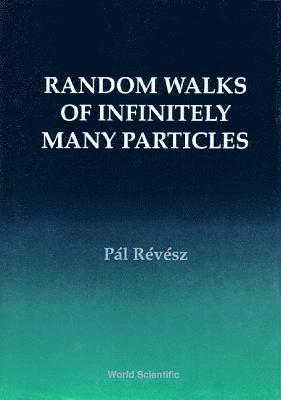
Random Walks Of Infinitely Many Particles
Inbunden, Engelska, 1994
1 206 kr
Skickas inom 5-8 vardagar
The author's previous book, Random Walk in Random and Non-Random Environments, was devoted to the investigation of the Brownian motion of a simple particle. The present book studies the independent motions of infinitely many particles in the d-dimensional Euclidean space Rd. In Part I the particles at time t = 0 are distributed in Rd according to the law of a given random field and they execute independent random walks. Part II is devoted to branching random walks, i.e. to the case where the particles execute random motions and birth and death processes independently. Finally, in Part III, functional laws of iterated logarithms are proved for the cases of independent motions and branching processes.
Inbunden, Engelska, 2005
2 715 kr
Skickas inom 5-8 vardagar
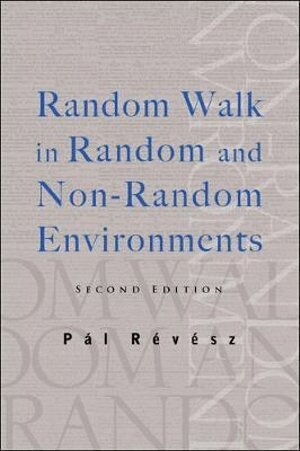
The simplest mathematical model of the Brownian motion of physics is the simple, symmetric random walk. This book collects and compares current results — mostly strong theorems which describe the properties of a random walk. The modern problems of the limit theorems of probability theory are treated in the simple case of coin tossing. Taking advantage of this simplicity, the reader is familiarized with limit theorems (especially strong ones) without the burden of technical tools and difficulties. An easy way of considering the Wiener process is also given, through the study of the random walk.Since the first edition was published in 1990, a number of new results have appeared in the literature. The original edition contained many unsolved problems and conjectures which have since been settled; this second revised and enlarged edition includes those new results. Three new chapters have been added: frequently and rarely visited points, heavy points and long excursions. This new edition presents the most complete study of, and the most elementary way to study, the path properties of the Brownian motion.
Inbunden, Engelska, 2013
2 012 kr
Skickas inom 3-6 vardagar
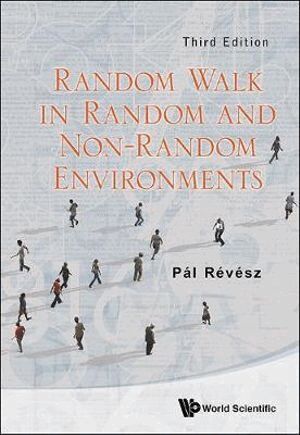
The simplest mathematical model of the Brownian motion of physics is the simple, symmetric random walk. This book collects and compares current results — mostly strong theorems which describe the properties of a random walk. The modern problems of the limit theorems of probability theory are treated in the simple case of coin tossing. Taking advantage of this simplicity, the reader is familiarized with limit theorems (especially strong ones) without the burden of technical tools and difficulties. An easy way of considering the Wiener process is also given, through the study of the random walk.Since the first and second editions were published in 1990 and 2005, a number of new results have appeared in the literature. The first two editions contained many unsolved problems and conjectures which have since been settled; this third, revised and enlarged edition includes those new results. In this edition, a completely new part is included concerning Simple Random Walks on Graphs. Properties of random walks on several concrete graphs have been studied in the last decade. Some of the obtained results are also presented.
Inbunden, Engelska, 1990
1 085 kr
Tillfälligt slut
This book collects and compares the results — mostly strong theorems which describe the properties of a simple symmetric random walk. The newest problems of limit theorems of probability theory are treated in the very simple case of coin tossing. Using the advantage of this simple situation, the reader can become familiar with limit theorems (especially strong ones) without suffering from technical tools and difficulties. A simple way to the study of the Wiener process is also given, through the study of the random walk. This book presents the most complete study of, and the most elementary way to the study of, the path properties of the Wiener process; and the most elementary way to the study of the strong theorems of probability theory.
Häftad, Engelska, 1990
446 kr
Tillfälligt slut
This book collects and compares the results — mostly strong theorems which describe the properties of a simple symmetric random walk. The newest problems of limit theorems of probability theory are treated in the very simple case of coin tossing. Using the advantage of this simple situation, the reader can become familiar with limit theorems (especially strong ones) without suffering from technical tools and difficulties. A simple way to the study of the Wiener process is also given, through the study of the random walk. This book presents the most complete study of, and the most elementary way to the study of, the path properties of the Wiener process; and the most elementary way to the study of the strong theorems of probability theory.