Paolo Pasini - Böcker
Visar alla böcker från författaren Paolo Pasini. Handla med fri frakt och snabb leverans.
6 produkter
6 produkter
1 059 kr
Skickas inom 10-15 vardagar
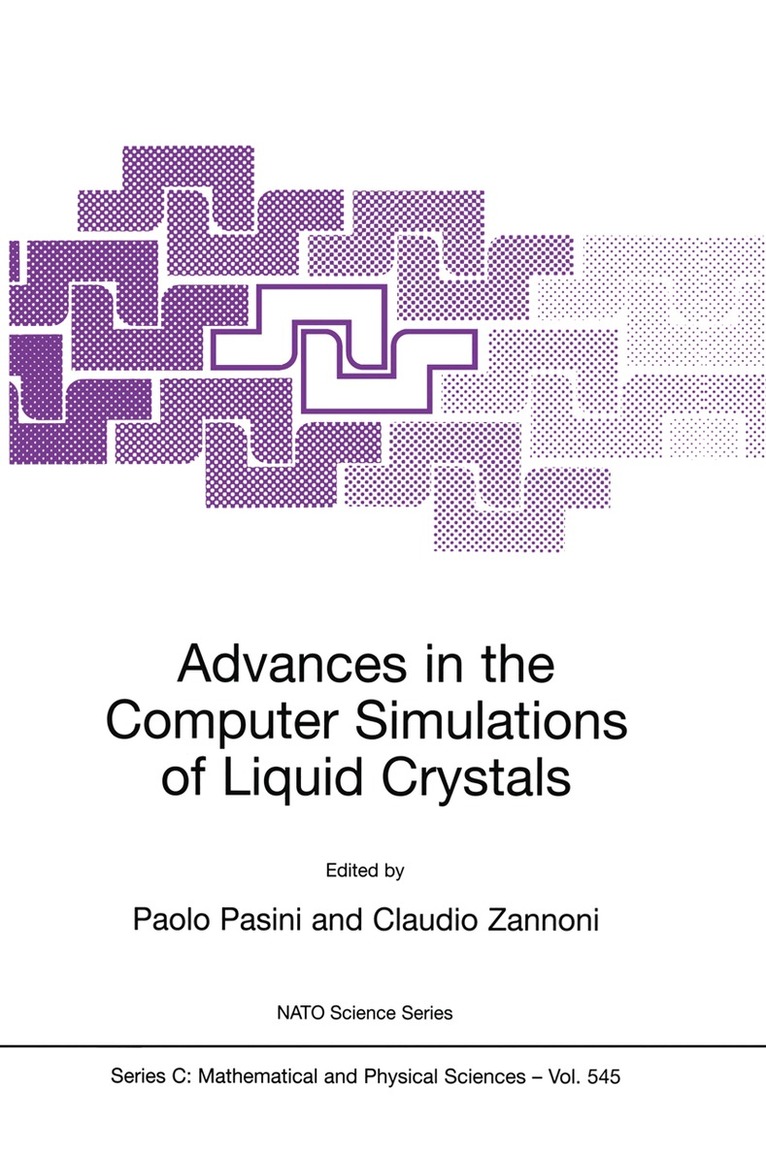
Computer simulations provide an essential set of tools for understanding the macroscopic properties of liquid crystals and of their phase transitions in terms of molecular models. While simulations of liquid crystals are based on the same general Monte Carlo and molecular dynamics techniques as are used for other fluids, they present a number of specific problems and peculiarities connected to the intrinsic properties of these mesophases. The field of computer simulations of anisotropic fluids is interdisciplinary and is evolving very rapidly. The present volume covers a variety of techniques and model systems, from lattices to hard particle and Gay-Berne to atomistic, for thermotropics, lyotropics, and some biologically interesting liquid crystals.
1 059 kr
Skickas inom 10-15 vardagar
Computer simulations provide an essential set of tools for understanding the macroscopic properties of liquid crystals and of their phase transitions in terms of molecular models. While simulations of liquid crystals are based on the same general Monte Carlo and molecular dynamics techniques as are used for other fluids, they present a number of specific problems and peculiarities connected to the intrinsic properties of these mesophases. The field of computer simulations of anisotropic fluids is interdisciplinary and is evolving very rapidly. The present volume covers a variety of techniques and model systems, from lattices to hard particle and Gay-Berne to atomistic, for thermotropics, lyotropics, and some biologically interesting liquid crystals.
1 585 kr
Skickas inom 10-15 vardagar
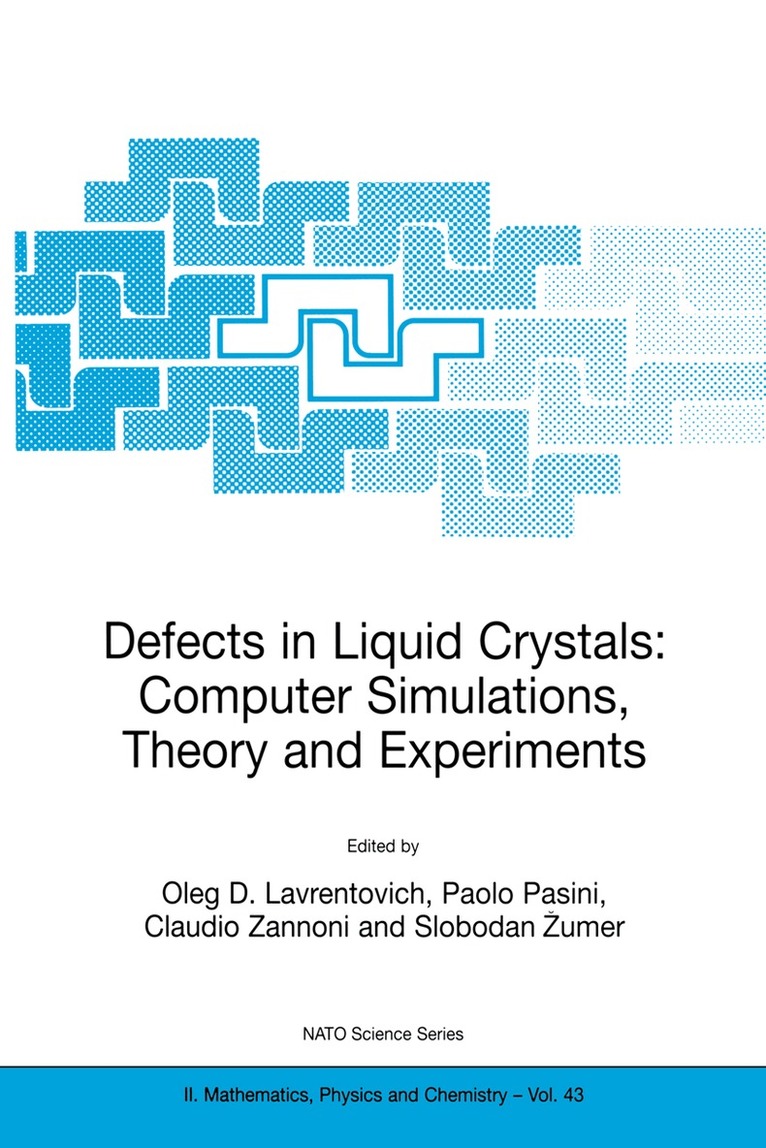
Topological defects have an attraction in many different branches of physics ranging from cosmology to liquid crystals and from elementary particles to colloids and biological systems. The experimental and theoretical results on defects in liquid crystals are increasing rapidly, particularly in heterogeneous systems such as liquid crystal dispersions and emulsions. Interest is also driven by the technological potential of these systems. Microscopic organizations in systems with defects are much more complex than in uniform systems, meaning that molecular level theories rapidly become inadequate. Computer simulations thus become a useful tool for studying topological defects in liquid crystals, starting from microscopic molecular interactions. These have matured to successfully capture such features as order parameter gradients both in the core of defects and far from it. Further simulations can incorporate the role of bulk elasticity, surface interactions and external electromagnetic fields. This book provides coverage of these issues and also considers a number of open problems which can now be tackled.Emphasis is on the use of computer simulations to test and to complement theoretical predictions, explain experimental observations and suggest new experiments.
1 585 kr
Skickas inom 10-15 vardagar
Topological defects have an attraction in many different branches of physics ranging from cosmology to liquid crystals and from elementary particles to colloids and biological systems. The experimental and theoretical results on defects in liquid crystals are increasing rapidly, particularly in heterogeneous systems such as liquid crystal dispersions and emulsions. Interest is also driven by the technological potential of these systems. Microscopic organizations in systems with defects are much more complex than in uniform systems, meaning that molecular level theories rapidly become inadequate. Computer simulations thus become a useful tool for studying topological defects in liquid crystals, starting from microscopic molecular interactions. These have matured to successfully capture such features as order parameter gradients both in the core of defects and far from it. Further simulations can incorporate the role of bulk elasticity, surface interactions and external electromagnetic fields. This book provides coverage of these issues and also considers a number of open problems which can now be tackled.Emphasis is on the use of computer simulations to test and to complement theoretical predictions, explain experimental observations and suggest new experiments.
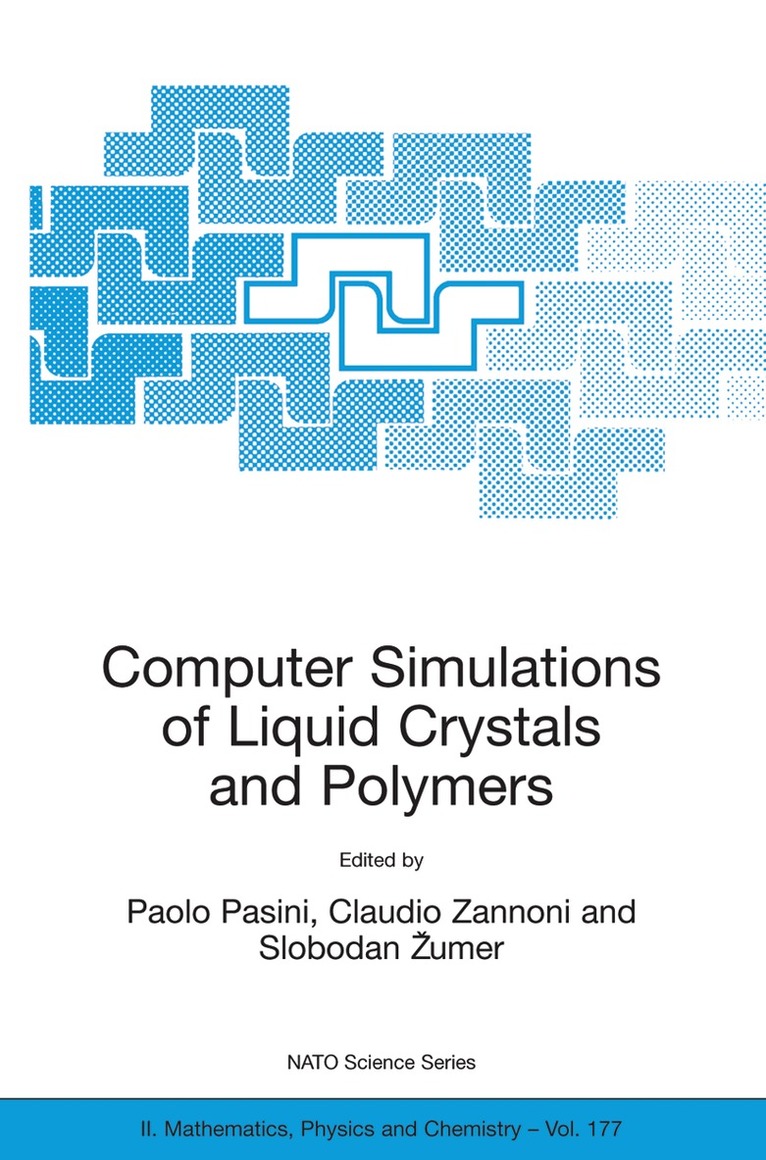
Computer Simulations of Liquid Crystals and Polymers
Proceedings of the NATO Advanced Research Workshop on Computational Methods for Polymers and Liquid Crystalline Polymers, Erice, Italy. 16-22 July 2003
Inbunden, Engelska, 2005
3 163 kr
Skickas inom 10-15 vardagar
Liquid crystals, polymers and polymer liquid crystals are soft condensed matter systems of major technological and scientific interest. An understanding of the macroscopic properties of these complex systems and of their many and interesting peculiarities at the molecular level can nowadays only be attained using computer simulations and statistical mechanical theories. Both in the Liquid Crystal and Polymer fields a considerable amount of simulation work has been done in the last few years with various classes of models at different special resolutions, ranging from atomistic to molecular and coarse-grained lattice models. Each of the two fields has developed its own set of tools and specialized procedures and the book aims to provide a state of the art review of the computer simulation studies of polymers and liquid crystals. This is of great importance in view of a potential cross-fertilization between these connected areas which is particularly apparent for a number of experimental systems like, e.g. polymer liquid crystals and anisotropic gels where the different fields necessarily merge. An effort has been made to assess the possibilities of a coherent description of the themes that have developed independently, and to compare and extend the theoretical and computational techniques put forward in the different areas.
3 163 kr
Skickas inom 10-15 vardagar
Liquid crystals, polymers and polymer liquid crystals are soft condensed matter systems of major technological and scientific interest. An understanding of the macroscopic properties of these complex systems and of their many and interesting peculiarities at the molecular level can nowadays only be attained using computer simulations and statistical mechanical theories. Both in the Liquid Crystal and Polymer fields a considerable amount of simulation work has been done in the last few years with various classes of models at different special resolutions, ranging from atomistic to molecular and coarse-grained lattice models. Each of the two fields has developed its own set of tools and specialized procedures and the book aims to provide a state of the art review of the computer simulation studies of polymers and liquid crystals. This is of great importance in view of a potential cross-fertilization between these connected areas which is particularly apparent for a number of experimental systems like, e.g. polymer liquid crystals and anisotropic gels where the different fields necessarily merge. An effort has been made to assess the possibilities of a coherent description of the themes that have developed independently, and to compare and extend the theoretical and computational techniques put forward in the different areas.