Paul Diesing – författare
Visar alla böcker från författaren Paul Diesing. Handla med fri frakt och snabb leverans.
18 produkter
18 produkter
Häftad, Engelska, 2005
695 kr
Skickas inom 10-15 vardagar
The purpose of this book is to examine how ideology operates - in the sense of influencing the conduct of inquiry - in the policy sciences, defined as economics, political science, and sociology. In it, Diesing critically explores all the major schools of policy-related social thought from 1930 to 1975. Richard Hartwig, in his new introduction, notes, 'In 1982, Diesing published a remarkable book entitled Science and Ideology in the Policy Sciences. [It] was the best book I had read in a decade, and it related directly to all the policy sciences…. I consider this to be the most brilliant of Diesing's books. Like all of Diesing's works, it remains highly relevant today.'
Häftad, Engelska, 2008
779 kr
Skickas inom 10-15 vardagar
Social scientists are often vexed because their work does not satisfy the criteria of "scientific" methodology developed by philosophers of science and logicians who use the natural sciences as their model. In this study, Paul Diesing defines science not by reference to these arbitrary norms delineated by those outside the field but in terms of norms implicit in what social scientists actually do in their everyday work.
Inbunden, Engelska, 2019
2 183 kr
Skickas inom 10-15 vardagar
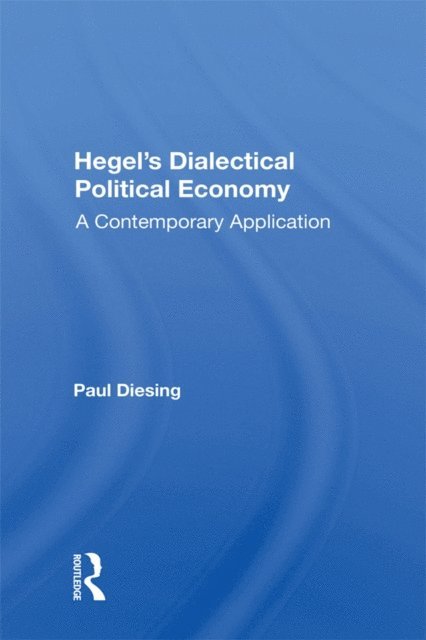
This book demonstrates how Hegel's dialectic can be used in empirical research, and shows how one can do dialectical research in economics. It also shows how one can use dialectical thinking to interpret some personal or social or political problem and devise a possible solution.
Häftad, Engelska, 2020
639 kr
Skickas inom 10-15 vardagar
This book demonstrates how Hegel's dialectic can be used in empirical research, and shows how one can do dialectical research in economics. It also shows how one can use dialectical thinking to interpret some personal or social or political problem and devise a possible solution.
E-bok
PDF, Engelska, 2019730 kr
Läs direkt efter köp
This book demonstrates how Hegel''s dialectic can be used in empirical research, and shows how one can do dialectical research in economics. It also shows how one can use dialectical thinking to interpret some personal or social or political problem and devise a possible solution.
E-bok
Engelska, 2019757 kr
Läs direkt efter köp
This book demonstrates how Hegel''s dialectic can be used in empirical research, and shows how one can do dialectical research in economics. It also shows how one can use dialectical thinking to interpret some personal or social or political problem and devise a possible solution.
Häftad, Engelska, 2015
797 kr
Skickas inom 5-8 vardagar
How do nations act in a crisis? This book seeks to answer that question both theoretically and historically. It tests and synthesizes theories of political behavior by comparing them with the historical record. The authors apply theories of bargaining, game theory, information processing, decision-making, and international systems to case histories of sixteen crises that occurred during a seventy-five year period. The result is a revision and integration of diverse concepts and the development of a new empirical theory of international conflict. Originally published in 1978. The Princeton Legacy Library uses the latest print-on-demand technology to again make available previously out-of-print books from the distinguished backlist of Princeton University Press. These editions preserve the original texts of these important books while presenting them in durable paperback and hardcover editions. The goal of the Princeton Legacy Library is to vastly increase access to the rich scholarly heritage found in the thousands of books published by Princeton University Press since its founding in 1905.
Inbunden, Engelska, 2016
3 787 kr
Skickas inom 3-6 vardagar
How do nations act in a crisis? This book seeks to answer that question both theoretically and historically. It tests and synthesizes theories of political behavior by comparing them with the historical record. The authors apply theories of bargaining, game theory, information processing, decision-making, and international systems to case histories of sixteen crises that occurred during a seventy-five year period. The result is a revision and integration of diverse concepts and the development of a new empirical theory of international conflict. Originally published in 1978. The Princeton Legacy Library uses the latest print-on-demand technology to again make available previously out-of-print books from the distinguished backlist of Princeton University Press. These editions preserve the original texts of these important books while presenting them in durable paperback and hardcover editions. The goal of the Princeton Legacy Library is to vastly increase access to the rich scholarly heritage found in the thousands of books published by Princeton University Press since its founding in 1905.
Häftad, Engelska, 1992
784 kr
Skickas inom 5-8 vardagar
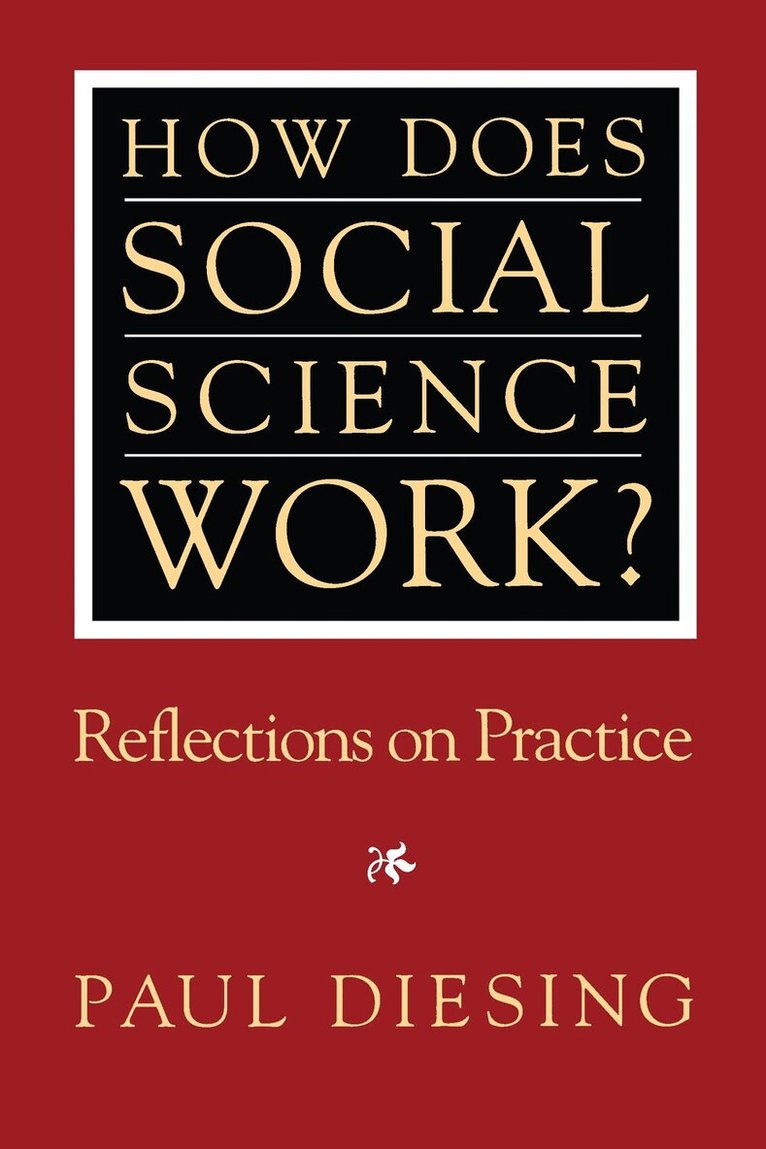
The culmination of a lifetime spent in a variety of fields - sociology, anthropology, economics, psychology, and philosophy of science - How Does Social Science Work? takes an innovative, sometimes iconoclastic look at social scientists at work in many disciplines. It describes how they investigate and the kinds of truth they produce, illuminating the weaknesses and dangers inherent in their research.At once an analysis, a critique, and a synthesis, this major study begins by surveying philosophical approaches to hermeneutics, to examine the question of how social science ought to work. It illustrates many of its arguments with untraditional examples, such as the reception of the work of the political biographer Robert Caro to show the hermeneutical problems of ethnographers. The major part of the book surveys sociological, political, and psychological studies of social science to get a rounded picture of how social science works,Paul Diesling warns that "social science exists between two opposite kinds of degeneration, a value-free professionalism that lives only for publications that show off the latest techniques, and a deep social concern that uses science for propaganda." He argues for greater self-awareness and humility among social scientists, although he notes that "some social scientists . . . will angrily reject the thought that their personality affects their research in any way."This profound and sometimes witty book will appeal to students and practitioners in the social sciences who are ready to take a fresh look at their field. An extensive bibliography provides a wealth of references across an array of social science disciplines.
Inbunden, Engelska, 2021
466 kr
Skickas inom 3-6 vardagar
Häftad, Engelska, 2021
355 kr
Skickas inom 3-6 vardagar
Inbunden, Engelska, 2017
2 773 kr
Skickas inom 3-6 vardagar
Social scientists are often vexed because their work does not satisfy the criteria of "scientific" methodology developed by philosophers of science and logicians who use the natural sciences as their model. In this study, Paul Diesing defines science not by reference to these arbitrary norms delineated by those outside the field but in terms of norms implicit in what social scientists actually do in their everyday work.
Inbunden, Engelska, 2017
2 183 kr
Skickas inom 10-15 vardagar
The purpose of this book is to examine how ideology operates - in the sense of influencing the conduct of inquiry - in the policy sciences, defined as economics, political science, and sociology. In it, Diesing critically explores all the major schools of policy-related social thought from 1930 to 1975. Richard Hartwig, in his new introduction, notes, 'In 1982, Diesing published a remarkable book entitled Science and Ideology in the Policy Sciences. [It] was the best book I had read in a decade, and it related directly to all the policy sciences…. I consider this to be the most brilliant of Diesing's books. Like all of Diesing's works, it remains highly relevant today.'
E-bok
Engelska, 2017824 kr
Läs direkt efter köp
The purpose of this book is to examine how ideology operates--in the sense of influencing the conduct of inquiry--in the policy sciences, defined as economics, political science, and sociology. The author seeks to identify the main ideologies and show how each ideology produces a preference for certain problems, methods, and hypotheses; how it sensitizes scientists to certain phenomena and suggests certain interpretations of those phenomena; and how it closes off other phenomena and concepts from investigation and testing, or at least distorts that investigation. In this book, Diesing critically examines all the major schools of policy-related social thought from 1930 to 1975. He deals with Neoclassical Economics and its various applications, the Keynesians, the Systems Approach, the Schumpeter perspective, the Critical Intellectuals, the Pluralists, the J. K. Galbraith School, New Left Marxism, and the Ecological Paradigm of Schumacher and others. The world looks different if your perspective is that of a rational small businessman working in a society of hypothetical perfect competition, as opposed to that of a proletarian, looking up at your oppressors. Part One is descriptive and evaluative, considering each ideology in turn; Part Two considers the policy implications. "In 1982, Diesing published a remarkable book entitled Science and Ideology in the Policy Sciences. When I interviewed Diesing in Buffalo in the summer of 1984, he told me that to date, the publication had been reviewed in only two professional journals. I was astounded. Science & Ideology...was the best book I had read in a decade, and it related directly to all the policy sciences. The lack of professional response may partially reflect Diesing''s disinterest in self-promotion, but beyond this is the ''community'' problem. Scholars are recognized within disciplines, but there is only a tiny ''community of social science''. I consider this to be the most brilliant of Diesing''s books. Like all of Diesing''s works, it remains highly relevant today."--from the introduction by Richard Hartwig.

E-bok
PDF, Engelska, 2017824 kr
Läs direkt efter köp
The purpose of this book is to examine how ideology operates--in the sense of influencing the conduct of inquiry--in the policy sciences, defined as economics, political science, and sociology. The author seeks to identify the main ideologies and show how each ideology produces a preference for certain problems, methods, and hypotheses; how it sensitizes scientists to certain phenomena and suggests certain interpretations of those phenomena; and how it closes off other phenomena and concepts from investigation and testing, or at least distorts that investigation. In this book, Diesing critically examines all the major schools of policy-related social thought from 1930 to 1975. He deals with Neoclassical Economics and its various applications, the Keynesians, the Systems Approach, the Schumpeter perspective, the Critical Intellectuals, the Pluralists, the J. K. Galbraith School, New Left Marxism, and the Ecological Paradigm of Schumacher and others. The world looks different if your perspective is that of a rational small businessman working in a society of hypothetical perfect competition, as opposed to that of a proletarian, looking up at your oppressors. Part One is descriptive and evaluative, considering each ideology in turn; Part Two considers the policy implications. "In 1982, Diesing published a remarkable book entitled Science and Ideology in the Policy Sciences. When I interviewed Diesing in Buffalo in the summer of 1984, he told me that to date, the publication had been reviewed in only two professional journals. I was astounded. Science & Ideology...was the best book I had read in a decade, and it related directly to all the policy sciences. The lack of professional response may partially reflect Diesing''s disinterest in self-promotion, but beyond this is the ''community'' problem. Scholars are recognized within disciplines, but there is only a tiny ''community of social science''. I consider this to be the most brilliant of Diesing''s books. Like all of Diesing''s works, it remains highly relevant today."--from the introduction by Richard Hartwig.
E-bok
Engelska, 2017925 kr
Läs direkt efter köp
Social scientists are often vexed because their work does not satisfy the criteria of "scientific" methodology developed by philosophers of science and logicians who use the natural sciences as their model. In this study, Paul Diesing defines science not by reference to these arbitrary norms delineated by those outside the field but in terms of norms implicit in what social scientists actually do in their everyday work.
E-bok
PDF, Engelska, 2017925 kr
Läs direkt efter köp
Social scientists are often vexed because their work does not satisfy the criteria of "scientific" methodology developed by philosophers of science and logicians who use the natural sciences as their model. In this study, Paul Diesing defines science not by reference to these arbitrary norms delineated by those outside the field but in terms of norms implicit in what social scientists actually do in their everyday work.
E-bok
PDF, Engelska, 20151 121 kr
Läs direkt efter köp
How do nations act in a crisis? This book seeks to answer that question both theoretically and historically. It tests and synthesizes theories of political behavior by comparing them with the historical record. The authors apply theories of bargaining, game theory, information processing, decision-making, and international systems to case histories of sixteen crises that occurred during a seventy-five year period. The result is a revision and integration of diverse concepts and the development of a new empirical theory of international conflict.Originally published in 1978.The Princeton Legacy Library uses the latest print-on-demand technology to again make available previously out-of-print books from the distinguished backlist of Princeton University Press. These editions preserve the original texts of these important books while presenting them in durable paperback and hardcover editions. The goal of the Princeton Legacy Library is to vastly increase access to the rich scholarly heritage found in the thousands of books published by Princeton University Press since its founding in 1905.