Paul Kovacs – författare
Visar alla böcker från författaren Paul Kovacs. Handla med fri frakt och snabb leverans.
4 produkter
4 produkter
Inbunden, Engelska, 2025
3 027 kr
Skickas inom 5-8 vardagar
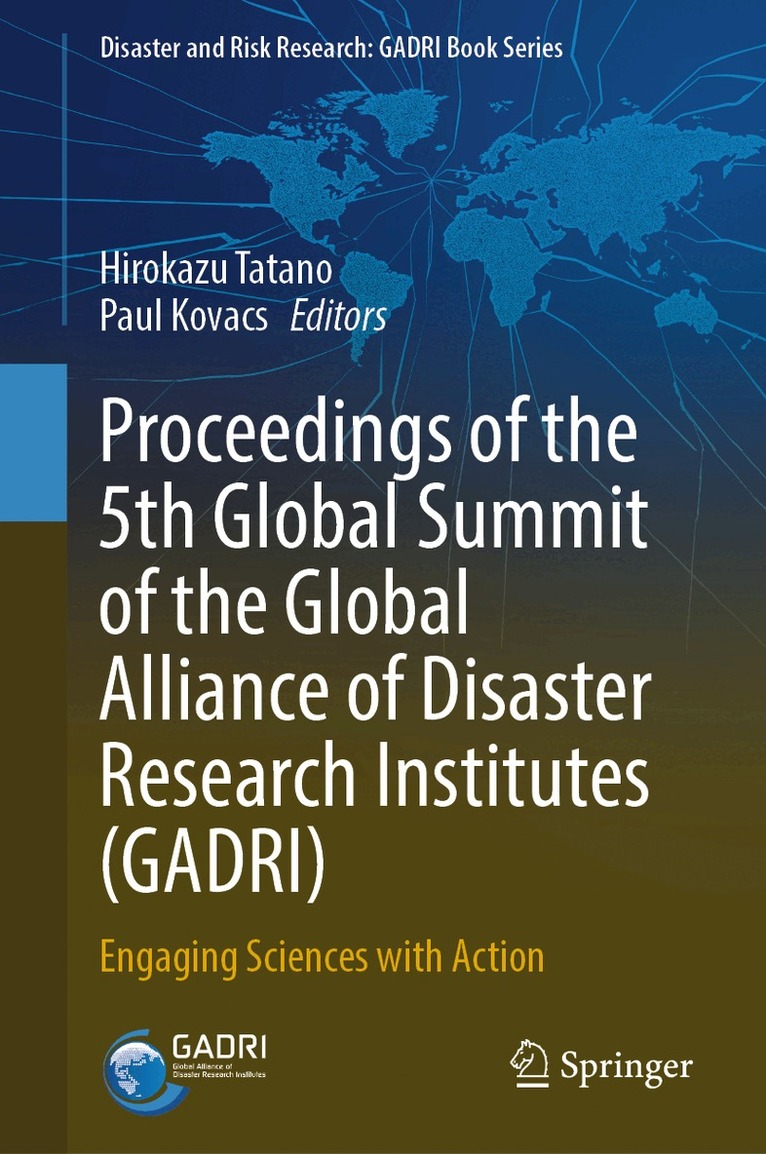
This book presents selected papers from the 5th Global Summit of the Global Alliance of Disaster Research Institutes (GADRI)—Engaging Sciences with Action, which was held virtually and regionally from 31 August to 1 September 2021. The Summit reappraised progress and achievements in disaster risk reduction research by the members towards the targets of the science and technology roadmap to implement the goals and priorities of the Sendai Framework for Disaster Risk Reduction 2015–2030. The programme communicated academic science across various scientific disciplines to policymakers and practitioners. This cross-disciplinary aspect is important for academics to be aware of how science can directly contribute to mitigate national and local disasters, for example, the global pandemic COVID-19, earthquakes and volcanic eruptions. The Global Summit of GADRI was attentive to the necessary influence of the Global Alliance and its supporting regional alliances to reflect disaster research into the outcome of the United Nations Climate Change Conference of the Parties (COP26) that took place in Glasgow, UK, in November 2021. The summit contributed to COP26 and provided an impetus to climate change mitigation and adaptation, and health challenges for climate policy to work in the framework of disaster resilience and response. Facilitated through the UK Alliance for Disaster Research, the recommendations by the 5th Global Summit of GADRI were presented at COP26 as well as the United Nations Office for Disaster Risk Reduction (UNDRR)’s Global Platform for Disaster Risk Reduction titled “From Risk to Resilience: Towards Sustainable Development for All in a COVID-19 Transformed World”, which was held in Bali, Indonesia, from 23 to 28 May 2022.
E-bok
Engelska, 20253 923 kr
Läs direkt efter köp
This book presents selected papers from the 5th Global Summit of the Global Alliance of Disaster Research Institutes (GADRI)-Engaging Sciences with Action, which was held virtually and regionally from 31 August to 1 September 2021. The Summit reappraised progress and achievements in disaster risk reduction research by the members towards the targets of the science and technology roadmap to implement the goals and priorities of the Sendai Framework for Disaster Risk Reduction 2015-2030. The programme communicated academic science across various scientific disciplines to policymakers and practitioners. This cross-disciplinary aspect is important for academics to be aware of how science can directly contribute to mitigate national and local disasters, for example, the global pandemic COVID-19, earthquakes and volcanic eruptions. The Global Summit of GADRI was attentive to the necessary influence of the Global Alliance and its supporting regional alliances to reflect disaster research into the outcome of the United Nations Climate Change Conference of the Parties (COP26) that took place in Glasgow, UK, in November 2021. The summit contributed to COP26 and provided an impetus to climate change mitigation and adaptation, and health challenges for climate policy to work in the framework of disaster resilience and response. Facilitated through the UK Alliance for Disaster Research, the recommendations by the 5th Global Summit of GADRI were presented at COP26 as well as the United Nations Office for Disaster Risk Reduction (UNDRR) s Global Platform for Disaster Risk Reduction titled From Risk to Resilience: Towards Sustainable Development for All in a COVID-19 Transformed World , which was held in Bali, Indonesia, from 23 to 28 May 2022.
Inbunden, Engelska, 2025
2 391 kr
Skickas inom 10-15 vardagar
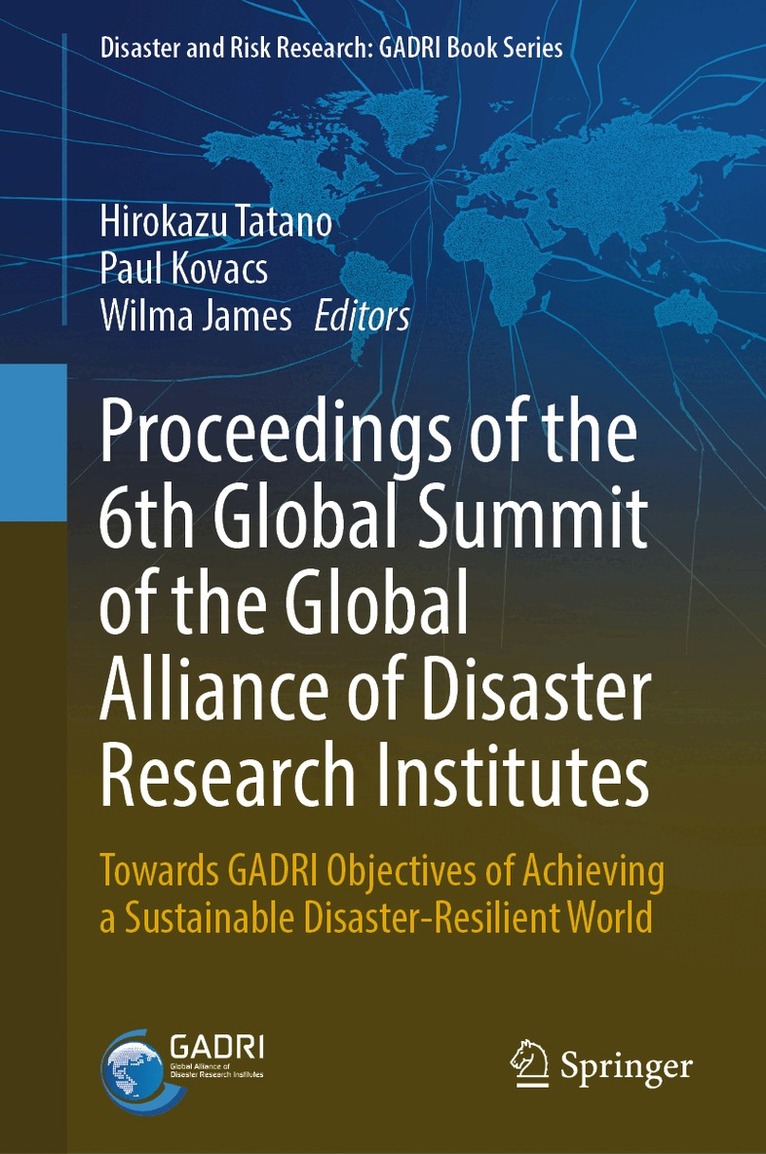
This book contains the proceedings of the 6th Global Summit of the Global Alliance of Disaster Research Institutes (GADRI) with the sub-theme of “Towards GADRI Objectives of Achieving a Sustainable Disaster-Resilient World”. The conference was held at the Disaster Prevention Research Institute (DPRI), Kyoto University, Uji Campus, Kyoto, Japan, 15–17 March 2023.The prolonged worldwide coronavirus pandemic and cascading risks have taught us that the conventional approach to disaster risk planning and management is ineffective for the development of sustainable and resilient communities. A worldwide pandemic underscores the importance of the following key points:i) Disaster risk should not be treated in isolation but should be integrated with health risks, climate change, and environmental risksii) Objectives and a vision of disaster risk reduction (DRR) should be integrated with sustainable development goals to foster a resilient worldiii) Short-term DRR objectives need to be integrated with a long-term vision and plans for a resilient societyThe conference discussions focused on how we could move towards a sustainable and resilient society by integrating the above three aspects in GADRI research and development. There were two panel group discussion sessions. The first session explored how GADRI objectives could contribute to achieving a sustainable and resilient society against disasters using the now-launched committees. The second session took these themes further to discuss new challenges for action by GADRI, based on the following themes:- Big Science for DRR: Large-Scale Experiments- Sustainable DRR: Integrating Climate Action, SDGs, Field DRR Experience Sharing – New Challenges for Action by GADRI- Gender and Inclusivity in DRR Policy and Practice- Putting Health into Disaster Risk Reduction (DRR) and Recovery- Young Scientists Session on Youth DRR – Role of Youth and Young Professionals in Data Knowledge Sharing in Disaster Risk ManagementThe conference presentations focused on progress, strategies and challenges, discussing how best to play an important role collectively as GADRI to influence the decision-making process for DRR across the board.
E-bok
Engelska, 20253 073 kr
Läs direkt efter köp
This book contains the proceedings of the 6th Global Summit of the Global Alliance of Disaster Research Institutes (GADRI) with the sub-theme of “Towards GADRI Objectives of Achieving a Sustainable Disaster-Resilient World”. The conference was held at the Disaster Prevention Research Institute (DPRI), Kyoto University, Uji Campus, Kyoto, Japan, 15–17 March 2023.The prolonged worldwide coronavirus pandemic and cascading risks have taught us that the conventional approach to disaster risk planning and management is ineffective for the development of sustainable and resilient communities. A worldwide pandemic underscores the importance of the following key points:i) Disaster risk should not be treated in isolation but should be integrated with health risks, climate change, and environmental risksii) Objectives and a vision of disaster risk reduction (DRR) should be integrated with sustainable development goals to foster a resilient worldiii) Short-term DRR objectives need to be integrated with a long-term vision and plans for a resilient societyThe conference discussions focused on how we could move towards a sustainable and resilient society by integrating the above three aspects in GADRI research and development. There were two panel group discussion sessions. The first session explored how GADRI objectives could contribute to achieving a sustainable and resilient society against disasters using the now-launched committees. The second session took these themes further to discuss new challenges for action by GADRI, based on the following themes:- Big Science for DRR: Large-Scale Experiments- Sustainable DRR: Integrating Climate Action, SDGs, Field DRR Experience Sharing – New Challenges for Action by GADRI- Gender and Inclusivity in DRR Policy and Practice- Putting Health into Disaster Risk Reduction (DRR) and Recovery- Young Scientists Session on Youth DRR – Role of Youth and Young Professionals in Data Knowledge Sharing in Disaster Risk ManagementThe conference presentations focused on progress, strategies and challenges, discussing how best to play an important role collectively as GADRI to influence the decision-making process for DRR across the board.