Paul Mertenskötter – författare
Visar alla böcker från författaren Paul Mertenskötter. Handla med fri frakt och snabb leverans.
2 produkter
2 produkter
Inbunden, Engelska, 2026
1 127 kr
Kommande
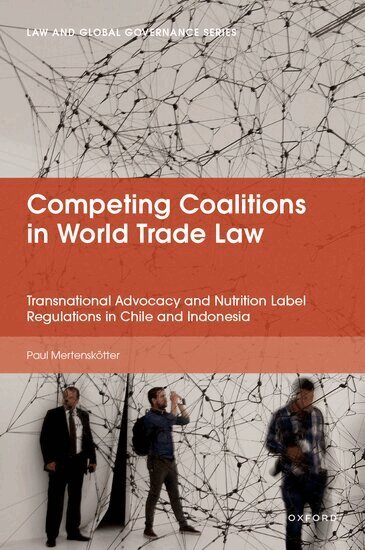
Competing Coalitions in World Trade Law: Transnational Advocacy and Nutrition Label Regulations in Chile and Indonesia argues that today's political economy of trade law is—for an important subset of social issues—best theorized as the exercise of regulatory network power by competing transnational coalitions. The book traces how WTO law, processes, and institutions within and between governments are used to advance the regulatory objectives of coalitions of transnational corporations and business-friendly bureaucrats; and how social regulation-focused coalitions of national and international bureaucrats work alongside civil society to resist these industry coalitions to prevail in their regulatory aims. The book finds that WTO law has significant impacts on social regulation in countries around the world, in particular in low- and middle-income countries susceptible to pressure from global industry coalitions. It is the granular, quotidian uses of WTO law which significantly affect regulatory and societal outcomes. To reveal these patterns, the book uses empirical material from interviews, document requests, and participant observation to focus on one specific area of social concern: the regulation of processed foods to combat the rising prevalence of noncommunicable diseases (NCDs). Two case studies on nutrition label regulations in Chile and Indonesia document how competing coalitions of industry and health advocates contested the potential introduction of mandatory nutrition labels on processed foods. Competing Coalitions in World Trade Law offers a counterpoint to accounts of the "re-securitization" of trade relations due to great power competition in which nationality figures as a theoretically sound organizing principle in global economic relations. While this account may have analytical traction for security-related sectors and industrial policy, contests over social regulatory programs filtering through trade law institutions, for example over health policy or the environment, are often better understood as a series of contests between competing transnational coalitions and their exercise of global network power.
Inbunden, Engelska, 2019
1 981 kr
Skickas inom 5-8 vardagar
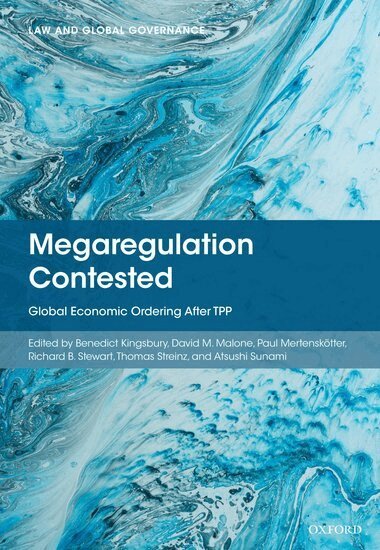
The Japan-led Trans-Pacific Partnership (CPTPPA) of 2018 is the most far-reaching 'megaregional' economic agreement in force, with several major countries beyond its eleven negotiating countries also interested. Still bearing the stamp of the original US involvement before the Trump-era reversal, TPP is the first instance of 'megaregulation': a demanding combination of inter-state economic ordering and national regulatory governance on a highly ambitious substantive and trans-regional scale. Its text and ambition have influenced other negotiations ranging from the Japan-EU Agreement (JEEPA) and the US-Mexico-Canada Agreement (USMCA) to the projected Pan-Asian Regional Comprehensive Economic Partnership (RCEP). This book provides an extensive analysis of TPP as a megaregulatory project for channelling and managing new pressures of globalization, and of core critical arguments made against economic megaregulation from standpoints of development, inequality, labour rights, environmental interests, corporate capture, and elite governance. Specialized chapters cover supply chains, digital economy, trade facilitation, intellectual property, currency levels, competition and state-owned enterprises, government procurement, investment, prescriptions for national regulation, and the TPP institutions. Country studies include detailed analyses of TPP-related politics and approaches in Japan, Mexico, Brazil, China, India, Indonesia, and Thailand. Contributors include leading practitioners and scholars in law, economics, and political science. At a time when the WTO and other global-scale institutions are struggling with economic nationalism and geopolitics, and bilateral and regional agreements are pressed by public disagreement and incompatibility with digital and capital and value chain flows, the megaregional ambition of TPP is increasingly important as a precedent requiring the close scrutiny this book presents.