Paul R. Masson – författare
Visar alla böcker från författaren Paul R. Masson. Handla med fri frakt och snabb leverans.
11 produkter
11 produkter
Häftad, Engelska, 2008
478 kr
Skickas inom 7-10 vardagar
Previous efforts to create a European Central Bank (ECB) have stimulated debate on topics for research into the political economy of the European Community's institutions. These include the exact division of responsibilities of national governments and the ECB - especially concerning exchange rate policy; the need for and design of constraints on national fiscal policies; and the nature of the transition from adjustable parities and national monetary policies to irrevocably fixed parities and a single European monetary policy. The book also considers the implications of EMU for the international monetary system - for the use of the ECU as a reserve currency and for policy coordination among the G-7 countries. The volume thus provides a comprehensive examination of the issues that will be decisive for Europe in its choice of monetary institutions.
Inbunden, Engelska, 1992
1 411 kr
Skickas inom 7-10 vardagar
Previous efforts to create a European Central Bank (ECB) have stimulated debate on topics for research into the political economy of the European Community's institutions. These include the exact division of responsibilities of national governments and the ECB - especially concerning exchange rate policy; the need for and design of constraints on national fiscal policies; and the nature of the transition from adjustable parities and national monetary policies to irrevocably fixed parities and a single European monetary policy. The book also considers the implications of EMU for the international monetary system - for the use of the ECU as a reserve currency and for policy coordination among the G-7 countries. The volume thus provides a comprehensive examination of the issues that will be decisive for Europe in its choice of monetary institutions.
Inbunden, Engelska, 1993
863 kr
Skickas inom 7-10 vardagar
This book provides an overview as well as the latest research on currency unions - geographical areas throughout which a single currency circulates as the medium of exchange. The issues discussed are central to debates on economic and monetary union in Europe, and the future of Eastern Europe. In addition to a specially written survey chapter by the editors, it contains previously unpublished contributions by leading researchers in the field, discussing real and potential currency unions in the United States, the former Soviet Union, Europe, and Africa.
Häftad, Engelska, 2001
507 kr
Skickas inom 10-15 vardagar
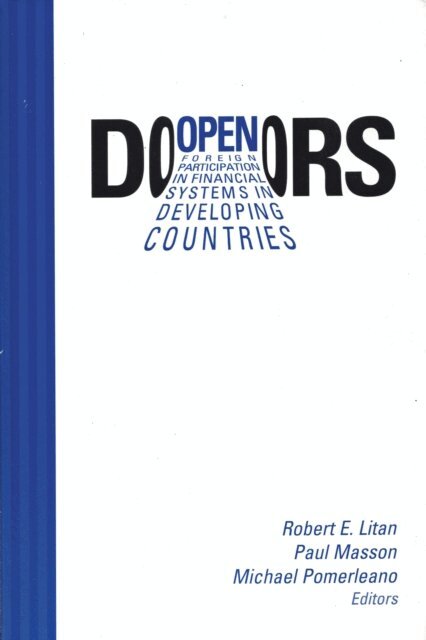
The extensive reforms and liberalization of financial services in emerging markets worldwide call for cutting-edge strategies to capture the benefits of new investment opportunities. In Open Doors, a volume of papers from the third annual Financial Markets and Development conference, multidisciplinary financial sector experts analyze current economic and political trends and prescribe practical advice to the financial development community. The book addresses the key issues of concern regarding the emerging markets, including the trends, motivations, and scope of FDI in finance; policy options that will best capture the opportunities of foreign entry; and the role of foreign institutions in e-finance innovation. The authors focus on specific topics such as foreign participation in emerging market banking systems and securities industries, WTO policies and enforcement, the role of foreign banks, liberalization of insurance markets, the need for capital markets, and the policy, regulatory, and legal issues associated with e-finance. For policymakers and financial practitioners affected by the WTO's Financial Services Agreement, this timely book should be of particular interest. Contributors include Donald Mathieson (International Money Fund), Pierre Sauvé (Trade Directorate, OECD), George J. Vojta (formerly with Bankers Trust and Citibank), Harold D. Skipper (J. Mack Robinson College of Business, Georgia State University), Benn Steil (Council on Foreign Relations), Morris Goldstein and Edward M. Graham (Institute for International Economics), Nicolas Lardy (Brookings Institution), Phillip Turner (Bank of International Settlements), and Robert Ledig (Fried, Frank, Shriver & Jacobson).
E-bok
PDF, Engelska, 2004469 kr
Läs direkt efter köp
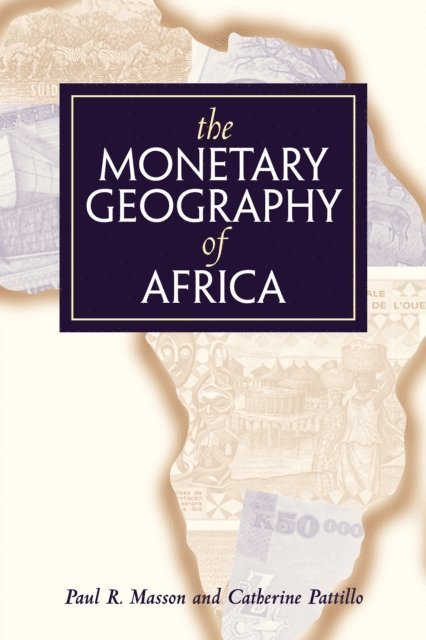
Africa is working toward the goal of creating a common currency that would serve as a symbol of African unity. The advantages of a common currency include lower transaction costs, increased stability, and greater insulation of central banks from pressures to provide monetary financing. Disadvantages relate to asymmetries among countries, especially in their terms of trade and in the degree of fiscal discipline. More disciplined countries will not want to form a union with countries whose excessive spending puts upward pressure on the central bank's monetary expansion. In T he Monetary Geography of Africa, Paul Masson and Catherine Pattillo review the history of monetary arrangements on the continent and analyze the current situation and prospects for further integration. They apply lessons from both experience and theory that lead to a number of conclusions. To begin with, West Africa faces a major problem because Nigeria has both asymmetric terms of tradeit is a large oil exporter while its potential partners are oil importersand most important, large fiscal imbalances. Secondly, a monetary union among all eastern or southern African countries seems infeasible at this stage, since a number of countries suffer from the effects of civil conflicts and drought and are far from achieving the macroeconomic stability of South Africa. Lastly, the plan by Kenya, Tanzania, and Uganda to create a common currency seems to be generally compatible with other initiatives that could contribute to greater regional solidarity. However, economic gains would likely favor Kenya, which, unlike the other two countries, has substantial exports to its neighbors, and this may constrain the political will needed to proceed. A more promising strategy for monetary integration would be to build on existing monetary unionsthe CFA franc zone in western and central Africa and the Common Monetary Area in southern Africa. Masson and Pattillo argue that the goal of a creating a s
E-bok
PDF, Engelska, 2004561 kr
Läs direkt efter köp
The extensive reforms and liberalization of financial services in emerging markets worldwide call for cutting-edge strategies to capture the benefits of new investment opportunities. In Open Doors, a volume of papers from the third annual Financial Markets and Development conference, multidisciplinary financial sector experts analyze current economic and political trends and prescribe practical advice to the financial development community. The book addresses the key issues of concern regarding the emerging markets, including the trends, motivations, and scope of FDI in finance; policy options that will best capture the opportunities of foreign entry; and the role of foreign institutions in e-finance innovation. The authors focus on specific topics such as foreign participation in emerging market banking systems and securities industries, WTO policies and enforcement, the role of foreign banks, liberalization of insurance markets, the need for capital markets, and the policy, regulatory, and legal issues associated with e-finance. For policymakers and financial practitioners affected by the WTO's Financial Services Agreement, this timely book should be of particular interest. Contributors include Donald Mathieson (International Money Fund), Pierre Sauve (Trade Directorate, OECD), George J. Vojta (formerly with Bankers Trust and Citibank), Harold D. Skipper (J. Mack Robinson College of Business, Georgia State University), Benn Steil (Council on Foreign Relations), Morris Goldstein and Edward M. Graham (Institute for International Economics), Nicolas Lardy (Brookings Institution), Phillip Turner (Bank of International Settlements), and Robert Ledig (Fried, Frank, Shriver & Jacobson).
Inbunden, Engelska, 2019
2 125 kr
Skickas inom 3-6 vardagar
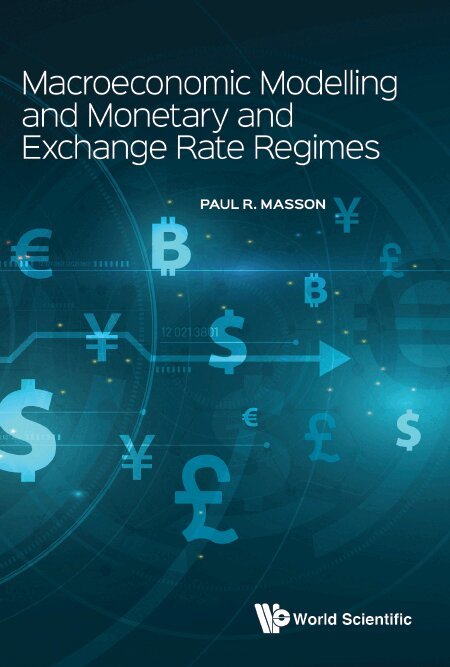
This book presents articles that focus on the inter-related issues of choice of exchange rate and monetary policy regimes, and others that use a global macroeconomic model developed by the author and collaborators to quantify the effects of the "baby boom" on global imbalances, costs of disinflation, and the effects of German unification. The book presents new analysis of the euro-zone experience and its applicability to other monetary unions, as well as a discussion of the prerequisites for successful inflation targeting. It is grounded in real-world data, readily accessible to non-specialists, and addresses important economic policy issues.
Inbunden, Engelska
1 049 kr
Tillfälligt slut
Inbunden, Engelska, 2007
1 302 kr
Tillfälligt slut
This book provides a good basis for a graduate course in international finance. It also serves as a reference source for professional economists. Though other good surveys and handbooks are available, they are too extensive to serve as a graduate textbook. In many cases they are outdated, as there has been an explosion of work on the issues over the last decade, stimulated by events such as the Asian crises of 1997 and 1998, the creation of the Euro zone in 1999, and Argentina's 2001 default. This book covers up-to-date developments on these issues.
Häftad, Engelska, 2007
885 kr
Tillfälligt slut
This book provides a good basis for a graduate course in international finance. It also serves as a reference source for professional economists. Though other good surveys and handbooks are available, they are too extensive to serve as a graduate textbook. In many cases they are outdated, as there has been an explosion of work on the issues over the last decade, stimulated by events such as the Asian crises of 1997 and 1998, the creation of the Euro zone in 1999, and Argentina's 2001 default. This book covers up-to-date developments on these issues.
Inbunden, Engelska, 2011
2 100 kr
Tillfälligt slut
This volume provides an integrated compilation of selected major articles published by the author in several fields of international finance. These include contributions to the understanding of currency crises and financial contagion, the evolution of exchange rate regimes, the interaction between national fiscal policies and regional monetary unions, and the effect of uncertainty on the gains from international economic policy coordination. The author spent most of his career doing research at established institutions (the Bank of Canada, OECD, and IMF), and these articles emerged from the need to understand the major economic policy issues of the day. In the book's introduction, the author discusses the motivation for these contributions and the unifying themes that emerged, while a concluding chapter provides his personal reflections and suggestions about promising avenues for further research.