Peter G. Clote - Böcker
Visar alla böcker från författaren Peter G. Clote. Handla med fri frakt och snabb leverans.
4 produkter
4 produkter
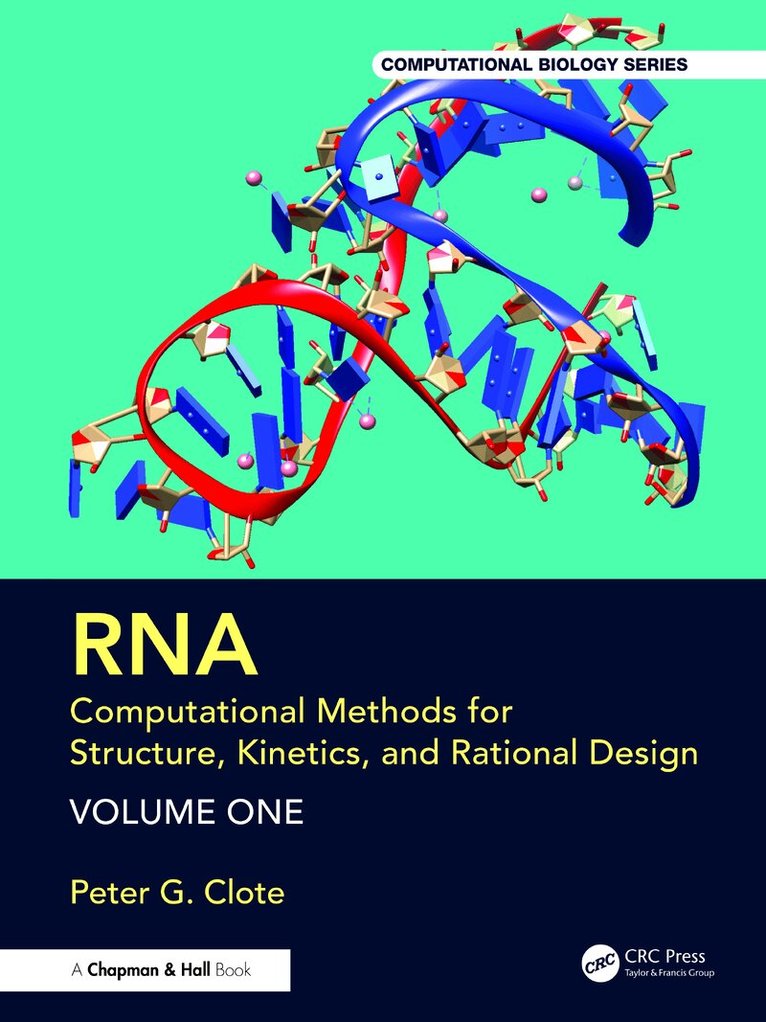
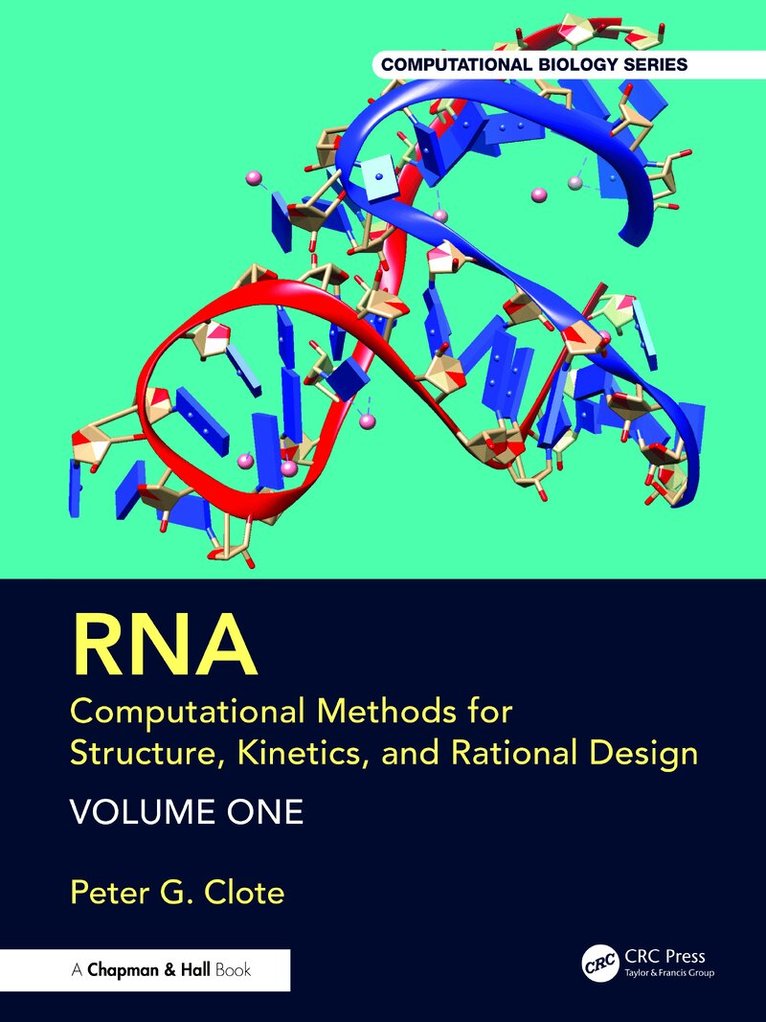
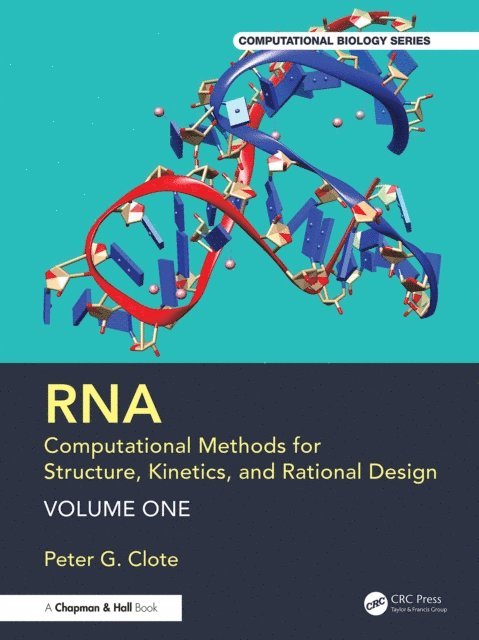
RNA: Computational Methods for Structure, Kinetics, and Rational Design: Volume One
Inbunden, Engelska, 2025
1 295 kr
Skickas inom 10-15 vardagar
Comprising two volumes, RNA: Computational Methods for Structure, Kinetics, and Rational Design is a comprehensive treatment of computational methods concerning the secondary structure, folding kinetics and rational design of RNA.Volume One concerns energy and structure and is divided into five chapters. Chapter 1 describes the molecular structure of ribonucleotides, basic classes of RNA and databases of RNA sequences and structure. Chapter 2 presents the basic concepts of thermodynamics, since thermodynamics-based algorithms constitute an essential tool in rational design of functional RNA molecules. Chapter 3 describes how empirical secondary structure energy parameters are obtained from ultraviolet absorbance experiments via Van 't Hoff plots and least-squares data fitting. Chapter 4 describes methods from combinatorics, automata and formal language theory, and complex analysis. Chapter 5 provides an overview of some of the most important thermodynamics-based algorithms related to secondary structure. Exercises and solutions are provided at the end of every chapter and source code is available at the book's website (sometimes including computer programs using Python and extensions Numpy and Scipy).This book provides the nuts, bolts and tools to take the next steps in computational RNA synthetic biology. It is perfect for advanced undergraduate, graduate and post-graduate readers having analytical interests and skills from areas such as physical chemistry, physics, mathematics, computer science, and statistics.Instructor slides, computer programs and solutions to all exercises from Volumes 1 and 2 can be found at the following website: https://github.com/pgclote/RNA-Computational-methods-for-structure-kinetics-and-rational-design-Solutions-slides-etc.-.
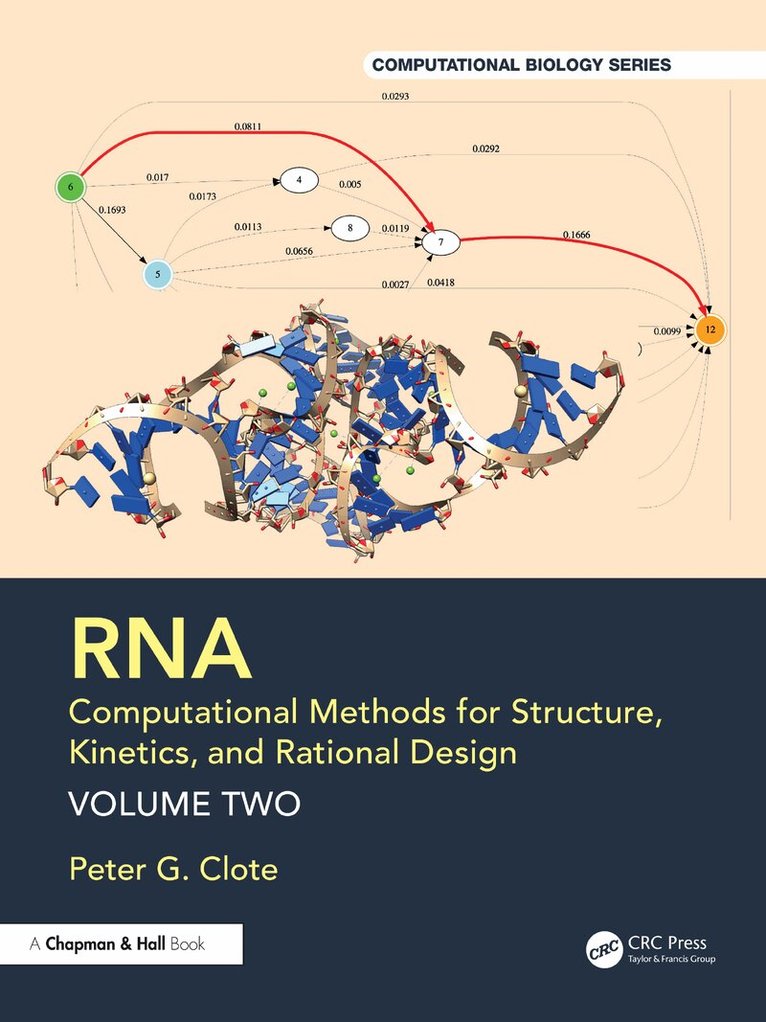
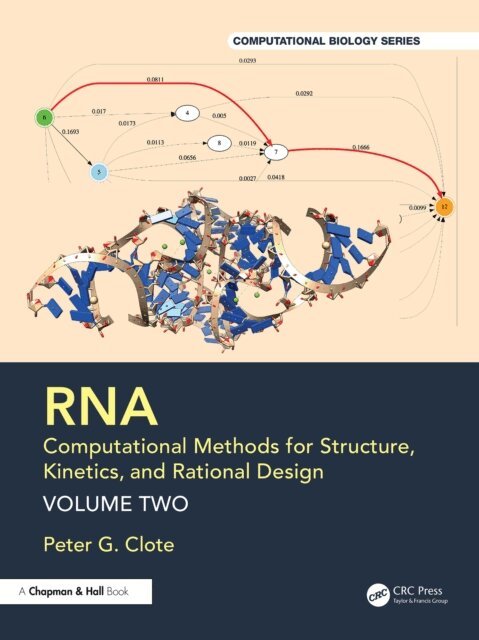
RNA: Computational Methods for Structure, Kinetics, and Rational Design
Volume Two
Häftad, Engelska, 2026
1 078 kr
Skickas inom 10-15 vardagar
Comprising two volumes, RNA: Computational Methods for Structure, Kinetics, and Rational Design is a comprehensive treatment of computational methods concerning the secondary structure, folding kinetics and rational design of RNA. Volume 2 covers secondary structure folding kinetics, starting with an inquiry into whether the ensemble of RNA structures is small-world or scale-free, then proceeding to the identification of local energy minima that create a basin of attraction, leading to a coarse-grained kinetics model.The book describes Markov state models created from secondary structure folding trajectories generated by the kinetic Monte Carlo (Gillespie) algorithm, the first such application. Python code is available at the book’s website, allowing research teams to use the code and extend the approach. Current RNA research concerns the rational design of functional RNA molecules, which The book provides an overview and comparison of various inverse folding algorithms, combinatorial optimization, and the question of whether inverse folding is computationally hard (NP-complete). Another chapter focuses on various types of designed RNA including ribozymes, RNA thermometers, bistable switches, toehold switches, mRNA vaccines, and paper-based COVID-19 tests. The final chapter is a math appendix for the linear algebra and Markov chain results that are essential to folding kinetics.This book provides the nuts, bolts and tools for the next generation of computational work on RNA, especially for the rational design of functional molecules – a topic that not so long ago seemed more like science fiction. Exercises at the end of each chapter introduce new material or related concepts, and solutions are available at the book’s website. It is perfect for advanced undergraduate, graduate and post-graduate readers having analytical interests and skills from areas such as physical chemistry, physics, mathematics, computer science, and statistics.Instructor slides, computer programs and solutions to all exercises from Volumes 1 and 2 can be found at the following website: https://github.com/pgclote/RNA-Computational-methods-for-structure-kinetics-and-rational-design-Solutions-slides-etc.-.
RNA: Computational Methods for Structure, Kinetics, and Rational Design
Volume Two
Inbunden, Engelska, 2026
2 088 kr
Skickas inom 10-15 vardagar
Comprising two volumes, RNA: Computational Methods for Structure, Kinetics, and Rational Design is a comprehensive treatment of computational methods concerning the secondary structure, folding kinetics and rational design of RNA. Volume 2 covers secondary structure folding kinetics, starting with an inquiry into whether the ensemble of RNA structures is small-world or scale-free, then proceeding to the identification of local energy minima that create a basin of attraction, leading to a coarse-grained kinetics model.The book describes Markov state models created from secondary structure folding trajectories generated by the kinetic Monte Carlo (Gillespie) algorithm, the first such application. Python code is available at the book’s website, allowing research teams to use the code and extend the approach. Current RNA research concerns the rational design of functional RNA molecules, which The book provides an overview and comparison of various inverse folding algorithms, combinatorial optimization, and the question of whether inverse folding is computationally hard (NP-complete). Another chapter focuses on various types of designed RNA including ribozymes, RNA thermometers, bistable switches, toehold switches, mRNA vaccines, and paper-based COVID-19 tests. The final chapter is a math appendix for the linear algebra and Markov chain results that are essential to folding kinetics.This book provides the nuts, bolts and tools for the next generation of computational work on RNA, especially for the rational design of functional molecules – a topic that not so long ago seemed more like science fiction. Exercises at the end of each chapter introduce new material or related concepts, and solutions are available at the book’s website. It is perfect for advanced undergraduate, graduate and post-graduate readers having analytical interests and skills from areas such as physical chemistry, physics, mathematics, computer science, and statistics.Instructor slides, computer programs and solutions to all exercises from Volumes 1 and 2 can be found at the following website: https://github.com/pgclote/RNA-Computational-methods-for-structure-kinetics-and-rational-design-Solutions-slides-etc.-.
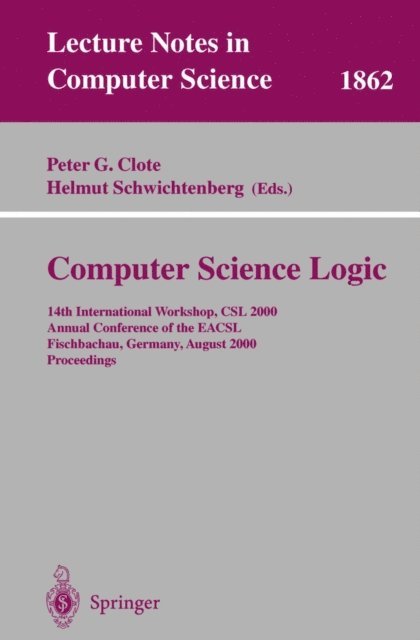
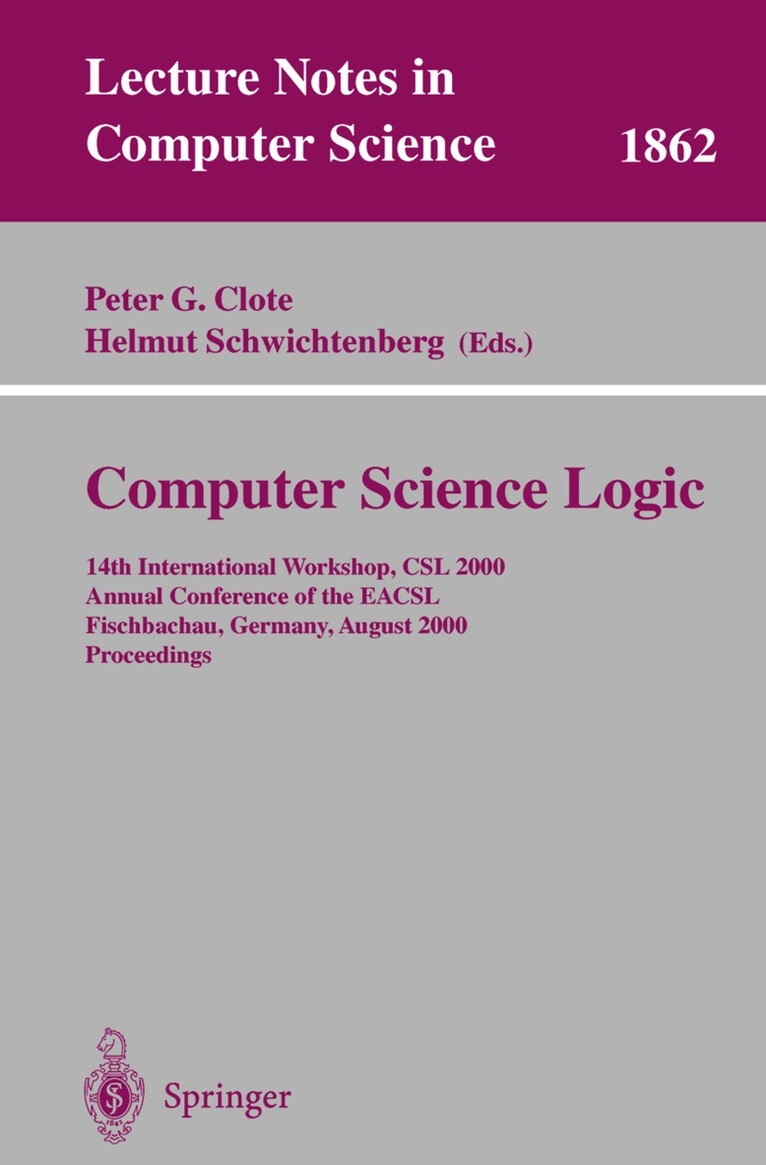
Computer Science Logic
14th International Workshop, CSL 2000 Annual Conference of the EACSL Fischbachau, Germany, August 21-26, 2000 Proceedings
Häftad, Engelska, 2000
1 095 kr
Skickas inom 10-15 vardagar
CSL is the annual conference of the European Association for Computer Science Logic (EACSL). CSL2000 is the 14th such annual conference, thus witnessing the importance and sustained international interest in the application of me- ods from mathematical logic to computer science. The current conference was organized by the Mathematics Institute and the Computer Science Institute of the Ludwig-Maximilians-Universit. at Munc .. hen (LMU), with generous ?nancial supportfromtheDeutscheForschungsgemeinschaft,Forschungsinstitutfur .. an- wandte Softwaretechnologie (FAST e.V.), Munc .. hener Universit. atsgesellschaft e.V., and Siemens AG. Our sponsors' generosity enabled, among other things, stipends for the ?nancial support of students as well as of researchers from Ea- ern Europe. Topics in the call for papers for CSL2000 included: automated deduction andinteractivetheoremproving,categoricallogicandtopologicalsemantics,c- structivemathematicsandtypetheory,domaintheory,equationallogicandterm rewriting, ?nite model theory, database theory, higher order logic, lambda and combinatory calculi, logical aspects of computational complexity, logical fo- dations of programming paradigms, logic programming and constraints, linear logic, modal and temporal logics, model checking, program extraction, program logicsandsemantics,programspeci?cation,transformationandveri?cation.The invited speakers were: Moshe Vardi (Houston), Paul Beame (Washington), - dreas Blass (Ann Arbor), Egon B.. orger (Pisa), Yuri Gurevich (Redmond), Bruno Poizat (Lyons), Wolfram Schulte (Redmond), Saharon Shelah (Jerusalem), and Colin Sterling (Edinburgh). Special thanks to Moshe Vardi for being willing to speakintheplaceofMikl' osAjtai(Almaden),whocouldnotattendthemeeting. The day of 24 August 2000, during the week-long CSL2000 meeting, was reserved for theGurevichSymposium, a special, one-day tribute to the scienti?c contributions of Professor Yuri Gurevich, at the occasion of his 60th birthday.