Peter Hofschröer - Böcker
Visar alla böcker från författaren Peter Hofschröer. Handla med fri frakt och snabb leverans.
9 produkter
9 produkter
149 kr
Skickas inom 10-15 vardagar
At the beginning of this period, the battalions of the Prussian Line usually fought in a linear formation three ranks deep, overwhelming the enemy with fire before a well-timed bayonet attack.By the end, the preferred formation was eight to 12 ranks deep. The responsibility for conducting the fire-fight was now given to the skirmish elements and the artillery. The formed battalions provided support for the fire line, and conducted the decisive bayonet charge. Whatever the change, the spirit and ability of the infantry remained consistently high throughout this bloody period.Peter Hofschroer's text is accompanied by illustrations throughout.
149 kr
Skickas inom 10-15 vardagar
When Frederick II (later known as Frederick the Great) came to the throne in 1740, he had three advantages for which he owed thanks to his father: a modern, well-organised state; full coffers; and a properly trained and equipped army.Under a leader as renowned as Seydlitz, the Prussian cavalry achieved the nearest to a state of perfection that it was ever going to. So great was its reputation in the Seven Years' War that Napoleon made a special point of warning his men at the beginning of the 1806 campaign to beware of the Prussian cavalry.In this detailed volume, Peter Hofschröer's text is accompanied by illustrations throughout.
149 kr
Skickas inom 10-15 vardagar
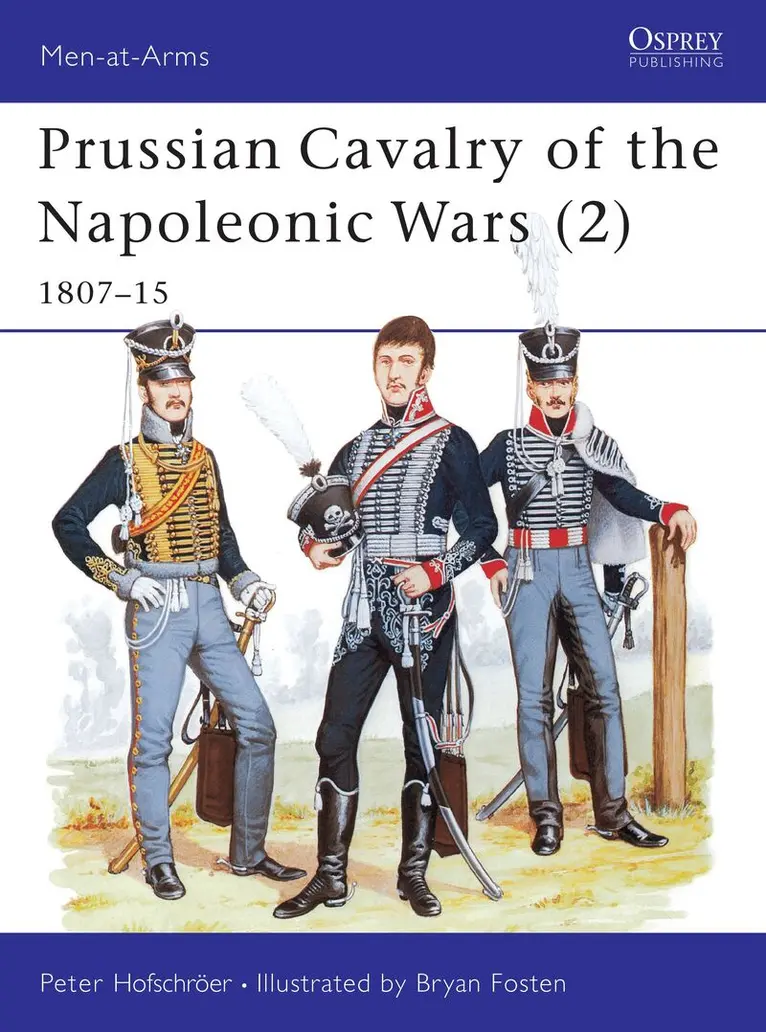
After Prussia's dismemberment a drastic re-organisation of the entire army was necessary, and the cavalry underwent this process with the rest.At the time of the mobilisation in 1813, the somewhat reduced mounted arm was supplemented by voluntary and militia formations; and once peace was established after the First Abdication, a further re-organisation was begun. The fateful campaign of 1815 was fought with the Prussian cavalry still in the throes of this re-organisation.Packed with diagrams, illustrations and eight full page colour plates by Bryan Fosten, this book by Peter Hofschröer details the history, organisation, equipment and uniforms of the Prussian cavalry which fought in the Napoleonic wars.
153 kr
Skickas inom 10-15 vardagar
Throughout the Napoleonic era Britain and Hanover had the same head of state, George III.Symbolic of their close relationship, the Hanoverian Army wore uniforms and used equipment largely similar to those used by the British Army.Complemented by numerous illustrations and photographs, plus eight full page colour plates, this text explores the uniforms and organization of the army of the Electorate of Hanover and the King's German Legion.
153 kr
Skickas inom 10-15 vardagar
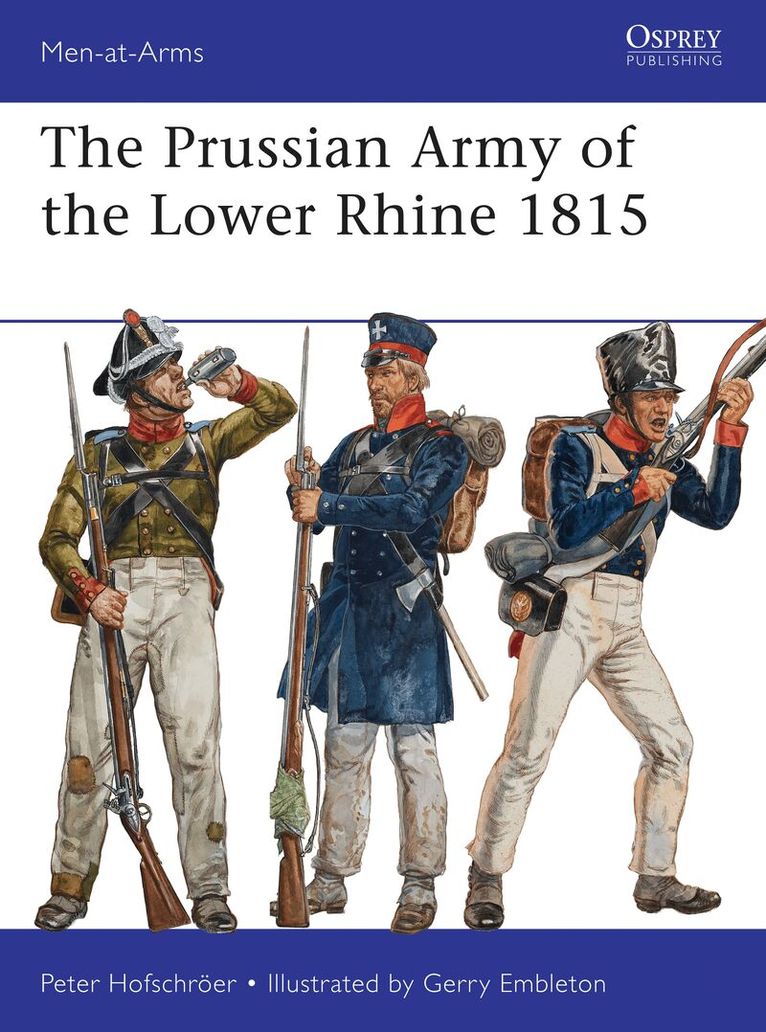
The Prussian Army of the Lower Rhine, led by Blücher in 1815, played a crucial part in the Allied victory at Waterloo, and was involved in intense fighting at Wavre and Ligny.Delving into original sources, including eyewitness accounts and regimental histories known only to German scholars, this book tells the story of the soldiers on the ground: how they were organised and drilled, their previous service; their march to the battlefield; and what they did when they got there.Also ideal for those interested in the actual appearance of the Prussian soldiers in 1815, this colourful study combines the latest findings and expert analysis to cast new light on the fateful Waterloo campaign.
153 kr
Skickas inom 10-15 vardagar
The Prussian armies that fought France were a key factor from the early Revolutionary Wars to the final campaigns of 1813-15, culminating in Marshal Blucher's joint victory with Wellington at Waterloo. Prussia was the most important of German states throughout the period, seeing both disaster and triumph. This work covers the Prussian Army of the Napoleonic Wars. It describes the organization, equipment, tactics and uniforms of the Artillery, Engineer and Medical branches; the staff; and colours and standards of pre-1806, post 1806 and 1815.
175 kr
Skickas inom 10-15 vardagar
Written by an expert on the Prussian army of the Napoleonic era, this is a fascinating insight into the 18th-century evolution of the Prussian forces into the war-winning troops of the final battles against Napoleon.Using contemporary materials including drill regulations, instructions, staff and regimental histories and after-action reports, this book provides a compelling history of Prussian tactics from 1792 until 1815. It includes studies of the professional Prussian army during the Revolutionary Wars and the mass mobilization of a conscript army that fought during the Wars of Liberation and Waterloo.Following on from the success of Osprey's other Elite Tactics volumes, this is a must-have for serious students of Napoleonic warfare, armchair generals, and wargamers alike.
198 kr
Skickas inom 10-15 vardagar
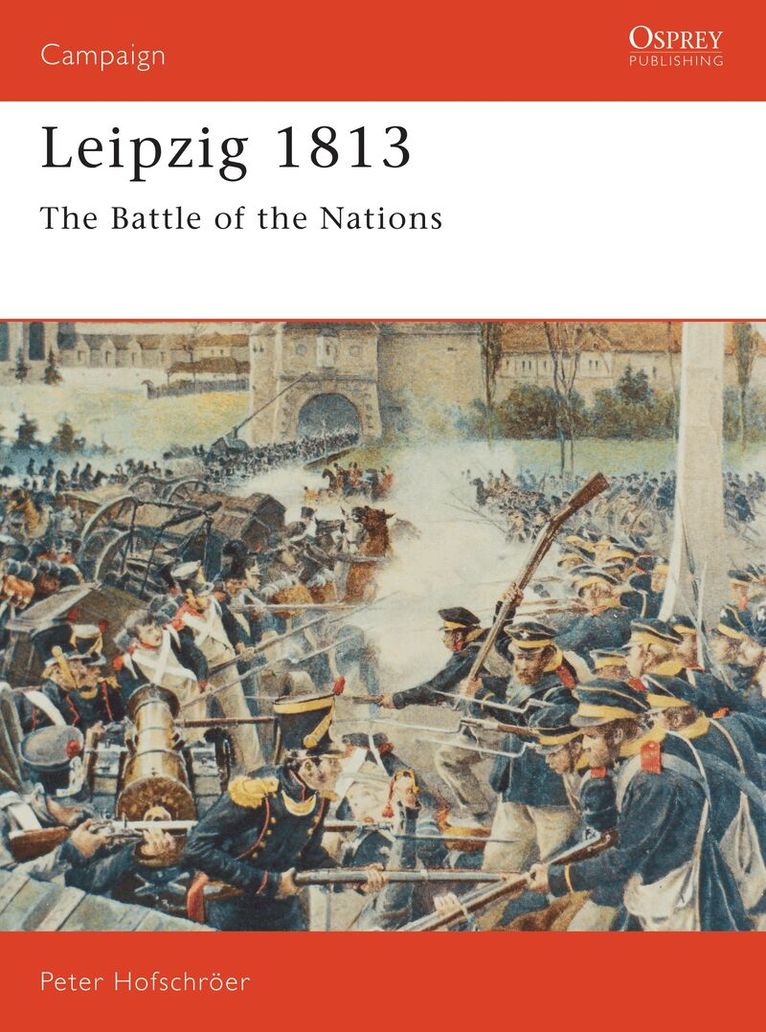
A fully-illustrated and detailed account of this crucial moment of conflict, from origins to the battlefield today.The battle of Leipzig was, in terms of the number of combatants involved, the largest engagement of the entire Napoleonic Wars. It was the only battle of the wars in which all Allied armies (including even the Swedes) fielded troops against Napoleon. Peter Hofschroer looks at the run-up to this crucial encounter as well as the battle itself.A wealth of background information is chronicled, including the strategies of both sides and detailed information on each of the combatant forces. The numerous battles leading up to Leipzig are also discussed, providing a fascinating and illuminating overview of the whole campaign.
198 kr
Skickas inom 10-15 vardagar
Following the disastrous Russian campaign of 1812, Napoleon faced a new coalition of his old enemies. With incredible speed he raised an army of 200,000 men and marched to join the remnants of the old Grand Army in Germany, where he planned to comprehensively defeat them. However the inexperience of his new army began to show, At Lutzen on 2 May Ney was surprised by Wittgenstein, Napoleon galloped to the scene and with his old brilliance turned defeat into victory. Crossing the Elbe he brought the allies to battle at Bautzen, but Ney's hesitancy allowed them to escape and victory slipped from his grasp.