Peter Murrell – författare
Visar alla böcker från författaren Peter Murrell. Handla med fri frakt och snabb leverans.
5 produkter
5 produkter
707 kr
Skickas inom 3-6 vardagar
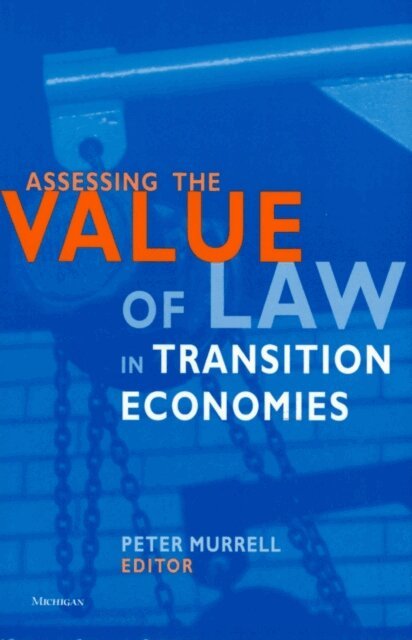
Does law play a role in the economies that are moving from Soviet-style socialism to market capitalism? The essays in this book examine that question, providing a vivid picture of how the new institutions of capitalism affect the lives of business people, legal practitioners, investors, and bureaucrats. They analyze the determinants of successful institutional reform, suggesting that law can influence economic behavior even in inhospitable environments. Contributors--including economists, political scientists, and legal and business scholars--examine the pathways through which legal and institutional reforms affect behavior and identify the circumstances under which such reforms add value. They ask: What are the microeconomic mechanisms by which law contributes to the activities of economic agents? How do the characteristics of economic agents affect their ability to use the law? Which spheres of the economy are most affected by institutional reforms and where does law fail? What are the preconditions for effective legal and institutional reforms? Which types of political processes produce a workable system of economic legislation? The focus throughout is on the analysis of the individual economic agent who is subject to the new institutions, and thus the decisions of the individual actor, the shopkeeper, the lawyer, the court, the legislator-politician, the enterprise, the bureaucrat, the regulatory authority, and the outside investor. There are lessons on research methodology, on the economic role of institutions, and on the practice of institutional development. The focus is on the transition economies, but the conclusions and methodologies are pertinent when understanding the role of law in any context. The book will be important reading for scholars and practitioners with a wide range of interests and in a wide range of disciplines and of interest to all those concerned with economic, legal, and institutional development, economists, political scientists, lawyers, and development specialists alike.
587 kr
Skickas inom 7-10 vardagar
This book is about the institutions, incentives and constraints that guide the behaviour of people and organizations involved in the implementation of foreign aid programmes. While traditional performance studies tend to focus almost exclusively on the policies and institutions in recipient countries, this book looks at incentives in the entire chain of organizations involved in the delivery of foreign aid, from donor governments and agencies to consultants, experts and other intermediaries. Four aspects of foreign aid delivery are examined in detail: incentives inside donor agencies, the interaction of subcontractors with recipient organizations, incentives inside recipient country institutions, and biases in aid performance monitoring systems.
1 477 kr
Skickas inom 7-10 vardagar
This book is about the institutions, incentives and constraints that guide the behaviour of people and organizations involved in the implementation of foreign aid programmes. While traditional performance studies tend to focus almost exclusively on the policies and institutions in recipient countries, this book looks at incentives in the entire chain of organizations involved in the delivery of foreign aid, from donor governments and agencies to consultants, experts and other intermediaries. Four aspects of foreign aid delivery are examined in detail: incentives inside donor agencies, the interaction of subcontractors with recipient organizations, incentives inside recipient country institutions, and biases in aid performance monitoring systems.
836 kr
Skickas inom 3-6 vardagar
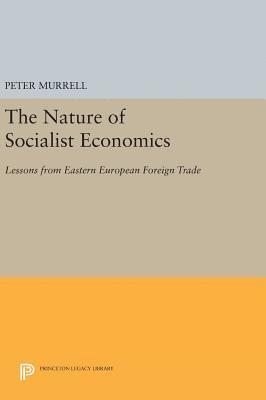
What are the sources of the well-known differences in the performance of capitalist and socialist economic systems? Peter Murrell argues that the Schumpeterian model has far more power to answer this question than does the neoclassical theory generally used for that purpose. The neoclassical theory focuses on the absence of a price system and the inability of a centralized system to allocate resources efficiently, while the Schumpeterian model emphasizes the rigidity of institutions and policies in socialist economies and their lack of mechanisms either to create new institutions or to identify and to foster the growth of the most efficient organizations (including multinational corporations). In a work that will have profound consequences for the analysis of economic reform in socialist economies, Murrell compares the predictions of these two models against data summarizing foreign trade performance and finds the Schumpeterian model clearly superior. Combining international trade theory and econometric techniques, the author develops new methods of comparative economic analysis.These methods provide new information on the values of eleven resource endowments implicit in trade, the degree to which the socialist countries fit standard models of trade, the effect of multinational corporations on trade, and myriad other features of economic performance. Originally published in 1990. The Princeton Legacy Library uses the latest print-on-demand technology to again make available previously out-of-print books from the distinguished backlist of Princeton University Press. These editions preserve the original texts of these important books while presenting them in durable paperback and hardcover editions. The goal of the Princeton Legacy Library is to vastly increase access to the rich scholarly heritage found in the thousands of books published by Princeton University Press since its founding in 1905.
1 923 kr
Skickas inom 3-6 vardagar
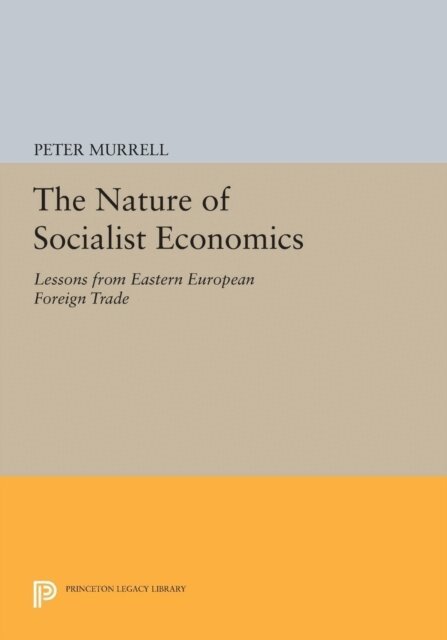
What are the sources of the well-known differences in the performance of capitalist and socialist economic systems? Peter Murrell argues that the Schumpeterian model has far more power to answer this question than does the neoclassical theory generally used for that purpose. The neoclassical theory focuses on the absence of a price system and the inability of a centralized system to allocate resources efficiently, while the Schumpeterian model emphasizes the rigidity of institutions and policies in socialist economies and their lack of mechanisms either to create new institutions or to identify and to foster the growth of the most efficient organizations (including multinational corporations). In a work that will have profound consequences for the analysis of economic reform in socialist economies, Murrell compares the predictions of these two models against data summarizing foreign trade performance and finds the Schumpeterian model clearly superior. Combining international trade theory and econometric techniques, the author develops new methods of comparative economic analysis.These methods provide new information on the values of eleven resource endowments implicit in trade, the degree to which the socialist countries fit standard models of trade, the effect of multinational corporations on trade, and myriad other features of economic performance. Originally published in 1990. The Princeton Legacy Library uses the latest print-on-demand technology to again make available previously out-of-print books from the distinguished backlist of Princeton University Press. These editions preserve the original texts of these important books while presenting them in durable paperback and hardcover editions. The goal of the Princeton Legacy Library is to vastly increase access to the rich scholarly heritage found in the thousands of books published by Princeton University Press since its founding in 1905.