Peter Revesz – författare
Visar alla böcker från författaren Peter Revesz. Handla med fri frakt och snabb leverans.
9 produkter
9 produkter
E-bok
PDF, Engelska, 2006708 kr
Läs direkt efter köp
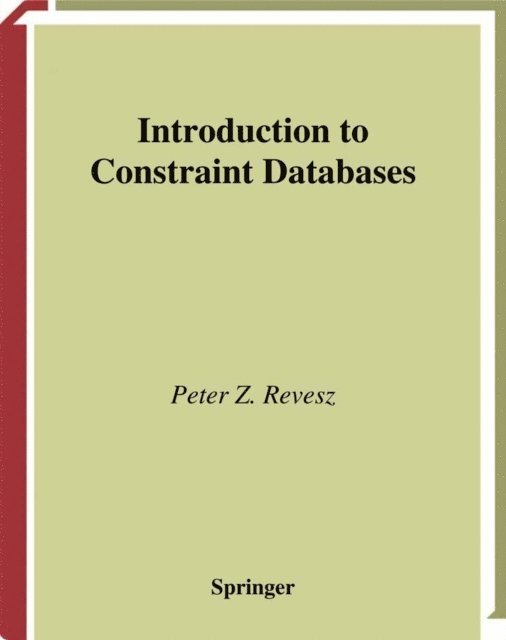
A new text/reference presenting the theory and applications of "e;constraint database"e; systems, which provide new methods for the design of data models and query languages. Constraint databases bring techniques from a variety of fields, such as logic and model theory, algebraic and computational geometry, as well as symbolic computation, to the design and analysis of data models and query languages. An essential resource for advanced students, practitioners, and professionals in computer science, database systems, and information systems.
Inbunden, Engelska, 2002
565 kr
Skickas inom 10-15 vardagar
A new text/reference presenting the theory and applications of "constraint database" systems, which provide new methods for the design of data models and query languages. Constraint databases bring techniques from a variety of fields, such as logic and model theory, algebraic and computational geometry, as well as symbolic computation, to the design and analysis of data models and query languages.An essential resource for advanced students, practitioners, and professionals in computer science, database systems, and information systems.
Häftad, Engelska, 2010
565 kr
Skickas inom 10-15 vardagar
A new text/reference presenting the theory and applications of "constraint database" systems, which provide new methods for the design of data models and query languages. Constraint databases bring techniques from a variety of fields, such as logic and model theory, algebraic and computational geometry, as well as symbolic computation, to the design and analysis of data models and query languages.An essential resource for advanced students, practitioners, and professionals in computer science, database systems, and information systems.
Häftad, Engelska, 2012
1 011 kr
Skickas inom 10-15 vardagar
Introduced forty years ago, relational databases proved unusually succe- ful and durable. However, relational database systems were not designed for modern applications and computers. As a result, specialized database systems now proliferate trying to capture various pieces of the database market. Database research is pulled into di?erent directions, and speci- ized database conferences are created. Yet the current chaos in databases is likely only temporary because every technology, including databases, becomes standardized over time. The history of databases shows periods of chaos followed by periods of dominant technologies. For example, in the early days of computing, users stored their data in text ?les in any format and organization they wanted. These early days were followed by information retrieval systems, which required some structure for text documents, such as a title, authors, and a publisher. The information retrieval systems were followed by database systems, which addedeven more structure to the data and made querying easier. In the late 1990s, the emergence of the Internet brought a period of relative chaos and interest in unstructured and “semistructured data” as it wasenvisionedthateverywebpagewouldbelikeapageinabook.However, with the growing maturity of the Internet, the interest in structured data was regained because the most popular websites are, in fact, based on databases. The question is not whether future data stores need structure but what structure they need.
Engelska, 2013
644 kr
Skickas inom 5-8 vardagar
Inbunden, Engelska, 2010
1 123 kr
Skickas inom 10-15 vardagar
Introduced forty years ago, relational databases proved unusually succe- ful and durable. However, relational database systems were not designed for modern applications and computers. As a result, specialized database systems now proliferate trying to capture various pieces of the database market. Database research is pulled into di?erent directions, and speci- ized database conferences are created. Yet the current chaos in databases is likely only temporary because every technology, including databases, becomes standardized over time. The history of databases shows periods of chaos followed by periods of dominant technologies. For example, in the early days of computing, users stored their data in text ?les in any format and organization they wanted. These early days were followed by information retrieval systems, which required some structure for text documents, such as a title, authors, and a publisher. The information retrieval systems were followed by database systems, which addedeven more structure to the data and made querying easier. In the late 1990s, the emergence of the Internet brought a period of relative chaos and interest in unstructured and “semistructured data” as it wasenvisionedthateverywebpagewouldbelikeapageinabook.However, with the growing maturity of the Internet, the interest in structured data was regained because the most popular websites are, in fact, based on databases. The question is not whether future data stores need structure but what structure they need.
E-bok
PDF, Engelska, 20091 242 kr
Läs direkt efter köp
Introduced forty years ago, relational databases proved unusually succe- ful and durable. However, relational database systems were not designed for modern applications and computers. As a result, specialized database systems now proliferate trying to capture various pieces of the database market. Database research is pulled into di?erent directions, and speci- ized database conferences are created. Yet the current chaos in databases is likely only temporary because every technology, including databases, becomes standardized over time. The history of databases shows periods of chaos followed by periods of dominant technologies. For example, in the early days of computing, users stored their data in text ?les in any format and organization they wanted. These early days were followed by information retrieval systems, which required some structure for text documents, such as a title, authors, and a publisher. The information retrieval systems were followed by database systems, which addedeven more structure to the data and made querying easier. In the late 1990s, the emergence of the Internet brought a period of relative chaos and interest in unstructured and “semistructured data” as it wasenvisionedthateverywebpagewouldbelikeapageinabook.However, with the growing maturity of the Internet, the interest in structured data was regained because the most popular websites are, in fact, based on databases. The question is not whether future data stores need structure but what structure they need.
Häftad, Engelska, 2004
565 kr
Skickas inom 10-15 vardagar
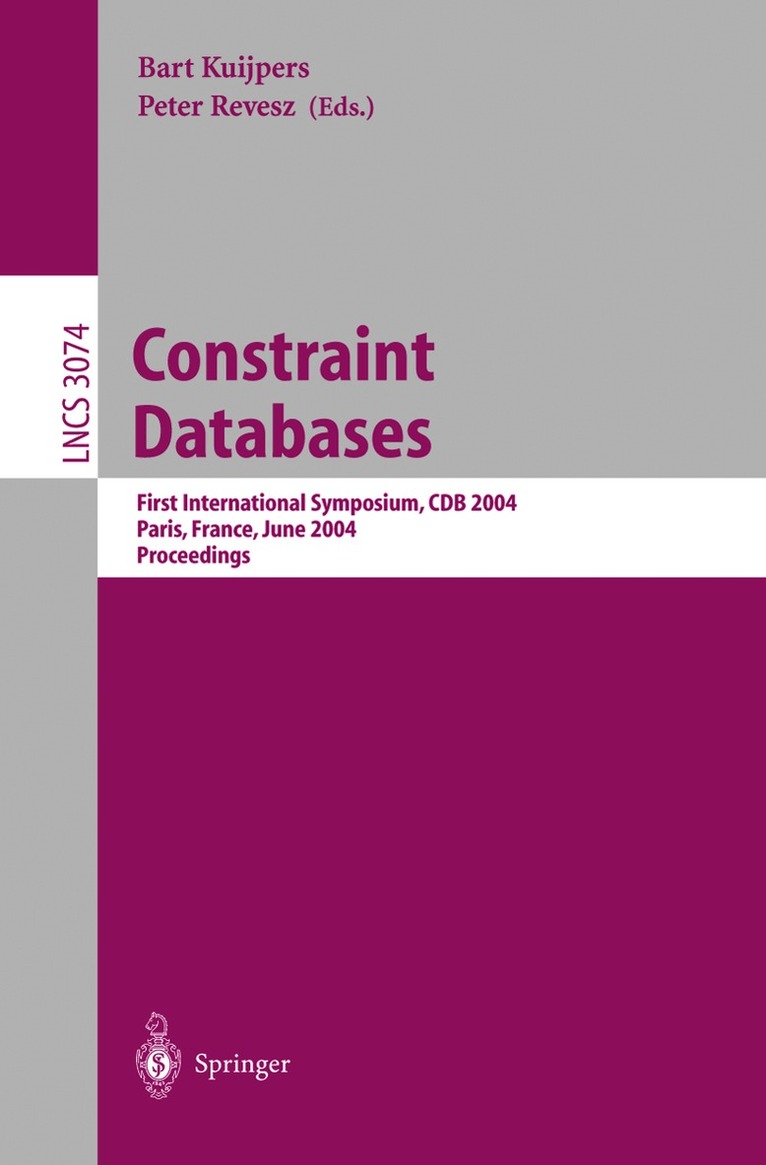
The ?rst International Symposium on the Applications of Constraint Databases (CDB2004) took place in Paris, France, on June 12–13, 2004, just before the ACM SIGMOD and PODS conferences. Since the publication of the paper “Constraint Query Languages” by Kan- lakis, Kuper and Revesz in 1990, the last decade has seen a growing interest in constraint database theory, query evaluation, and applications, re?ected in a variety of conferences, journals, and books. Constraint databases have proven to be extremely ?exible and adoptable in environments that relational database systems cannot serve well, such as geographic information systems and bioinf- matics. This symposium brought together people from several diverse areas all c- tributing to the practice and the application of constraint databases. It was a continuation and extension of previous workshops held in Friedrichshafen, G- many (1995), Cambridge, USA (1996), Delphi, Greece (1997), and Seattle, USA (1998) as well as of the work in the comprehensive volume “Constraint Data- ses” edited by G. Kuper, L. Libkin and J. Paredaens (2000) and the textbook “Introduction to Constraint Databases” by P. Revesz (2002). The aim of the symposium was to open new and future directions in c- straint database research; to address constraints over domains other than the reals; to contribute to a better implementation of constraint database systems, in particular of query evaluation; to address e?cient quanti?er elimination; and to describe applications of constraint databases.
E-bok
PDF, Engelska, 2004687 kr
Läs direkt efter köp
The ?rst International Symposium on the Applications of Constraint Databases (CDB2004) took place in Paris, France, on June 12–13, 2004, just before the ACM SIGMOD and PODS conferences. Since the publication of the paper “Constraint Query Languages” by Kan- lakis, Kuper and Revesz in 1990, the last decade has seen a growing interest in constraint database theory, query evaluation, and applications, re?ected in a variety of conferences, journals, and books. Constraint databases have proven to be extremely ?exible and adoptable in environments that relational database systems cannot serve well, such as geographic information systems and bioinf- matics. This symposium brought together people from several diverse areas all c- tributing to the practice and the application of constraint databases. It was a continuation and extension of previous workshops held in Friedrichshafen, G- many (1995), Cambridge, USA (1996), Delphi, Greece (1997), and Seattle, USA (1998) as well as of the work in the comprehensive volume “Constraint Data- ses” edited by G. Kuper, L. Libkin and J. Paredaens (2000) and the textbook “Introduction to Constraint Databases” by P. Revesz (2002). The aim of the symposium was to open new and future directions in c- straint database research; to address constraints over domains other than the reals; to contribute to a better implementation of constraint database systems, in particular of query evaluation; to address e?cient quanti?er elimination; and to describe applications of constraint databases.