Peter Steen – författare
Visar alla böcker från författaren Peter Steen. Handla med fri frakt och snabb leverans.
7 produkter
7 produkter
Häftad, Engelska, 2000
853 kr
Skickas inom 10-15 vardagar
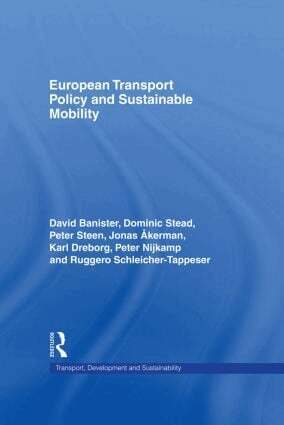
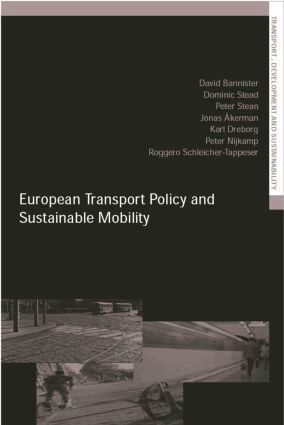
It is now widely accepted that transport is becoming increasingly unsustainable and that strong policy intervention is required to reduce both the growth in transport demand and the environmental costs of transport. This book challenges conventional approaches to transport by moving away from trend based analysis towards the use of scenarios to identify alternative sustainable transport futures. It both summaries the development of EU transport policy and presents a critique. The policy context is widened to include the global changes taking place in economics, society and technology. It develops new methodologies for policy making for the next 25 years.
Häftad, Engelska, 2022
469 kr
Skickas inom 5-8 vardagar
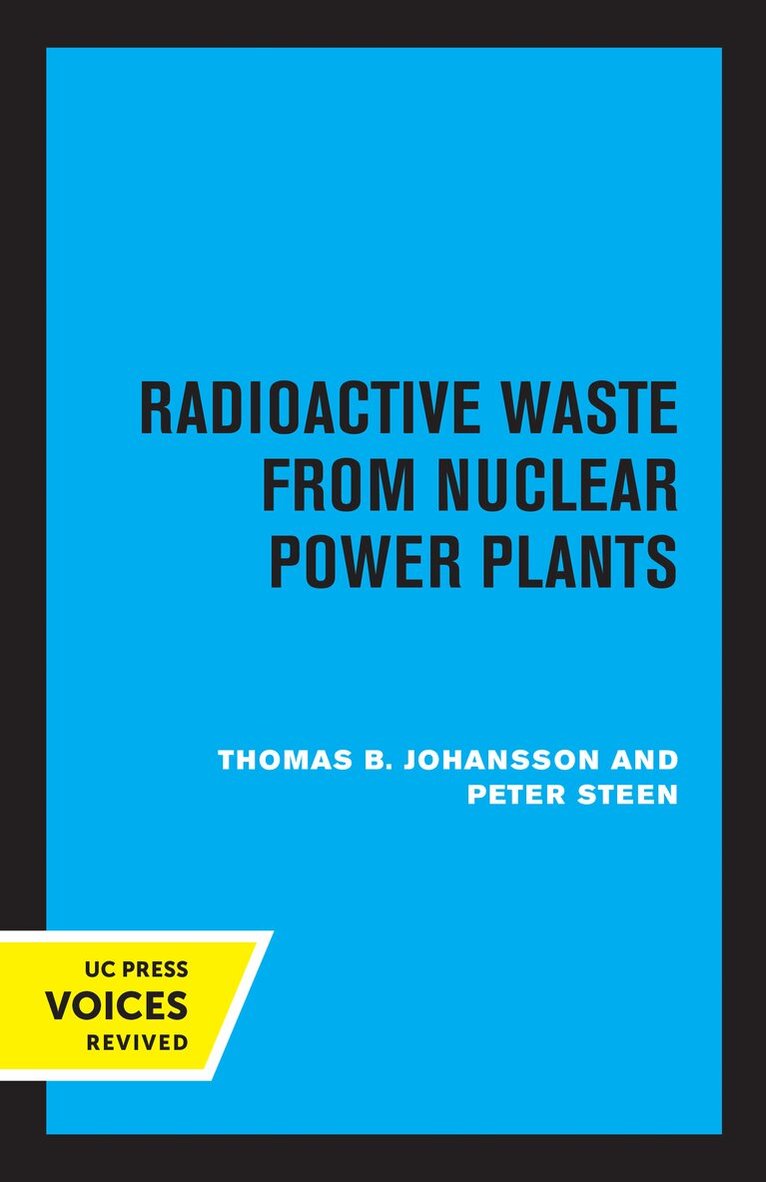
Radioactive Waste from Nuclear Power Plants provides a comprehensive examination of Sweden’s evolving nuclear waste management policies and the political landscape that shaped them. With a focus on the Nuclear Stipulation Act of 1977, the book outlines the stringent requirements imposed on reactor operators to ensure the safe long-term disposal of radioactive waste. The Swedish nuclear industry’s response to these demands, particularly the KBS (Nuclear Fuel Safety) project’s approach to vitrified waste management, is analyzed in detail, alongside the broader political debates that influenced Sweden’s nuclear future. The book serves as both a technical and historical account of the country's nuclear energy policy, detailing the transition from early optimism about nuclear power to increasing public skepticism and government intervention.Beyond Sweden’s domestic policies, Radioactive Waste from Nuclear Power Plants explores the international implications of nuclear waste disposal, offering insights into how other nations might approach similar challenges. The detailed safety assessments, site evaluations, and legislative measures presented in the book underscore the complexities of balancing energy needs with environmental and public health concerns. The analysis of Sweden’s 1980 nuclear referendum, which ultimately led to a commitment to phase out nuclear energy, highlights the intersection of science, policy, and public opinion in shaping national energy strategies. This work is essential for anyone interested in the governance of nuclear energy, the intricacies of waste management, and the broader implications of transitioning away from nuclear power in the face of mounting environmental and political pressures.This title is part of UC Press's Voices Revived program, which commemorates University of California Press’s mission to seek out and cultivate the brightest minds and give them voice, reach, and impact. Drawing on a backlist dating to 1893, Voices Revived makes high-quality, peer-reviewed scholarship accessible once again using print-on-demand technology. This title was originally published in 1981.
E-bok
Engelska, 2023325 kr
Läs direkt efter köp
This title is part of UC Press's Voices Revived program, which commemorates University of California Press’s mission to seek out and cultivate the brightest minds and give them voice, reach, and impact. Drawing on a backlist dating to 1893, Voices Revived makes high-quality, peer-reviewed scholarship accessible once again using print-on-demand technology. This title was originally published in 1981.
Inbunden, Engelska, 2022
1 122 kr
Skickas inom 5-8 vardagar
Radioactive Waste from Nuclear Power Plants provides a comprehensive examination of Sweden’s evolving nuclear waste management policies and the political landscape that shaped them. With a focus on the Nuclear Stipulation Act of 1977, the book outlines the stringent requirements imposed on reactor operators to ensure the safe long-term disposal of radioactive waste. The Swedish nuclear industry’s response to these demands, particularly the KBS (Nuclear Fuel Safety) project’s approach to vitrified waste management, is analyzed in detail, alongside the broader political debates that influenced Sweden’s nuclear future. The book serves as both a technical and historical account of the country's nuclear energy policy, detailing the transition from early optimism about nuclear power to increasing public skepticism and government intervention.Beyond Sweden’s domestic policies, Radioactive Waste from Nuclear Power Plants explores the international implications of nuclear waste disposal, offering insights into how other nations might approach similar challenges. The detailed safety assessments, site evaluations, and legislative measures presented in the book underscore the complexities of balancing energy needs with environmental and public health concerns. The analysis of Sweden’s 1980 nuclear referendum, which ultimately led to a commitment to phase out nuclear energy, highlights the intersection of science, policy, and public opinion in shaping national energy strategies. This work is essential for anyone interested in the governance of nuclear energy, the intricacies of waste management, and the broader implications of transitioning away from nuclear power in the face of mounting environmental and political pressures.This title is part of UC Press's Voices Revived program, which commemorates University of California Press’s mission to seek out and cultivate the brightest minds and give them voice, reach, and impact. Drawing on a backlist dating to 1893, Voices Revived makes high-quality, peer-reviewed scholarship accessible once again using print-on-demand technology. This title was originally published in 1981.
E-bok
Engelska, 2000974 kr
Läs direkt efter köp
It is now widely accepted that transport is becoming increasingly unsustainable and that strong policy intervention is required to reduce both the growth in transport demand and the environmental costs of transport. This book challenges conventional approaches to transport by moving away from trend based analysis towards the use of scenarios to identify alternative sustainable transport futures. It both summaries the development of EU transport policy and presents a critique. The policy context is widened to include the global changes taking place in economics, society and technology. It develops new methodologies for policy making for the next 25 years.
E-bok
PDF, Engelska, 20001 009 kr
Läs direkt efter köp
It is now widely accepted that transport is becoming increasingly unsustainable and that strong policy intervention is required to reduce both the growth in transport demand and the environmental costs of transport. This book challenges conventional approaches to transport by moving away from trend based analysis towards the use of scenarios to identify alternative sustainable transport futures. It both summaries the development of EU transport policy and presents a critique. The policy context is widened to include the global changes taking place in economics, society and technology. It develops new methodologies for policy making for the next 25 years.
E-bok
Engelska, 2013344 kr
Läs direkt efter köp
Solar Versus Nuclear: Choosing Energy Futures study is an eight-chapter text that studies the long-term implications of Sweden''s decisions to explore nuclear energy and other alternative development options. Sweden''s high standards of living, energy intensive industries, advanced technology in many fields, strong tradition of electrification and a competent utility organization, abundant reserves of (admittedly low grade) uranium, low population density and a large number of suitable reactor sites, make nuclear energy seemed ideal. Chapter I deals with some different ways of describing and viewing energy, while Chapter 2 analyzes the earlier changes of energy sources in an attempt to describe the relations between the development of society and energy consumption. Chapter 3 is concerned with the durability and other essential characteristics of these energy sources. Chapter 4 discusses two distinct developments, one leads to a Nuclear Sweden with its energy supply based chiefly on uranium and the other to a Solar Sweden based on renewable energy sources. This chapter compares the characteristics and costs of the two alternatives and discusses the possibilities of combining them. Chapter 5 covers the possible developmental tendencies built into the present energy policy, and Chapter 6 looks into the proposals for a conceivable transitional solution for the 1980''s, which could reduce the dependence on oil while preserving both the solar and nuclear option as possible alternatives. Chapter 7 discusses the organizational changes in energy conservation and energy production. Lastly, Chapter 8 considers some questions regarding the effect of the energy systems on the long-term development of society.