Peter W. Hallinan – författare
Visar alla böcker från författaren Peter W. Hallinan. Handla med fri frakt och snabb leverans.
4 produkter
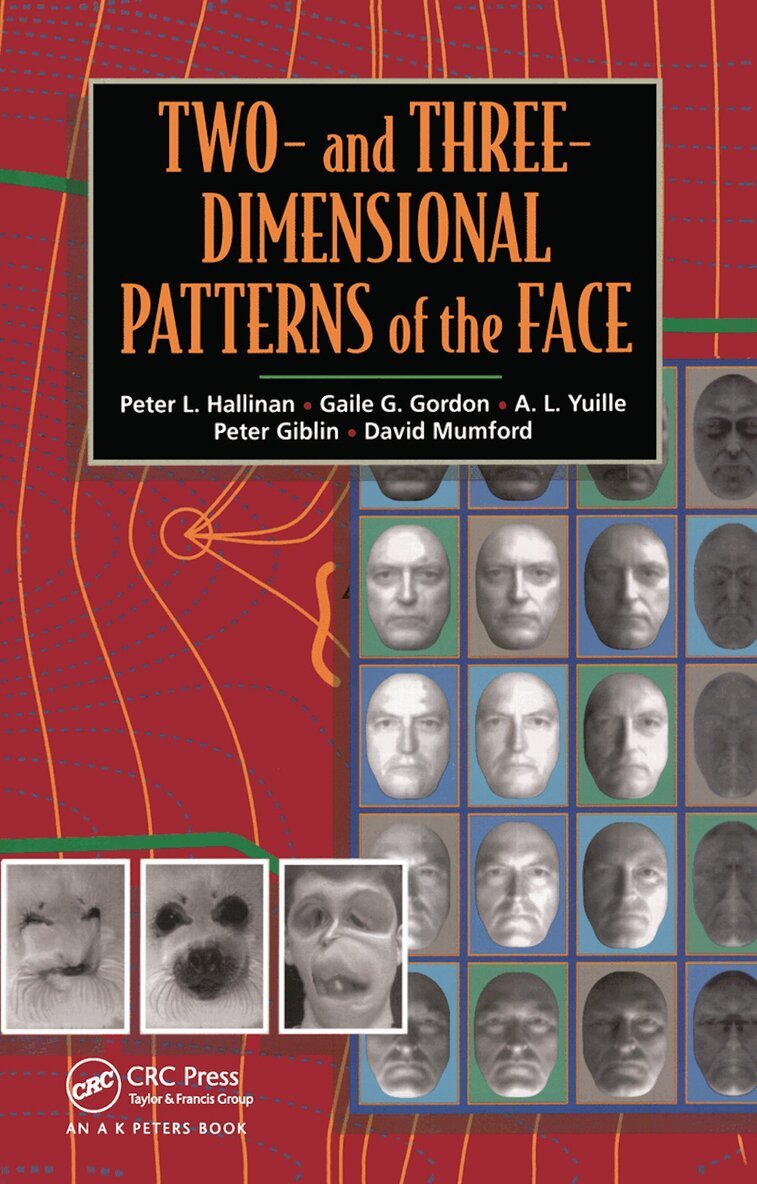
Two- and Three-Dimensional Patterns of the Face
Av Peter W. Hallinan, Gaile Gordon m. fl.
Häftad, 2019
981 kr
Lägg i varukorg
The human face is perhaps the most familiar and easily recognized object in the world, yet both its three-dimensional shape and its two-dimensional images are complex and hard to characterize. This book develops the vocabulary of ridges and parabolic curves, of illumination eigenfaces and elastic …
Two- and Three-Dimensional Patterns of the Face
Av David Mumford, Peter Giblin m. fl.
E-bok, 1999
898 kr
Lägg i varukorg
The human face is perhaps the most familiar and easily recognized object in the world, yet both its three-dimensional shape and its two-dimensional images are complex and hard to characterize. This book develops the vocabulary of ridges and parabolic curves, of illumination eigenfaces and elastic …
Two- and Three-Dimensional Patterns of the Face
Av David Mumford, Peter Giblin m. fl.
E-bok, 1999
907 kr
Lägg i varukorg
The human face is perhaps the most familiar and easily recognized object in the world, yet both its three-dimensional shape and its two-dimensional images are complex and hard to characterize. This book develops the vocabulary of ridges and parabolic curves, of illumination eigenfaces and elastic …
Two- and Three-Dimensional Patterns of the Face
Av Peter W. Hallinan, Gaile Gordon m. fl.
Inbunden, 1999
1567 kr
Lägg i varukorg
The human face is perhaps the most familiar and easily recognized object in the world, yet both its three-dimensional shape and its two-dimensional images are complex and hard to characterize. This book develops the vocabulary of ridges and parabolic curves, of illumination eigenfaces and elastic …