
Peters James F Peters – författare
Visar alla böcker från författaren Peters James F Peters. Handla med fri frakt och snabb leverans.
2 produkter
2 produkter
E-bok
PDF, Engelska, 2013475 kr
Läs direkt efter köp
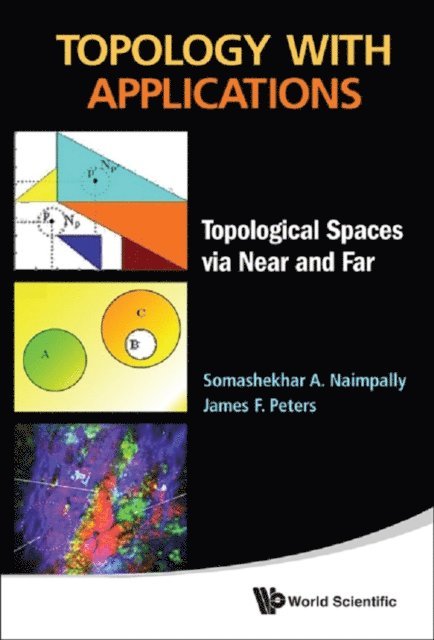
The principal aim of this book is to introduce topology and its many applications viewed within a framework that includes a consideration of compactness, completeness, continuity, filters, function spaces, grills, clusters and bunches, hyperspace topologies, initial and final structures, metric spaces, metrization, nets, proximal continuity, proximity spaces, separation axioms, and uniform spaces.This book provides a complete framework for the study of topology with a variety of applications in science and engineering that include camouflage filters, classification, digital image processing, forgery detection, Hausdorff raster spaces, image analysis, microscopy, paleontology, pattern recognition, population dynamics, stem cell biology, topological psychology, and visual merchandising.It is the first complete presentation on topology with applications considered in the context of proximity spaces, and the nearness and remoteness of sets of objects. A novel feature throughout this book is the use of near and far, discovered by F Riesz over 100 years ago. In addition, it is the first time that this form of topology is presented in the context of a number of new applications.

E-bok
PDF, Engelska, 1998642 kr
Läs direkt efter köp
This unique volume is the first publication on software engineering and computational intelligence (CI) viewed as a synergistic interplay of neurocomputing, granular computation (including fuzzy sets and rough sets), and evolutionary methods. It presents a unified view of CI in the context of software engineering.The book addresses a number of crucial issues: what is CI, what role does it play in software development, how are CI elements built into successive phases of the software life cycle, and what is the role played by CI in quantifying fundamental features of software artifacts?With contributions from leading researchers and practitioners, the book provides the reader with a wealth of new concepts and approaches, complete algorithms, in-depth case studies, and thought-provoking exercises. The topics coverage include neurocomputing, granular as well as evolutionary computing, object-oriented analysis and design in software engineering. There is also an extensive bibliography.