Philippe Poulin – författare
Visar alla böcker från författaren Philippe Poulin. Handla med fri frakt och snabb leverans.
2 produkter
2 produkter
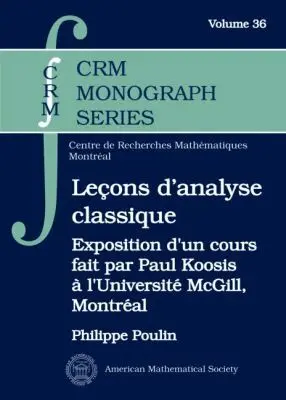
Lecons D'Analyse Classique
Exposition D'un Cours Fait Par Paul Koosis a L'Universite McGill, Montreal
Inbunden, Franska, 2015
1 596 kr
Skickas inom 11-20 vardagar
Ce livre est base sur un cours de deuxieme cycle donne en 2005-2006 par M. Paul Koosis, professeur emerite a l'universite McGill. Il traite de sujets soigneusement choisis par le professeur a l'intention de ceux qui, plutot que de rechercher un catalogue exhaustif de resultats techniques et abstraits, veulent etre inities aux decouvertes les plus essentielles et prolifiques de l'analyse classique du vingtieme siecle. Analyse harmonique, quasi-analyticite, zeros des fonctions entieres (dont une preuve inedite du theoreme de Levinson-Cartwright), approximation ponderee, principe d'incertitude, mesures harmoniques ... , les resultats saillants et geniaux de l'analyse classique sont presentes dans un style soigne, rigoureux et detaille, preparant les etudiants a des etudes plus poussees ; et au service du lecteur qui, connaissant les bases de la theorie de la mesure et de l'analyse complexe, desire suivre le merveilleux developpement de M. Koosis et accroitre sa connaissance du sujet. Je reconnais les choix et le style de Paul Koosis, et j'aime beaucoup les deux. Le titre est volontairement modeste et hors-mode; ce qui fait l'originalite du livre est que, sous l'apparence du ``classique'', il echappe completement aux modes actuelles. Il ne me parait pas avoir d'equivalent, en aucune langue. C'est un beau cadeau au francais ... --Jean-Pierre Kahane, Universite Paris-Sud Orsay, France. This book is based on a graduate course given in 2005-2006 by Paul Koosis, Emeritus Professor at McGill University. It addresses topics carefully selected by Prof. Koosis and is intended for those who, far from seeking an exhaustive catalog of technical and abstract results, prefer to be initiated in the most essential and prolific discoveries of the 20th century in classical analysis. Harmonic analysis, quasi-analyticity, zeroes of classes of entire functions (including a new proof of the Levinson-Cartwright theorem), weighted approximation, gap theorems, harmonic measures, and other gems of classical analysis are presented in a rigorous, detailed, and elegant style. This work prepares students for more advanced studies and serves readers who, aware of the basics in measure theory and complex analysis, wish to follow Prof. Koosis in his marvelous development of the subject.
E-bok
PDF, Engelska, 20031 109 kr
Läs direkt efter köp
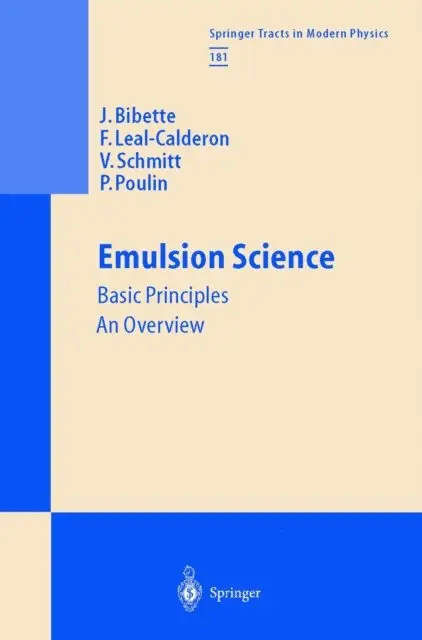
Emulsions occur either as end products or during the processing of products in a huge range of areas including the food, agrochemical, pharmaceuticals, paints and oil industries. As end products, emulsions allow to avoid organic solvent in processing hydrophobic coatings. Emulsion technology is a suitable approach to vehicle viscous phases. It is also a remarkable mean of targeting actives or capturing specific species. The range of applications of emulsions progresses and their manufacturing becomes more and more sophisticated. Besides this broad domain of technological interest, emulsions are raising a variety of fundamental questions at the frontier between physic and chem istry. Indeed, as a class of soft colloidal materials, emulsions science is linked to various aspects of these disciplines: phase transitions, surface forces and wetting, metastability and hydrodynamic instabilities, mechanical properties and flow. The aim of this book is to review the main important concepts governing emulsion science. In Chapter 2, repulsive interactions between liquid films are discussed as well as adhesive interaction related to wetting. In Chap ter 3, consequences of weak and strong attractions are presented, related to the well accepted liquid solid transition analogy. In Chapter 4, the basics of both bulk compressibility and shear elasticity are presented, the role of disorder being the most important aspect of the elastic behavior of these soft systems. In Chapter 5 the central question of the emulsion lifetime related to metastability is discussed.