Phillip S. Meilinger – författare
Visar alla böcker från författaren Phillip S. Meilinger. Handla med fri frakt och snabb leverans.
8 produkter
8 produkter
Inbunden, Engelska, 2003
2 828 kr
Skickas inom 10-15 vardagar
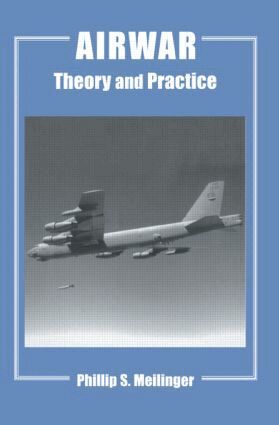
According to the author all aircrews, tacticians and those who direct them have to realise the limitations of air power during conflicts. For years opinion has differed as to whether the aircraft has altered war strategies or merely the tactics of war. This volume explores the limits of airpower.
Häftad, Engelska, 2003
698 kr
Skickas inom 10-15 vardagar
According to the author all aircrews, tacticians and those who direct them have to realise the limitations of air power during conflicts. For years opinion has differed as to whether the aircraft has altered war strategies or merely the tactics of war. This volume explores the limits of airpower.
E-bok
PDF, Engelska, 2026551 kr
Läs direkt efter köp
Inbunden, Engelska, 2026
471 kr
Skickas inom 7-10 vardagar
Until the Japanese attack on Pearl Harbour, America did not want war, with the 1930s marked by strong isolationism and an emphasis on defense. However, in December 1941, it wasn't defensive aircraft the Army Air Corps had been steadily procuring, but offensive long-range heavy bombers, whilst US pursuit planes were decidedly inferior to their European counterparts. In this new history of the development of American air power, Phillip Meilinger dispels the notion that young air zealots pushed for a bomber-heavy force, revealing instead the technological, economic and bureaucratic forces which shaped the air force. He examines the role of scientists and engineers, developments in commercial aviation, and conflicting priorities of the Army and Air Corps, as well as how these were in turn influenced by America's political leaders. Building an Air Force is essential for understanding a conflict in which whoever controlled the skies controlled the land and seas beneath.
E-bok
Engelska, 2026571 kr
Läs direkt efter köp
E-bok
Engelska, 2003849 kr
Läs direkt efter köp
According to the author all aircrews, tacticians and those who direct them have to realise the limitations of air power during conflicts. For years opinion has differed as to whether the aircraft has altered war strategies or merely the tactics of war. This volume explores the limits of airpower.
Häftad, Engelska, 2004
352 kr
Skickas inom 5-8 vardagar
E-bok
Engelska, 2017536 kr
Läs direkt efter köp
The United States has the most expensive and seemingly military forces in the world. Yet, since World War II its military success rate has been fairly meager. The Korean War was a draw, Vietnam, Mogadishu, Afghanistan and Iraq were clear losses. Successes include: Iraq in 1991, the Balkans (Croatia and Kosovo), Panama, the initial takedowns of Afghanistan in 2001 and Iraq in 2003, and Libya.Failures have been marked by the introduction of large numbers of conventional American ground troops, while successes have been characterized by the use of airpower, special operations forces, robust intelligence and sensor platforms, and the use of indigenous ground troops. The vital interests of the United States are seldom at stake; instead, the US intervenes to punish aggressors or topple particularly inhumane dictators. As a result, the US and its allies strive to maintain public support, both at home and abroad. One of the surest ways to lose this support is to suffer high casualties or, worse, inflict them on the societies we are ostensibly attempting to help. The goal of limiting cost and casualties is hindered by the introduction of large numbers of conventional ground troops—especially in the xenophobic societies of the Middle East.This desire to limit risk and cost, while still achieving definable political goals, results in a quandary. This is not a new problem, and as early as two millennia ago nations sought to achieve these dual and often contradictory goals against enemies with asymmetric strengths. Often, nations rejected taking on a powerful enemy head-to-head; instead, belligerents launched “second front operations”—they moved the war elsewhere to achieve local superiority. Not surprisingly, this strategy was especially appealing to nations possessing powerful navies. Britain, who controlled the seas for several centuries, was especially adept at using this “second front” strategy.Today we find that although second fronts may not be necessary, the reasons for conducting such operations are still with us—the desire to limit risk while achieving measurable goals. For America that means eschewing the use of massive numbers of ground troops to invade and occupy a subject country, but instead using its asymmetric strengths—a combination of airpower, SOF, intelligence and indigenous ground troops to achieve political goals.