Piergiorgio Strata - Böcker
Visar alla böcker från författaren Piergiorgio Strata. Handla med fri frakt och snabb leverans.
2 produkter
2 produkter
1 064 kr
Skickas inom 10-15 vardagar
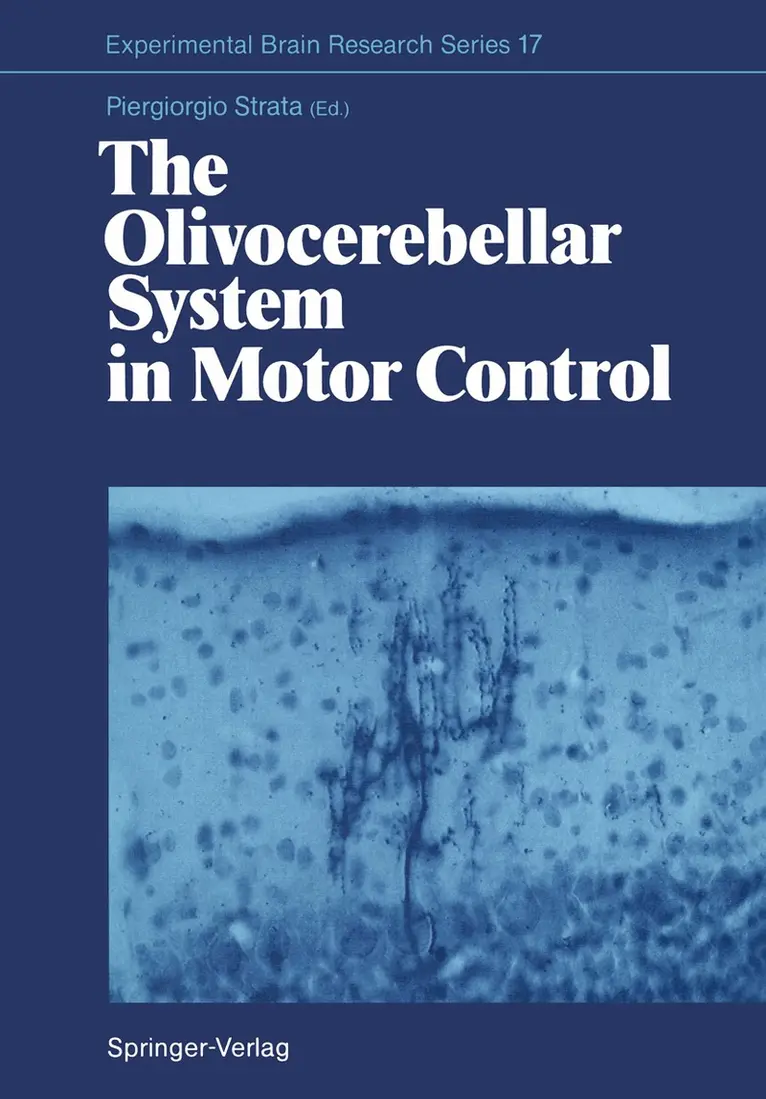
Recently, the role of the olivocerebellar projection in cerebellar operation has drawn the attention of many scientists who are trying to understand how the cerebellum controls movements. The papers published in this book were presented at a meeting held in Turin on August 9-12, 1987 as a satellite symposium of the 2nd World IBRO Congress in Budapest. It was planned in collaboration with Rodolfo Llinas and Masao Ito, although the latter was not able to attend. Some of the papers are in the form of reviews, others are short communications of new unpublished results. All aspects of research on the inferior olive are covered including morphology, neurotransmission, development, and electrophysiology, as well as its relation to behaviour and to human pathology. The lively, endless scientific discussions have not been published, but the reader may well imagine them from the different and sometimes contrasting pOints of views expressed in the papers. There are many examples showing that integrity of the inferior olive is necessary for some forms of motor learning and for the adaptive capabilities ofthe motor system. On the other hand, there is evidence that the inferior olive is important in controlling the dynamic characteristics of movement, both as a phasic and as a tonic operator. From this, two main viewpoints have emerged. The "plasticitists" attribute the role of inducing plastic changes to the synapse between the climbing fibre and the Purkinje cell.
1 096 kr
Skickas inom 10-15 vardagar
The present book is the outcome of a symposium on magnesium and excitable membranes, held in September 1989 on the occasion of the 12th annual meeting of the European Neuroscience Associ- ation in Torino. Leading specialists from around the world met in order to discuss the physiological and clinical effects of magne- sium on excitable cells. Magnesium ions are known to playa key role in the regulation of a variety of cell functions and, as such, have been implicated in the control of neuronal excitability and cardiovascular diseases. In the last decade, the advent of new electro physiological techniques has provided important details on the modulatory action of mag- nesium on ion channels and the receptor proteins of neurotrans- mitters. Thus, in neuronal and muscle cells, extracellular and in- is shown to block ion passage through open tracellular magnesium channels in a voltage- and time-dependent manner. The mecha- nism appears to be common for voltage- and receptor-operated channels, and it is thought to be an important cofactor in the long-term potentiation of synaptic transmission, brain aging, and cardiac activity.Recent findings show that the action of internal magnesium has additional features. High and low affinity sites for internal magnesium are involved in the regulation of channel gat- ings and ion permeation. Biochemical studies suggest that internal magnesium interferes with G-protein subunits, GTP-ase activity, and second messengers involved in channel phosphorylation.