P.L. Stoffa – författare
Visar alla böcker från författaren P.L. Stoffa. Handla med fri frakt och snabb leverans.
3 produkter
3 produkter
E-bok
PDF, Engelska, 1995672 kr
Läs direkt efter köp
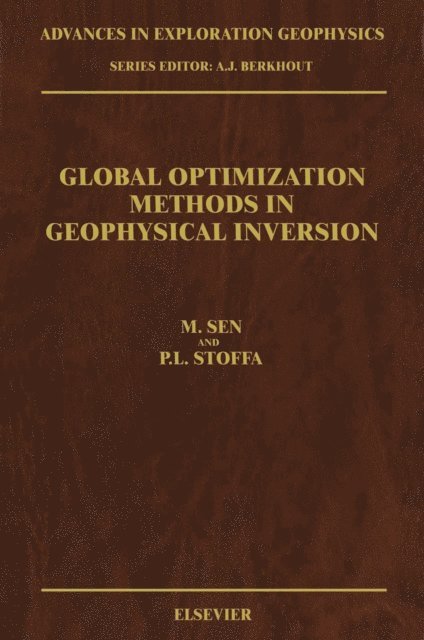
One of the major goals of geophysical inversion is to find earth models that explain the geophysical observations. Thus the branch of mathematics known as optimization has found significant use in many geophysical applications.Both local and global optimization methods are used in the estimation of material properties from geophysical data. As the title of the book suggests, the aim of this book is to describe the application of several recently developed global optimization methods to geophysical problems. • The well known linear and gradient based optimization methods have been summarized in order to explain their advantages and limitations• The theory of simulated annealing and genetic algorithms have been described in sufficient detail for the readers to understand the underlying fundamental principles upon which these algorithms are based• The algorithms have been described using simple flow charts (the algorithms are general and can be applied to a wide variety of problemsStudents, researchers and practitioners will be able to design practical algorithms to solve their specific geophysical inversion problems. The book is virtually self-contained so that there are no prerequisites, except for a fundamental mathematical background that includes a basic understanding of linear algebra and calculus.
E-bok
PDF, Engelska, 2012687 kr
Läs direkt efter köp
In exploration seismology, data are acquired at multiple source and receiver posi tions along a profile line. These data are subsequently processed and interpreted. The primary result of this process is a subsurface image of the exploration target. As part of this procedure, additional information is also obtained about the subsurface material properties, e.g., seismic velocities. The methods that are employed in the acquisition and processing of exploration seismic data are internally consistent. That is, principally near vertical incidence seismic waves are generated, recorded and subsequently imaged. The data processing methods commonly used are based upon a small angle of incidence approximation, thus making the imaging problem tractable for existing data processing technology. Although tremendously successful, the limitations of this method are generally recognized. Current and future exploration goals will likely require the use of additional seismic waves, i.e., both compressional and shear precritical and postcritical reflections and refractions. Also, in addition to making better use of seismic travel times, recent efforts to directly incorporate seismic amplitude variations show that the approach may lead to a better understanding of subsurface rock properties. In response to more demanding exploration goals, recent data acquisition techniques have improved significantly by increasing the spatial aperture and incorporating a large number of closely spaced receivers. The need for better subsurface resolution in depth and position has encouraged the use of 240, 512, and even 1024 recorded data channels with receiver separations of 5 to 25 m.
Del 8 - Modern Approaches in Geophysics
Tau-p: a plane wave approach to the analysis of seismic data
Häftad, Engelska, 2011
540 kr
Skickas inom 10-15 vardagar
In exploration seismology, data are acquired at multiple source and receiver posi tions along a profile line. These data are subsequently processed and interpreted. The primary result of this process is a subsurface image of the exploration target. As part of this procedure, additional information is also obtained about the subsurface material properties, e.g., seismic velocities. The methods that are employed in the acquisition and processing of exploration seismic data are internally consistent. That is, principally near vertical incidence seismic waves are generated, recorded and subsequently imaged. The data processing methods commonly used are based upon a small angle of incidence approximation, thus making the imaging problem tractable for existing data processing technology. Although tremendously successful, the limitations of this method are generally recognized. Current and future exploration goals will likely require the use of additional seismic waves, i.e., both compressional and shear precritical and postcritical reflections and refractions. Also, in addition to making better use of seismic travel times, recent efforts to directly incorporate seismic amplitude variations show that the approach may lead to a better understanding of subsurface rock properties. In response to more demanding exploration goals, recent data acquisition techniques have improved significantly by increasing the spatial aperture and incorporating a large number of closely spaced receivers. The need for better subsurface resolution in depth and position has encouraged the use of 240, 512, and even 1024 recorded data channels with receiver separations of 5 to 25 m.