Poulami Roychowdhury – författare
Visar alla böcker från författaren Poulami Roychowdhury. Handla med fri frakt och snabb leverans.
4 produkter
4 produkter
1 034 kr
Skickas inom 5-8 vardagar
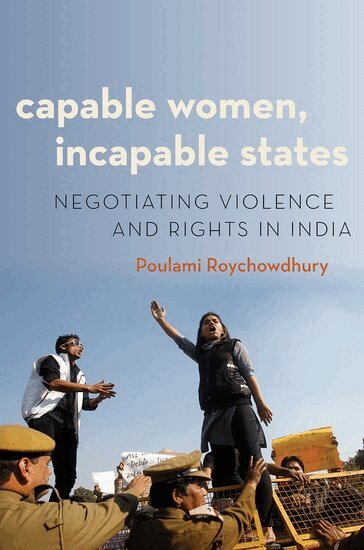
In recent decades, the issue of gender-based violence has become heavily politicized in India. Yet, Indian law enforcement personnel continue to be biased against women and overburdened. In Capable Women, Incapable States, Poulami Roychowdhury asks how women claim rights within these conditions. Through long term ethnography, she provides an in-depth lens on rights negotiations in the world's largest democracy, detailing their social and political effects. Roychowdhury finds that women interact with the law not by following legal procedure or abiding by the rules, but by deploying collective threats and doing the work of the state themselves. And they behave this way because law enforcement personnel do not protect women from harm but do allow women to take the law into their own hands.These negotiations do not enhance legal enforcement. Instead, they create a space where capable women can extract concessions outside the law, all while shouldering a new burden of labor and risk. A unique theory of gender inequality and governance, Capable Women, Incapable States forces us to rethink the effects of rights activism across large parts of the world where political mobilization confronts negligent criminal justice systems.
364 kr
Skickas inom 5-8 vardagar
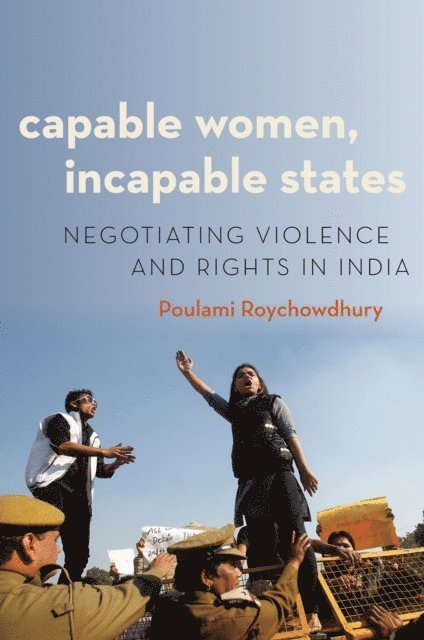
In recent decades, the issue of gender-based violence has become heavily politicized in India. Yet, Indian law enforcement personnel continue to be biased against women and overburdened. In Capable Women, Incapable States, Poulami Roychowdhury asks how women claim rights within these conditions. Through long term ethnography, she provides an in-depth lens on rights negotiations in the world's largest democracy, detailing their social and political effects. Roychowdhury finds that women interact with the law not by following legal procedure or abiding by the rules, but by deploying collective threats and doing the work of the state themselves. And they behave this way because law enforcement personnel do not protect women from harm but do allow women to take the law into their own hands.These negotiations do not enhance legal enforcement. Instead, they create a space where capable women can extract concessions outside the law, all while shouldering a new burden of labor and risk. A unique theory of gender inequality and governance, Capable Women, Incapable States forces us to rethink the effects of rights activism across large parts of the world where political mobilization confronts negligent criminal justice systems.
Unequal Contagion
Citizenship, Democracy, and the Politics of COVID-19 in India
Inbunden, Engelska, 2027
1 162 kr
Kommande
The COVID-19 pandemic was a global emergency, but its health, social, and economic effects were highly uneven. In India--one of the world's most unequal democracies--the pandemic and government responses unfolded across a hierarchical social landscape and uneven institutional terrain, producing starkly different experiences of risk, protection, and loss. In Unequal Contagion, Gabrielle Kruks-Wisner and Poulami Roychowdhury bring together an interdisciplinary group of scholars to analyze how long-standing patterns of inequality shaped pandemic experiences in India, how those inequalities were intensified by state responses, and how historically rooted forms of social mobilization and citizen-state relations helped, in some contexts, to mitigate their effects. Drawing on wide-ranging methods, from surveys to ethnography, chapter authors examine how centrally imposed lockdowns, disruptions to health systems, and uneven welfare provision interacted with class, caste, gender, religious, and regional inequalities. While responses varied substantially across states and localities, seemingly universal policy responses often amplified vulnerability--particularly among migrants, informal sector workers, women, and other marginalized groups--leaving many without access to livelihoods, healthcare, or protection from violence. Chapters also trace how access to healthcare, welfare, and relief depended not only on policy design but on everyday relationships between citizens, local officials, frontline workers, and civil society organizations. Grounded in India yet widely relevant, Unequal Contagion advances a relational and intersectional account of governance under stress. By linking sub-national variation in pandemic policy and welfare outcomes to historically embedded patterns of social mobilization and political engagement, the book offers insights on the formulation and implementation of emergency-related public policy in other unequal democracies, revealing how social inequality and uneven citizen-state relations shape who is protected and who is left vulnerable.
Unequal Contagion
Citizenship, Democracy, and the Politics of COVID-19 in India
Häftad, Engelska, 2027
297 kr
Kommande
The COVID-19 pandemic was a global emergency, but its health, social, and economic effects were highly uneven. In India--one of the world's most unequal democracies--the pandemic and government responses unfolded across a hierarchical social landscape and uneven institutional terrain, producing starkly different experiences of risk, protection, and loss. In Unequal Contagion, Gabrielle Kruks-Wisner and Poulami Roychowdhury bring together an interdisciplinary group of scholars to analyze how long-standing patterns of inequality shaped pandemic experiences in India, how those inequalities were intensified by state responses, and how historically rooted forms of social mobilization and citizen-state relations helped, in some contexts, to mitigate their effects. Drawing on wide-ranging methods, from surveys to ethnography, chapter authors examine how centrally imposed lockdowns, disruptions to health systems, and uneven welfare provision interacted with class, caste, gender, religious, and regional inequalities. While responses varied substantially across states and localities, seemingly universal policy responses often amplified vulnerability--particularly among migrants, informal sector workers, women, and other marginalized groups--leaving many without access to livelihoods, healthcare, or protection from violence. Chapters also trace how access to healthcare, welfare, and relief depended not only on policy design but on everyday relationships between citizens, local officials, frontline workers, and civil society organizations. Grounded in India yet widely relevant, Unequal Contagion advances a relational and intersectional account of governance under stress. By linking sub-national variation in pandemic policy and welfare outcomes to historically embedded patterns of social mobilization and political engagement, the book offers insights on the formulation and implementation of emergency-related public policy in other unequal democracies, revealing how social inequality and uneven citizen-state relations shape who is protected and who is left vulnerable.