Prosser - Böcker
Visar alla böcker från författaren Prosser. Handla med fri frakt och snabb leverans.
2 produkter
2 produkter
3 878 kr
Skickas inom 7-10 vardagar
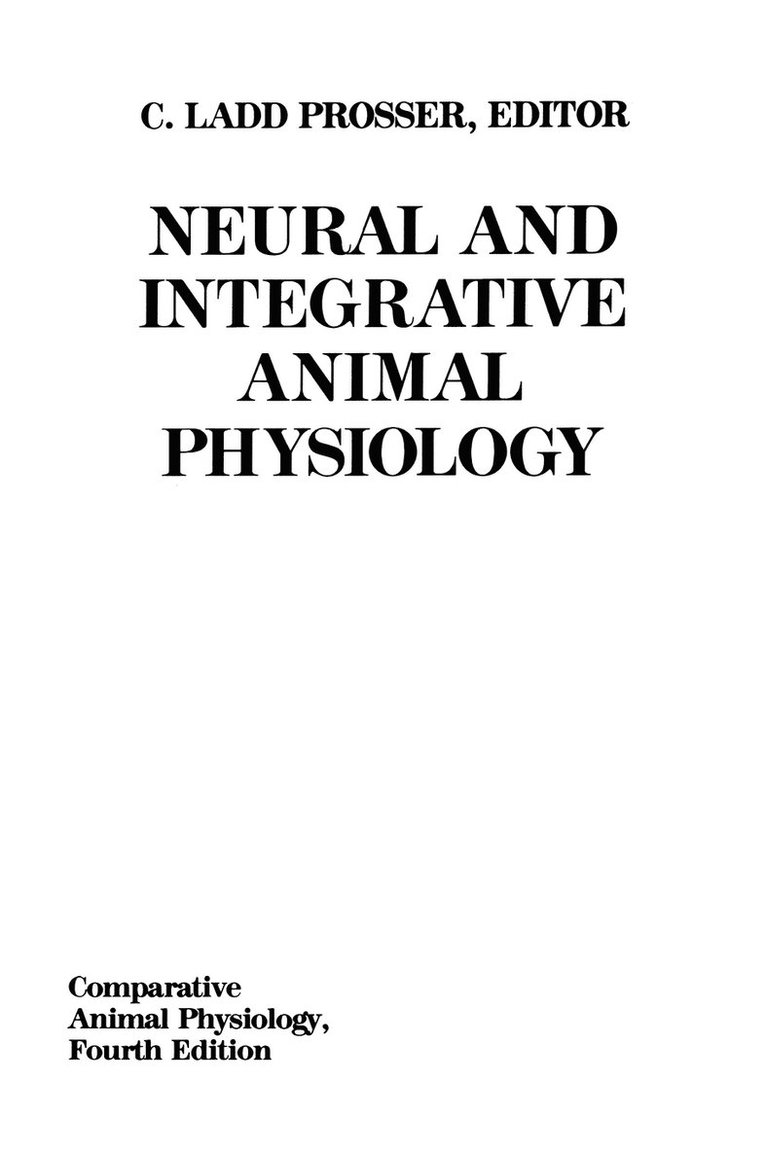
Here is a uniquely modern approach to the study of physiological diversity that builds on the tradition established by C. Ladd Prosser's Comparative Animal Physiology. Responding to the need for a rigorously up-to-date, comprehensive survey of function and integrative systems in a variety of species, which is also easily accessible to the user, Dr. Prosser has delivered a thoroughly revised Fourth Edition in a convenient two-volume format. This carefully designed framework lets each volume zero-in on distinct aspects of comparative physiology normally studied as a whole unit. From the study of genetically replicating molecules to investigations of adaptive modulation, these two companion volumes offer an all-encompassing view of the field. With their contemporary approach,scholarly editing, flexible format, and detailed contents, Neural and Integrative Animal Physiology and Environmental and Metabolic Animal Physiology will stand together as the authoritative source in the field.
534 kr
Skickas inom 10-15 vardagar
Ionic polymers, like elephants, are easier to recognise than to define. Several methods of classification have been attempted but none is wholly satisfactory because of the extreme diversity of ionic polymers, which range from the organic, water-soluble polyelectrolytes, through hydrogels and ionomer carboxylate rubbers, to the almost infusible inorganic silicate minerals. For this reason, a general classification is not only difficult, but has minimal utility. However, there are some characteristics of these materials that should be highlighted. The role of counterions is the significant one. These ions, either singly or as clusters, take part in the formation of ionic bonds which have a varying structural role. Often they act as crosslinks, but in the halato-polymers the ionic bonds form an integral part of the polymer backbone itself. Conversely, in polymers contain ing covalent crosslinks, such as the ion-exchange resins, the coun terions have virtually no structural role to play, since they dwell in cage-like structures without affecting the crosslinking, and are readily exchanged. They are, perhaps, best described as ion-containing polymers rather than structural ionic polymers. Another crucial factor is the role of water in ionic polymers. The presence of ionic bonds means that there is a tendency for these materials to interact with water. Where the ionic polymer contains a high proportion of ionic units, it acts as a hydrogel and may be highly soluble. Such interactions with water decrease sharply as the ionic content is reduced, though even then water can act as a plasticiser.