Przemyslaw Prusinkiewicz – författare
Visar alla böcker från författaren Przemyslaw Prusinkiewicz. Handla med fri frakt och snabb leverans.
4 produkter
4 produkter
Häftad, Engelska, 1996
979 kr
Skickas inom 3-6 vardagar
The beauty of plants has attracted the attention of mathematicians for Mathematics centuries. Conspicuous geometric features such as the bilateral sym and beauty metry of leaves, the rotational symmetry of flowers, and the helical arrangements of scales in pine cones have been studied most exten sively. This focus is reflected in a quotation from Weyl [159, page 3], "Beauty is bound up with symmetry. " This book explores two other factors that organize plant structures and therefore contribute to their beauty. The first is the elegance and relative simplicity of developmental algorithms, that is, the rules which describe plant development in time. The second is self-similarity, char acterized by Mandelbrot [95, page 34] as follows: When each piece of a shape is geometrically similar to the whole, both the shape and the cascade that generate it are called self-similar. This corresponds with the biological phenomenon described by Herman, Lindenmayer and Rozenberg [61]: In many growthprocesses of living organisms, especially of plants, regularly repeated appearances of certain multicel lular structures are readily noticeable. . . . In the case of a compound leaf, for instance, some of the lobes (or leaflets), which are parts of a leaf at an advanced stage, have the same shape as the whole leaf has at an earlier stage. Thus, self-similarity in plants is a result of developmental processes. Growth and By emphasizing the relationship between growth and form, this book form follows a long tradition in biology.
E-bok
PDF, Engelska, 20121 344 kr
Läs direkt efter köp
The beauty of plants has attracted the attention of mathematicians for Mathematics centuries. Conspicuous geometric features such as the bilateral sym and beauty metry of leaves, the rotational symmetry of flowers, and the helical arrangements of scales in pine cones have been studied most exten sively. This focus is reflected in a quotation from Weyl [159, page 3], "Beauty is bound up with symmetry. " This book explores two other factors that organize plant structures and therefore contribute to their beauty. The first is the elegance and relative simplicity of developmental algorithms, that is, the rules which describe plant development in time. The second is self-similarity, char acterized by Mandelbrot [95, page 34] as follows: When each piece of a shape is geometrically similar to the whole, both the shape and the cascade that generate it are called self-similar. This corresponds with the biological phenomenon described by Herman, Lindenmayer and Rozenberg [61]: In many growthprocesses of living organisms, especially of plants, regularly repeated appearances of certain multicel lular structures are readily noticeable. . . . In the case of a compound leaf, for instance, some of the lobes (or leaflets), which are parts of a leaf at an advanced stage, have the same shape as the whole leaf has at an earlier stage. Thus, self-similarity in plants is a result of developmental processes. Growth and By emphasizing the relationship between growth and form, this book form follows a long tradition in biology.
E-bok
PDF, Engelska, 20131 108 kr
Läs direkt efter köp
1-systems are a mathematical formalism which was proposed by Aristid 1indenmayer in 1968 as a foundation for an axiomatic theory of develop ment. The notion promptly attracted the attention of computer scientists, who investigated 1-systems from the viewpoint of formal language theory. This theoretical line of research was pursued very actively in the seventies, resulting in over one thousand publications. A different research direction was taken in 1984 by Alvy Ray Smith, who proposed 1-systems as a tool for synthesizing realistic images of plants and pointed out the relationship between 1-systems and the concept of fractals introduced by Benoit Mandel brot. The work by Smith inspired our studies of the application of 1-systems to computer graphics. Originally, we were interested in two problems: • Can 1-systems be used as a realistic model of plant species found in nature? • Can 1-systems be applied to generate images of a wide class of fractals? It turned out that both questions had affirmative answers. Subsequently we found that 1-systems could be applied to other areas, such as the generation of tilings, reproduction of a geometric art form from East India, and synthesis of musical scores based on an interpretation of fractals. This book collects our results related to the graphical applications of- systems. It is a corrected version of the notes which we prepared for the ACM SIGGRAPH ''88 course on fractals.
Inbunden, Engelska, 2000
2 296 kr
Tillfälligt slut
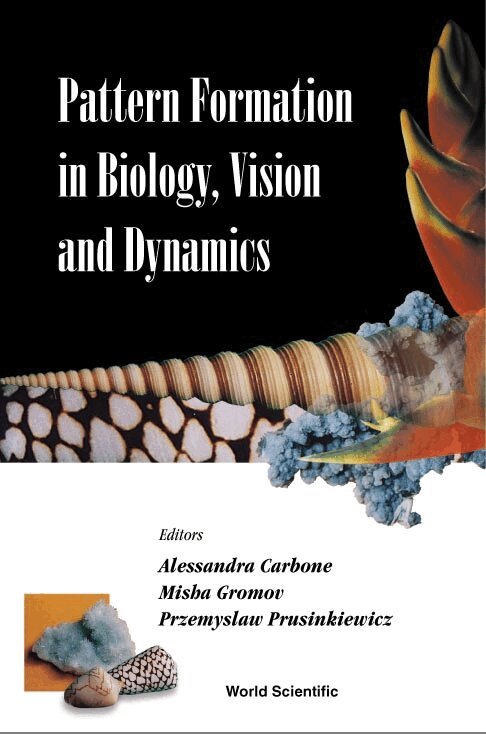
Half a billion years of evolution have turned the eye into an unbelievable pattern detector. Everything we perceive comes in delightful multicolored forms. Now, in the age of science, we want to comprehend what and why we see.Two dozen outstanding biologists, chemists, physicists, psychologists, computer scientists and mathematicians met at the Institut d'Hautes Etudes Scientifiques in Bures-sur-Yvette, France. They expounded their views on the physical, biological and physiological mechanisms creating the tapestry of patterns we see in molecules, plants, insects, seashells, and even the human brain. This volume comprises surveys of different aspects of pattern formation and recognition, and is aimed at the scientifically minded reader.