R. Bellman – författare
Visar alla böcker från författaren R. Bellman. Handla med fri frakt och snabb leverans.
4 produkter
4 produkter
Häftad, Engelska, 1992
824 kr
Skickas inom 5-8 vardagar
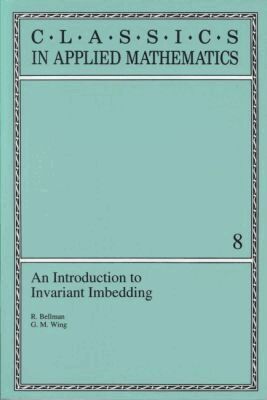
Here is a book that provides the classical foundations of invariant imbedding, a concept that provided the first indication of the connection between transport theory and the Riccati Equation. The reprinting of this classic volume was prompted by a revival of interest in the subject area because of its uses for inverse problems. The major part of the book consists of applications of the invariant imbedding method to specific areas that are of interest to engineers, physicists, applied mathematicians, and numerical analysts.A large set of problems can be found at the end of each chapter. Numerous problems on apparently disparate matters such as Riccati equations, continued fractions, functional equations, and Laplace transforms are included. The exercises present the reader with ""real-life"" situations.The material is accessible to a general audience, however, the authors do not hesitate to state, and even to prove, a rigorous theorem when one is available. To keep the original flavor of the book, very few changes were made to the manuscript; typographical errors were corrected and slight changes in word order were made to reduce ambiguities.
E-bok
PDF, Engelska, 2014779 kr
Läs direkt efter köp
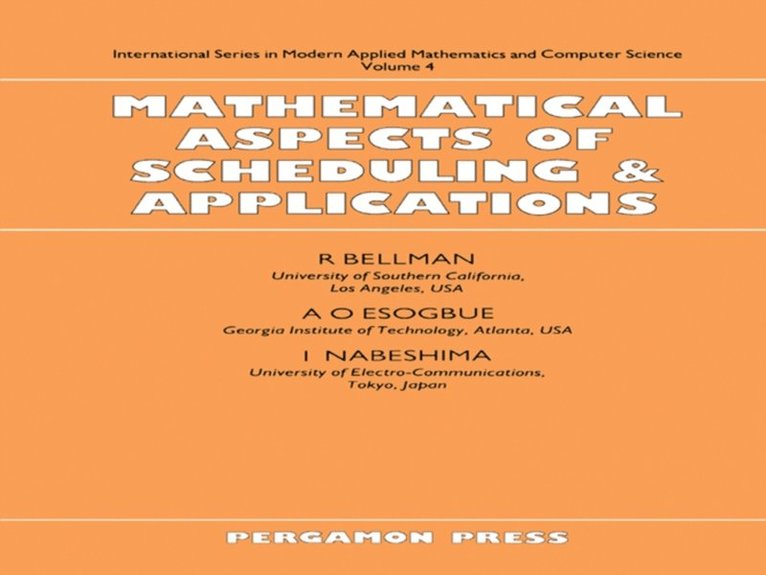
Mathematical Aspects of Scheduling and Applications addresses the perennial problem of optimal utilization of finite resources in the accomplishment of an assortment of tasks or objectives. The book provides ways to uncover the core of these problems, presents them in mathematical terms, and devises mathematical solutions for them. The book consists of 12 chapters. Chapter 1 deals with network problems, the shortest path problem, and applications to control theory. Chapter 2 stresses the role and use of computers based on the decision-making problems outlined in the preceding chapter. Chapter 3 classifies scheduling problems and their solution approaches. Chapters 4 to 6 discuss machine sequencing problems and techniques. Chapter 5 tackles capacity expansion problems and introduces the technique of embedded state space dynamic programming for reducing dimensionality so that larger problems can be solved. Chapter 6 then examines an important class of network problems with non-serial phase structures and exploits dimensionality reduction techniques, such as the pseudo-stage concept, branch compression, and optimal order elimination methods to solve large-scale, nonlinear network scheduling problems. Chapters 7 to 11 consider the flow-shop scheduling problem under different objectives and constraints. Chapter 12 discusses the job-shop-scheduling problem. The book will be useful to economists, planners, and graduate students in the fields of mathematics, operations research, management science, computer science, and engineering.
E-bok
PDF, Engelska, 20121 138 kr
Läs direkt efter köp
Häftad, Engelska, 2011
929 kr
Skickas inom 10-15 vardagar
Since the elassie work on inequalities by HARDY, LITTLEWOOD, and P6LYA in 1934, an enonnous amount of effort has been devoted to the sharpening and extension of the elassieal inequalities, to the discovery of new types of inequalities, and to the application of inqualities in many parts of analysis. As examples, let us eite the fields of ordinary and partial differential equations, whieh are dominated by inequalities and variational prineiples involving functions and their derivatives; the many applications of linear inequalities to game theory and mathe- matieal economics, which have triggered a renewed interest in con- vexity and moment-space theory; and the growing uses of digital com- puters, which have given impetus to a systematie study of error esti- mates involving much sophisticated matrix theory and operator theory. The results presented in the following pages reflect to some extent these ramifications of inequalities into contiguous regions of analysis, but to a greater extent our concem is with inequalities in their native habitat.Since it is elearly impossible to give a connected account of the burst of analytic activity of the last twenty-five years centering about inequalities, we have d. eeided to limit our attention to those topies that have particularly delighted and intrigued us, and to the study of whieh we have contributed.