R. Blanpain – författare
2 772 kr
Läs direkt efter köp
2 788 kr
Läs direkt efter köp
1 822 kr
Läs direkt efter köp
The workers in modern businesses face growing pressure as they attempt to combine their work with a family life and its associated responsibilities. This is a very relevant issue in many countries, but the approaches taken by governments, trades unions and employers'' organizations show a great variety.
The Harmonization of Working Life and Family Life includes seven national reports, representing a wide spectrum of approaches and measures. A review of the national reports reveals the variety of national approaches.
In many cases, measures such as flexible working hours and part-time working have been adopted without the specific intention of facilitating working and family life, but the result has nevertheless been beneficial in this area. Other countries have made the harmonization of work and family life the hallmark of their labour relations systems.
2 298 kr
Läs direkt efter köp
This volume provides a comparative overview of the ongoing changes in the legal regulation of industrial relations in the Central and Eastern European countries. It discusses the current transformation and development taking place in Bulgaria, Croatia, the Czech Republic, Hungary, Poland, Romania, Russia, the Slovak Republic and Slovenia, and provides the reader with an insight into how the fall of communism and the transition to market economies have affected the field of labour law throughout the region.
2 732 kr
Läs direkt efter köp
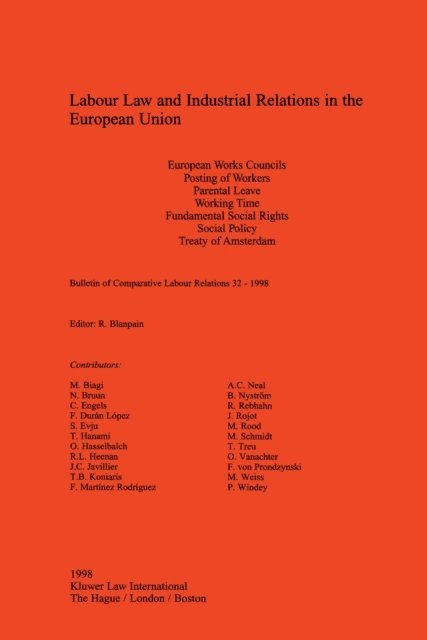
This work presents the discussion highlights and papers from the 28-29 April 1997 Conference held by the Euro-Japan Institute for Law and Business in Leuven-Belgium.
The work from this lively, focused conference covers the most significant recently-passed legislation, starting with the European Works Council Directive of 22 December 1994, and ending with the Treaty of Amsterdam presented in June 1997.
The bulk of Labour Law and Industrial Relations in the European Union focuses on the European Works Council Directive currently in force throughout all EU Member States and the EEA countries, except the United Kingdom. The discussion concentrates on the implementation process in the Member States, with national reports presented in alphabetical order by country, and additional reports from EEA countries, North America, and Japan.
The wide range of issues also discussed in this work includes:
• The important, recently passed Posting of Workers Directive which addresses the working conditions for sub-contracting, working in a group, or temporary work;• The first European collective agreement concluded on Parental Leave;• Fundamental Social Rights and their treatment at the Intergovernmental Conference of June 1997;• Developments on working time regulations within the EU; and• The newly promulgated Treaty of Amsterdam, with a focus on the social provisions.1 429 kr
Läs direkt efter köp
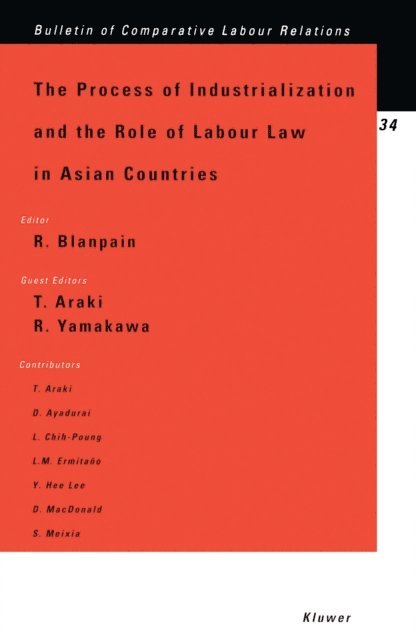
The role of state or the function of labour law during industrialization in Asian countries is of utmost importance when examining how Asian labour laws differ from European or American labour law models and whether or not any common characteristics exist in Asian labour law.
The seven national reports (Australia, China, Japan, Korea, Malaysia, the Philippines and Taiwan) included in this volume provide an overview of the regulation of union organization, collective bargaining and industrial disputes. These reports also analyze the role of government in industrial relations in the course of economic development. In regulations on formation of labour unions, some countries, such as Japan, have the least government intervention whereas other countries, for example Korea and Taiwan, have experienced more direct government control through imposition of certain forms of labour unions or registration requirements and procedures. The same applies to regulations on collective bargaining and industrial disputes. For instance, in Korea, Taiwan and Malaysia violation of collective agreements is not only sanctioned by civil liability but is also criminally punished. A review of the national reports reveals that while diversity in labour laws exists in the Asian countries represented, the significant role of government in labour relations is widely recognized. Through various modes of government there is commitment to the industrial relations ranging from direct intervention to indirect, soft, intervention.
Whether the government''s significant role in industrial relations in Asian countries is a transitional phenomenom which takes place during economic development and maturity of democracy, or Asian labour law is heading for a new labour law model which differs from the western model should be further examined. The national papers in this volume provide fundamental information on current labour laws in Asian countries and on comparable characteristics in western labour law models.
2 382 kr
Läs direkt efter köp
2 424 kr
Läs direkt efter köp
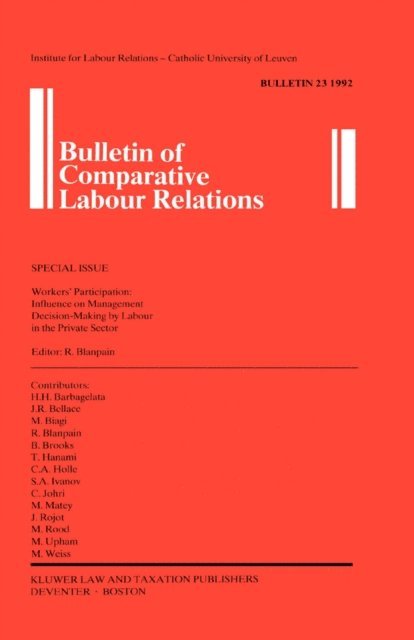
Workers'' participation continues to be an important and much debated, even contested, subject in industrial relations and human resource management. It is also a topic which evolves as the labour force becomes more educated, the economy more international and technology more advanced.
2 244 kr
Läs direkt efter köp
This publication gives an overview of the criteria of the existence of an employment relationship in the following 10 countries: Argentina, Australia, Belgium, France, Great Britain, Italy, Japan, The Netherlands New Zealand, and Scotland.
2 018 kr
Läs direkt efter köp
Recorded in this volume are some papers presented at an international symposium in comparative industrial relations held in Bologna on 11 January 1991, organized by SINNEA, research and training institute, in collaboration with The John Hopkins University, Bologna Center.
Key issues such as collective bargaining, health and safety matters, dismissal law and atypical labour are discussed in a comparative perspective in connection with the working environment of the small and medium-sized enterprises.
2 116 kr
Läs direkt efter köp
Even in countries which regard themselves as model democracies, such as the United States of America, the situation at the workplace may be entirely different with regard to the basic freedoms and equal treatment.
In the USA, which is a genuine democracy in a political sense, the importance which is attached to democratic values is not always apparent in the codes of conduct in American enterprises and organizations.
The degree to which democratic notions are put into practice in the industrial world is the basic theme of this 28th Bulletin entitled Employee Rights and Industrial Justice.
2 434 kr
Läs direkt efter köp
At the time of his brutal murder in March 2002, Marco Biagi was working with the Italian authorities to find ways and means of bringing innovative proposals in his field of expertise, labor and industrial relations. The White Paper to a large extent the work of Biagi himself, was commissioned by the Italian Ministry of Labour and Social Policy and first presented to the government in October 2001. The other collaborative works included in this volume, The ''Europeanisation'' of Industrial Relations and Changing Industrial Relations, are among Professor Biagi''s last writings.
At the core of these deeply committed studies lies a direct and positive response to the violent clash between the modern European heritage of social security and the unstoppable onset of globalisation. That such a response proved fatal is a potent reminder of perhaps the deepest rift in our society, a dangerously widening divide that demands the scrutiny and understanding of all lawyers, policymakers, and social scientists. This book clearly demonstrates that, for Biagi and his co-authors, such terms as "employability." "flexibility." "quality." and "security" must become measured legal terms representing social realities for employees as well as employers, and cannot be mere empty words masking "business as usual."
The importance of the White Paper cannot be overestimated, especially for Italy. Among the EU member States preparing to meet the standards of sustainable economic growth set out by the European Councils of Lisbon and Stockholm, Italy has the longest road to travel. For that very reason - and because of the seriousness of social unrest in Italy - its travails in this area can be seen as emblematic of an immense global social crisis that lurks in every country.
The second study in this volume analyses criteria for the quality of industrial relations in the EU as compared with those prevailing in the US, Japan, Russia, and the CEECs. Although each industrialised country has its own particular traditions and pressures to deal with in the world of work, this study finds evidence everywhere of intense change as well as persistent continuity. Furthermore, these commentators find that an overall European model of industrial relations cannot yet be discerned. Their recommendations, scrupulously built on existing realities, provide for a cohesive system including monitoring, incentives, interactions between different levels of policy making, new regulatory processes, and appropriate indicators, all of which will ensure an EU-wide improvement in quality of life both inside and outside work without weakening each member State''s responsibility and freedom to define its own policies.
As an unflinching corrective to the sterile ideology that paralyses progress in this vital area of social development, these two works are of great significance. They do not wave a magic wand and resolve the intractable issues with which they are concerned, but they succeed in isolating the essential elements of the problem and take a giant step toward understanding and a beginning of consensus.
The third part offers a few comments on the Report of the High Level Group on Industrial Relations and Managing Change in the European Union.
1 339 kr
Läs direkt efter köp
In recent years, a number of company bankruptcies in Europe - particularly in the Netherlands - have exposed serious gaps in the securing by law of reparations due to employees. As matters stand, employees - who were dependent upon the bankruptcy not only for their income but also for their employment and social security - have little to expect in terms of payment of arrears of pay, protection against dismissal, continued employment in the event of a business transfer, or participation rights.
This work opens this far-reaching and hugely important issue by comparing employee rights in bankruptcy among four major European trading partners - the Netherlands, the United Kingdom, Belgium and Germany. It is to be hoped that, armed with the substantive and procedural details that are fully laid out in these pages, company lawyers and bankruptcy lawyers throughout Europe will be enabled to bring the rights of employees in bankruptcy into a light at least as clear as that focused on other creditors.
The contributors examine not only the individual fairness issue - the unequal position of the employee as weaker party in the labour market - but also the central policy issue: does an improvement of the position of employees in a bankruptcy give rise to less willingness on the part of lenders to keep the flow of money open, or greater control by lenders over the way in which borrowers run their businesses with, as a result, slower economic growth and hence a lower level of employment?
The study was commissioned by the Stichting Ondersteuningsfonds Oud-Werknemers DAF (Benevolent Fund Foundation for Former DAF Employees) in Eindhoven and carried out by researchers of the Faculty of Law of the Katholieke Universiteit Brabant in Tilburg. Its provisional findings, presented at the conference on "Employee Rights in Bankruptcy" held in Tilburg on 8 December 1999, were considered and discussed from a variety of viewpoints by representatives of such relevant parties as trade unions and employers'' organizations, receivers in bankruptcy, banks, public authorities, politicians and legal experts. The end result is this report, which is sure to contribute to a better understanding of the difficult issue of employee rights in bankruptcy and to stimulate discussion of remedies that are indispensable to the maintenance of a responsible society.
2 116 kr
Läs direkt efter köp
Although no-one disputes that employment relations worldwide have been greatly affected by globalisation, no clear consensus has emerged on the nature and significance of this impact. The seven contributions to this symposium pursue a comparative approach, suggesting that direct analysis of employment relations in distinct industries in two comparably-sized economies since the advent of globalisation leads to a more precise understanding of the interaction of globalisation and employment relations, and sets a pattern for other studies to follow.
The economies studied in the symposium are Australia and Korea, and the industries are automobile (and auto parts) manufacturing and retail banking. In both countries, labour unions play a key role in the way in which employers and governments react to political and economic pressures.
Among the particular topics discussed by the contributors are the following:
effects of the 1997 financial crisis in Korea; the extent to which the automobile industry in one country (Korea) depends on parts and raw material from another country (Australia);• cross-border co-operation between unions;• the growing trend toward enterprise bargaining;• conciliation and arbitration of industrial disputes; and• the role of government-sponsored industrial relations commissions.The contributing authors are all industrial relations authorities in Australia or Korea. The in-depth analysis they offer in these very specific areas will be of value to labour lawyers and industrial relations scholars everywhere for the light it sheds on this crucial aspect of contemporary social and economic development.
2 760 kr
Läs direkt efter köp
Far from settling into a recognisable pattern, the new employment relationship spawned by globalisation and communications technology continues to evolve. If the labour law and industrial relations community are to retain expertise and social utility in their vital role, constant monitoring of the field and discussion is essential. It was to further this purpose that the Club of Labour Law Journals held a conference in Brussels in April 2001, under the auspices of the Royal Flemish Academy of Belgium and the Society for Social and International Cooperation. This book is the record of that significant conference.
The presentations and discussion proceed along four main avenues: the "battle for the brains," the impact of atypical work arrangements, the concept of employability, and the online rights of workers. Important questions addressed include:
• Do globalisation and high technology necessarily go hand in hand?• Which skills increase employability? • What are the social factors of employability? • Are contingent and partly dependent workers protected in a fair way? • To what degree can the employment contract be stabilized? • How can we tackle the erosion of social security provisions? • To what extent should intra-company electronic resources be regulated? • What is the relation between employers and illegal immigrants?Participants include representatives from Belgium, Germany. Italy, Spain, the United Kingdom, Australia, Japan, South Africa, Latin America, and the United States.
For an understanding of the current realities of industrial relations from a global perspective, The Evolving Employment Relationship and the New Economy is essential reading. It will greatly assist lawyers, employers, policymakers, and academics to proceed conscientiously and creatively toward the definition of much-needed values and guidelines in this crucial area of economic activity.