R. Fraisse - Böcker
Visar alla böcker från författaren R. Fraisse. Handla med fri frakt och snabb leverans.
3 produkter
3 produkter
Del 145 - Studies in Logic and the Foundations of Mathematics
Theory of Relations
Inbunden, Engelska, 2000
1 825 kr
Skickas inom 7-10 vardagar
Relation theory originates with Hausdorff (Mengenlehre 1914) and Sierpinski (Nombres transfinis, 1928) with the study of order types, specially among chains = total orders = linear orders. One of its first important problems was partially solved by Dushnik, Miller 1940 who, starting from the chain of reals, obtained an infinite strictly decreasing sequence of chains (of continuum power) with respect to embeddability. In 1948 I conjectured that every strictly decreasing sequence of denumerable chains is finite. This was affirmatively proved by Laver (1968), in the more general case of denumerable unions of scattered chains (ie: which do not embed the chain Q of rationals), by using the barrier and the better orderin gof Nash-Williams (1965 to 68).Another important problem is the extension to posets of classical properties of chains. For instance one easily sees that a chain A is scattered if the chain of inclusion of its initial intervals is itself scattered (6.1.4). Let us again define a scattered poset A by the non-embedding of Q in A. We say that A is finitely free if every antichain restriction of A is finite (antichain = set of mutually incomparable elements of the base). In 1969 Bonnet and Pouzet proved that a poset A is finitely free and scattered iff the ordering of inclusion of initial intervals of A is scattered. In 1981 Pouzet proved the equivalence with the a priori stronger condition that A is topologically scattered: (see 6.7.4; a more general result is due to Mislove 1984); ie: every non-empty set of initial intervals contains an isolated elements for the simple convergence topology.In chapter 9 we begin the general theory of relations, with the notions of local isomorphism, free interpretability and free operator (9.1 to 9.3), which is the relationist version of a free logical formula. This is generalized by the back-and-forth notions in 10.10: the (k,p)-operator is the relationist version of the elementary formula (first order formula with equality).Chapter 12 connects relation theory with permutations: theorem of the increasing number of orbits (Livingstone, Wagner in 12.4). Also in this chapter homogeneity is introduced, then more deeply studied in the Appendix written by Norbert Saucer.Chapter 13 connects relation theory with finite permutation groups; the main notions and results are due to Frasnay. Also mention the extension to relations of adjacent elements, by Hodges, Lachlan, Shelah who by this mean give an exact calculus of the reduction threshold.The book covers almost all present knowledge in Relation Theory, from origins (Hausdorff 1914, Sierpinski 1928) to classical results (Frasnay 1965, Laver 1968, Pouzet 1981) until recent important publications (Abraham, Bonnet 1999).All results are exposed in axiomatic set theory. This allows us, for each statement, to specify if it is proved only from ZF axioms of choice, the continuum hypothesis or only the ultrafilter axiom or the axiom of dependent choice, for instance.
534 kr
Skickas inom 10-15 vardagar
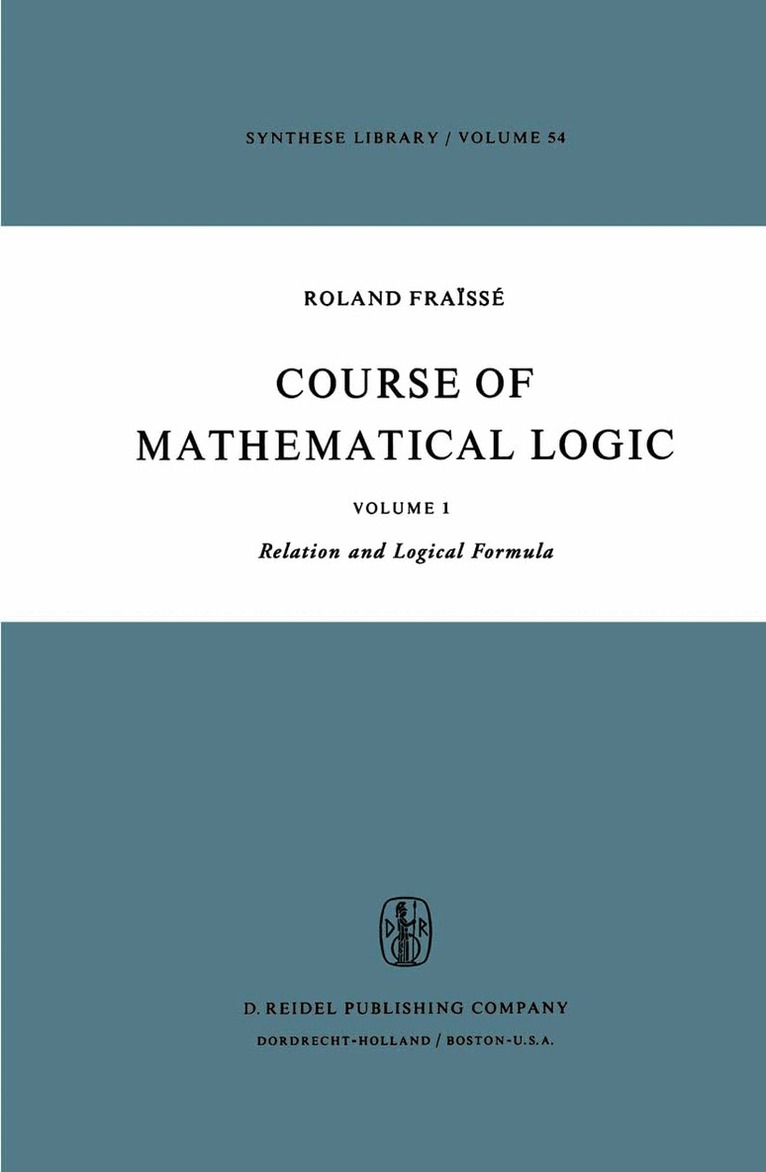
This book is addressed primarily to researchers specializing in mathemat ical logic. It may also be of interest to students completing a Masters Degree in mathematics and desiring to embark on research in logic, as well as to teachers at universities and high schools, mathematicians in general, or philosophers wishing to gain a more rigorous conception of deductive reasoning. The material stems from lectures read from 1962 to 1968 at the Faculte des Sciences de Paris and since 1969 at the Universities of Provence and Paris-VI. The only prerequisites demanded of the reader are elementary combinatorial theory and set theory. We lay emphasis on the semantic aspect of logic rather than on syntax; in other words, we are concerned with the connection between formulas and the multirelations, or models, which satisfy them. In this context considerable importance attaches to the theory of relations, which yields a novel approach and algebraization of many concepts of logic. The present two-volume edition considerably widens the scope of the original [French] one-volume edition (1967: Relation, Formule logique, Compacite, Completude). The new Volume 1 (1971: Relation et Formule logique) reproduces the old Chapters 1, 2, 3, 4, 5 and 8, redivided as follows: Word, formula (Chapter 1), Connection (Chapter 2), Relation, operator (Chapter 3), Free formula (Chapter 4), Logicalformula,denumer able-model theorem (L6wenheim-Skolem) (Chapter 5), Completeness theorem (G6del-Herbrand) and Interpolation theorem (Craig-Lyndon) (Chapter 6), Interpretability of relations (Chapter 7).
534 kr
Skickas inom 10-15 vardagar
This book is addressed primarily to researchers specializing in mathemat ical logic. It may also be of interest to students completing a Masters Degree in mathematics and desiring to embark on research in logic, as well as to teachers at universities and high schools, mathematicians in general, or philosophers wishing to gain a more rigorous conception of deductive reasoning. The material stems from lectures read from 1962 to 1968 at the Faculte des Sciences de Paris and since 1969 at the Universities of Provence and Paris-VI. The only prerequisites demanded of the reader are elementary combinatorial theory and set theory. We lay emphasis on the semantic aspect of logic rather than on syntax; in other words, we are concerned with the connection between formulas and the multirelations, or models, which satisfy them. In this context considerable importance attaches to the theory of relations, which yields a novel approach and algebraization of many concepts of logic. The present two-volume edition considerably widens the scope of the original [French] one-volume edition (1967: Relation, Formule logique, Compacite, Completude). The new Volume 1 (1971: Relation et Formule logique) reproduces the old Chapters 1, 2, 3, 4, 5 and 8, redivided as follows: Word, formula (Chapter 1), Connection (Chapter 2), Relation, operator (Chapter 3), Free formula (Chapter 4), Logicalformula,denumer able-model theorem (L6wenheim-Skolem) (Chapter 5), Completeness theorem (G6del-Herbrand) and Interpolation theorem (Craig-Lyndon) (Chapter 6), Interpretability of relations (Chapter 7).