R. J. Hamilton – författare
Visar alla böcker från författaren R. J. Hamilton. Handla med fri frakt och snabb leverans.
4 produkter
4 produkter
1 434 kr
Tillfälligt slut
This book presents a practical guide to the laboratory techniques commonly used in the analysis of lipids. It covers methods of lipid extraction in solvent and solid phase systems, as well as methods of derivation formation needed for a number of analytical procedures such as gas liquid chromatography and mass spectrometry. The book also describes in practical detail the techniques for complete analysis of both isolated lipids and lipid mixtures. These include GLC, HPLC, TLC and NMR. These molecules are found in every living system, and are of interest to the chemical, biotechnological and pharmaceutical industries in addition to academic research workers.
1 061 kr
Skickas inom 10-15 vardagar
534 kr
Skickas inom 10-15 vardagar
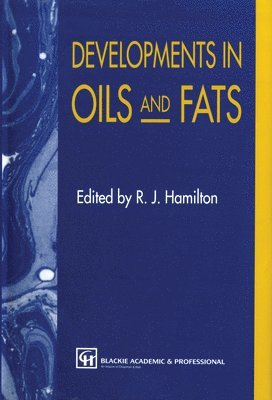
This first volume in a series is intended to provide up-to-date information on specific topics in oils and fats. The oils and fats industry is closely aligned with the food industry and it is no surprise to find that five of the chapters (1, 2, 3, 6 and 7) are written from a food perspective.
534 kr
Skickas inom 10-15 vardagar
Since we produced Fats and Oils: Chemistry and Technology in 1980, the trend we anticipated to up-date the classical texts of oils and fats has manifested itself. Bailey's famous textbook has been completely revised and a second edition of Bernardini's work has been produced. The present text is an attempt to provide some insight into the current state of the art. Chapter 1 discusses the physical properties of oils and fats with special reference to those properties which can be monitored to give an in dication of the suitability of fats for chocolate production. The physical properties of the fats are often determined by the order in which the fatty acids are attached to the glyceride molecule. Ram Bhati, in the last article he wrote before his death, showed how mass spectrometry and chemical methods could be used to determine the sequence of fatty acids. Ram's essentially practical approach to the problem is exemplified by the section dealing with the experimental details of the techniques. Chapter 3 outlines some of the problems which can arise in industry when the lipid part of a foodstuff undergoes oxidation, whilst in Chapter 4 Patterson describes the major technique, hydrogenation, which is used to circumvent the problems caused by oxidation of the unsaturated fatty acids. In Chapter 4 the essentials of the theory are given to enable the reader to appreciate the design features of the apparatus. Chapter 5 deals with the analysis, mainly chromatographic, of lipids.