R. Nieuwenhuys – författare
Visar alla böcker från författaren R. Nieuwenhuys. Handla med fri frakt och snabb leverans.
7 produkter
7 produkter
Häftad, Engelska, 1985
1 460 kr
Skickas inom 10-15 vardagar
The purpose of this book is threefold: (1) review, and I realized that the script had to present a short but comprehensive survey spontaneously taken on the size and format of the localization of a number of transmit- of a book. I wrote a letter to Mr. B. Lewer- ich, of Springer-Verlag, advising him that ters and other neuroactive principles in the mammalian central nervous system, (2) to there would be some delay in the production provide some comments on the relation be- of the third edition of The Human Central tween "classical" neuroanatomy and "chem- Nervous System, that I happened to have gen- ical" neuroanatomy, and (3) to suggest that erated an entirely different book on a brand by a synthesis of these two approaches of knowledge usually referred to as 'chemical "new" entities in the brain can, be delin- neuroanatomy', and that I should like to eated. publish this work, as previous ones, with of the origin of this volume is Springer. Mr. Lewerich's reply was quite The history somwhat unusual and may be worth relating. characteristic: 'I must admit that, in spite In a previous book, namely Nieuwenhuys, of seven years of cooperation, you still suc- Voogd and Van Huijzen: The Human Central ceed in surprising me; I had not the slightest Nervous System (second editi9n, 1981), there idea about your plans so far.
E-bok
PDF, Engelska, 20121 367 kr
Läs direkt efter köp
Although a large body of data about the structure of the central nervous system of cartilaginous fishes has now been accumulated, a systematic survey of the neuromorphology of this, in so many respects, highly interesting group of animals is lacking. The present book is an effort to fill this gap. The information provided is derived partly from the literature and partly from original observations based on our own material. We have attempted to present a complete review of the relevant literature of the last 25 years, but the earlier literature has also been thoroughly scrutinized. Wherever possible we have commented on the functional significance of the various structures. The information available in the literature has been incorporated with our own findings from a detailed study of four species, the sharks Squalus acanthias and Scyliorhinus canicula, the ray Raja clavata and the holocepha Ii an Hydrolagus collei. Although these species do not reflect the total range of cartilaginous fishes they do exemplify the main features of the major groups.
Häftad, Engelska, 2011
1 092 kr
Skickas inom 10-15 vardagar
Although a large body of data about the structure of the central nervous system of cartilaginous fishes has now been accumulated, a systematic survey of the neuromorphology of this, in so many respects, highly interesting group of animals is lacking. The present book is an effort to fill this gap. The information provided is derived partly from the literature and partly from original observations based on our own material. We have attempted to present a complete review of the relevant literature of the last 25 years, but the earlier literature has also been thoroughly scrutinized. Wherever possible we have commented on the functional significance of the various structures. The information available in the literature has been incorporated with our own findings from a detailed study of four species, the sharks Squalus acanthias and Scyliorhinus canicula, the ray Raja clavata and the holocepha Ii an Hydrolagus collei. Although these species do not reflect the total range of cartilaginous fishes they do exemplify the main features of the major groups.
E-bok
PDF, Engelska, 20121 722 kr
Läs direkt efter köp
E-bok
PDF, Engelska, 20121 142 kr
Läs direkt efter köp
Purpose and Plan This atlas, though primarily intended for medical students, mayaiso be expected to This atlas has been designed with the object be useful as a quick pictorial review for of providing a comprehensive pictorial practitioners in the various neurological survey of the macroscopic and microscopic SClences. structure of the human central nervous s- tem. The pictorial material encompasses 154 Material, Techniques, and Preparation half-tone and li ne drawings, all derived of the Illustrations from original macroscopic and microscopic preparations. Considerable thought has The gross anatomical section of this atlas been given in the preparation of these draw is based on eight brains and one spinal cord of adult individuals with no record of n- ings to an optimal combination of c1arity and exactness. Moreover great pains have rological diseases. These specimens were been taken to achieve a maximal coherence fixed for at least two months in formalin. of thematically related figures. The illustra One specimen was used for the illustrations tions are arranged in four sections. The first showing the external morphology. This section depicts the gross appearance and brain was then serially sliced into 2-mm three-dimensional structure of the brain thick sections in the coronal plane. Three and spinal cord. The second section in other brains were sliced in the three other c1udes dra wings of a number of wh oIe brain conventional planes: sagittal, horizontal slices, sectioned in four different directions.
E-bok
PDF, Tyska, 2014535 kr
Läs direkt efter köp
E-bok
PDF, Engelska, 20131 142 kr
Läs direkt efter köp
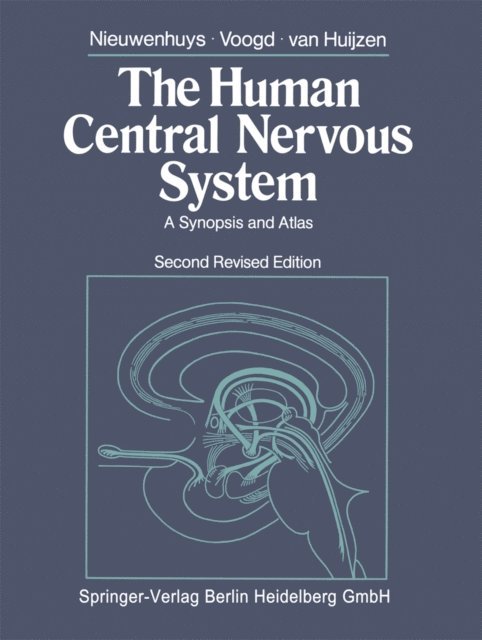
The particularly good reception enjoyed by our "The Human Central Ner vous System, a Synopsis and Atlas" has made a second edition necessary, hardly more than two years after its first appearance: This new edition enabled us to make a number of corrections, but it was judged premature to undertake a thorough updating of the text. However, a major improvement - suggested by some reviewers and many colleagues - is that in this new edition the abbreviations in the figures have been replaced by the full Latin terms. We want to emphasize that the study of this book can facilitate and deepen but never replace the study of the anatomical preparation. Acquaintance and histology of nervous tissue has been taken for with the basic cytology granted. This book is evidently often consulted with the aim of looking up a particular and its topographical relations. This cer structure together with its name is tainly one of the purposes of the book. We are, however, of the opinion that during a systematic study of the figures showing the functional systems in part IV, perusal of the accompanying text will be necessary. As a matter of fact the spatial representations of the fibre systems are no more than a visualization of the most salient features discussed in the text. The pictures are so to speak a snapshot of the current knowledge of a particular functional system within the central nervous system; no less, but no more either.