Ralph Jeffery - Böcker
Visar alla böcker från författaren Ralph Jeffery. Handla med fri frakt och snabb leverans.
3 produkter
3 produkter
153 kr
Skickas inom 10-15 vardagar
A survey of some of the main-line developments in trigonometric series. It is an extension of a Presidential address to Section III of the Royal Society of Canada. Part I deals briefly, in chronological order, with the mathematical problems that arose out of trigonometric series and the interactions between these problems and general mathematical analysis. There is mention of the contributions of Euler, Daniel Bernoulli, d'Alembert, Fourier, Lagrange, Dirichlet. This is followed by a description of some of the problems still open at the end of the period covered by these men, and a description of the way these problems were later solved by Denjoy, by Zygmund and Marcinkiewicz, by Burkill and by James. Part II gives complete proofs of the results of the earlier period outlined in Part I, and concludes with the essential details of the approach of Denjoy and of James.Canadian Mathematical Congress Lecture Series, No. 2.
287 kr
Skickas inom 7-10 vardagar
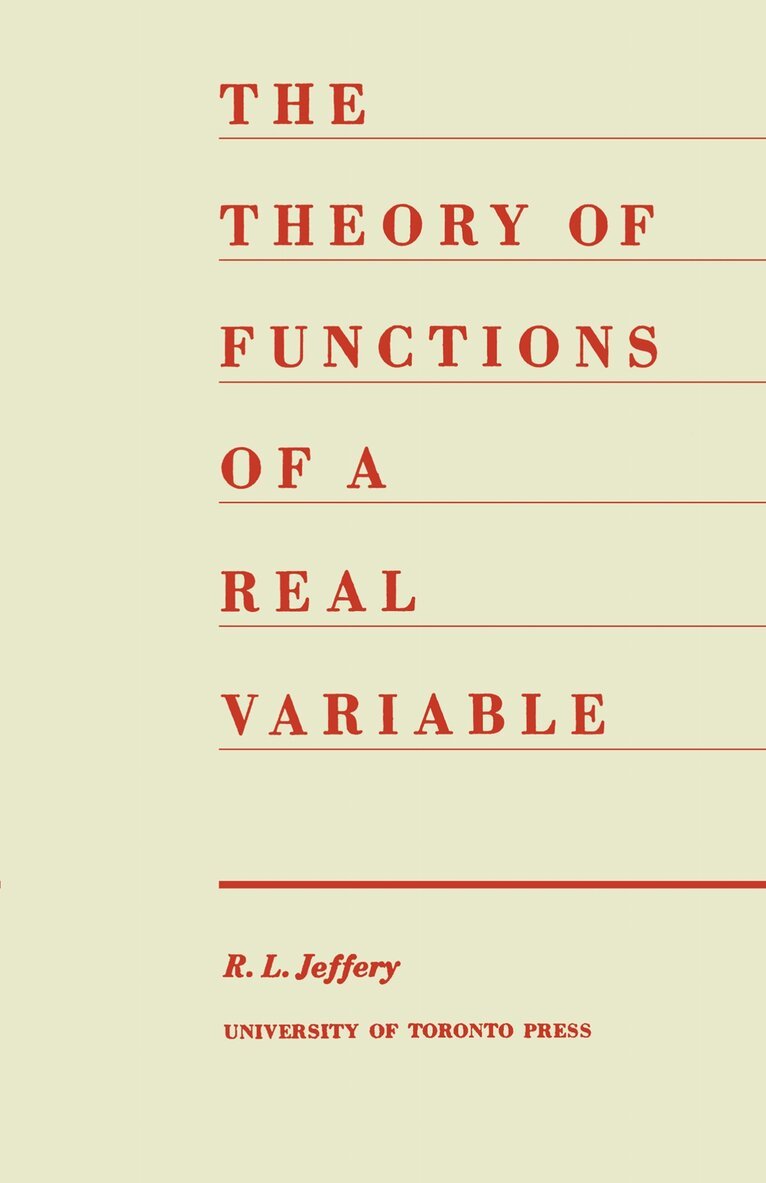
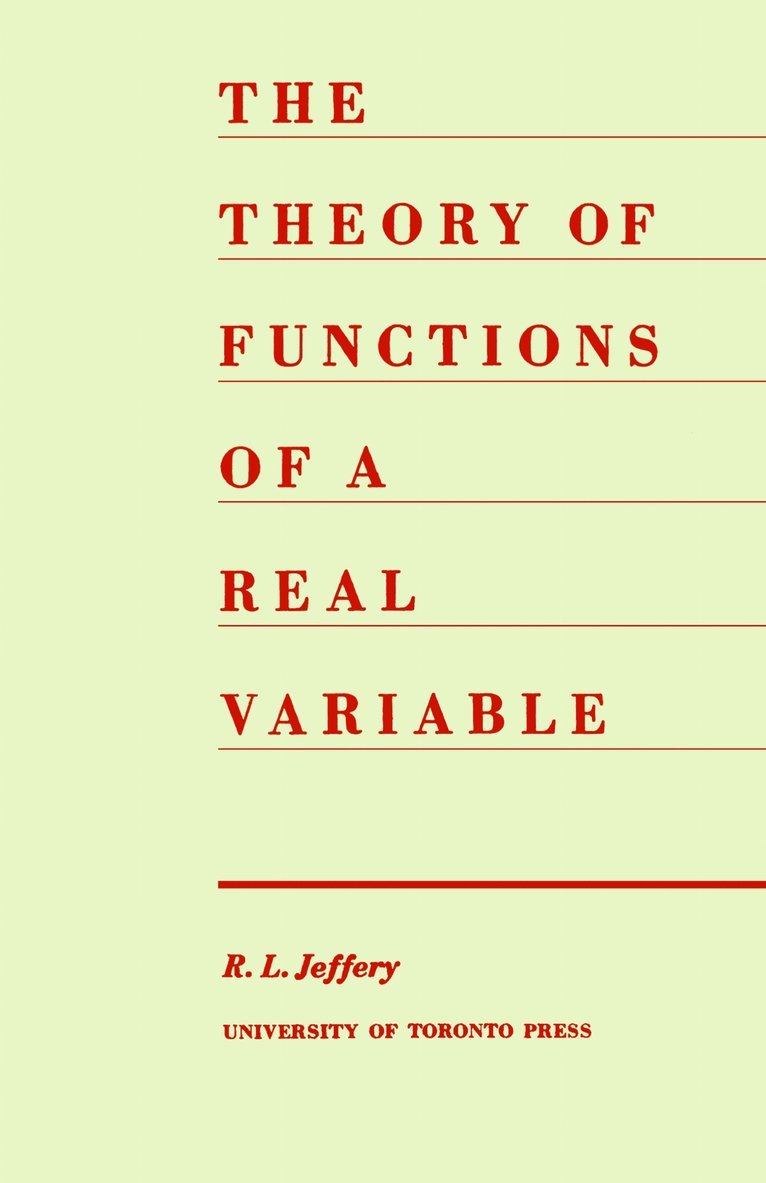
This textbook leads the reader by easy stages through the essential parts of the theory of sets and theory of measure to the properties of the Lebesgue integral. The first part of the book gives a general introduction to functions of a real variable, measure, and integration, while the second part treats the problem of inverting the derivative of continuous functions, leading to the Denjoy integrals, and studies the derivates and approximate derivates of functions of a real variable on arbitrary linear sets. The author considers the presentation of this second part as the main purpose of his book.
351 kr
Skickas inom 7-10 vardagar
Since first publication in 1954, this text has been widely used in North American universities in introductory courses in science and engineering. It is a streamlined text, in which essential ideas are not buried in endless detail. For science students and engineers the sine qua non is formal training in the techniques and manipulations which they will use in their regular engineering courses and in their professional work. But at the same time there is in every class a small group who have an interest in knowing the reasons back of their manipulative work. In Professor Jeffery's text, a framework of fundamental principles is always in sight and available. In the new edition, the study of the definite integral has been moved ahead from Chapter VII to Chapter V. The differential and the differential notation are introduced and used soon after the derivative has been defined. Some topics have been added—the chain rule for partial derivatives, directional derivatives, l'Hospital's rule, determinants, and linear dependence relative to vectors. More practice problems, especially in determining anti-differentials, have been added and where experience has shown it desirable, more detailed explanations have been given.