Ramesh S. V. Teegavarapu - Böcker
Visar alla böcker från författaren Ramesh S. V. Teegavarapu. Handla med fri frakt och snabb leverans.
4 produkter
4 produkter
1 364 kr
Skickas inom 11-20 vardagar
Radar Rainfall Data Estimation and Use, MOP 139, provides a detailed look at the basic philosophy and principles for estimating radar rainfall data and analyzing data. Radar-derived rainfall estimation is one of the most significant recent advances in hydrologic engineering and practice. Manual of Practice 139 provides a framework for researchers and practicing engineers working in hydrologic engineering to develop radar rainfall data sets and analyze them according to their varied goals and resources. This manual will be a valuable resource for government agencies, engineering firms, and practicing engineers working in the hydrologic engineering field.|Radar Rainfall Data Estimation and Use, MOP 139, provides a detailed look at the basic philosophy and principles for estimating radar rainfall data and analyzing data. Radar-derived rainfall estimation is one of the most significant recent advances in hydrologic engineering and practice. Manual of Practice 139 provides a framework for researchers and practicing engineers working in hydrologic engineering to develop radar rainfall data sets and analyze them according to their varied goals and resources. This manual will be a valuable resource for government agencies, engineering firms, and practicing engineers working in the hydrologic engineering field.|Prepared by the Standard Practice on Radar Rainfall Estimation Task Committee of the Environmental and Water Resources Institute of ASCERadar Rainfall Data Estimation and Use, MOP 139, provides a detailed look at the basic philosophy and principles for estimating and analyzing radar rainfall data and analyzing data. Radar-derived rainfall estimation is one of the most significant recent advances in hydrologic engineering and practice. Rain gauges provide point values of rainfall depth and intensity but are not cost effective in providing information about the spatial distribution of rainfall, whereas radar-derived rainfall data provides a density of measurements that are not obtainable by rain gauges alone. Combining these two sensor systems produces better rainfall estimates that more accurately characterize rainfall across a watershed. This Manual of Practice provides a framework for researchers and practicing engineers working in hydrologic engineering to develop radar rainfall data sets and analyze them according to their varied goals and resources. Topics includeAn introduction to and examples of radar rainfall estimation, Temporal and spatial characteristics of radar rainfall data,Methodology for radar rainfall data quality evaluation and improvement,Use of radar rainfall data in hydrologic modeling,Rainfall data augmentation and design of rainfall monitoring networks, andExamples of radar rainfall data analysis and data applications.MOP 139 will be a valuable resource for government agencies, a framework for engineering firms, practicing engineers, researchers, and students working in the hydrologic engineering field.
1 100 kr
Tillfälligt slut
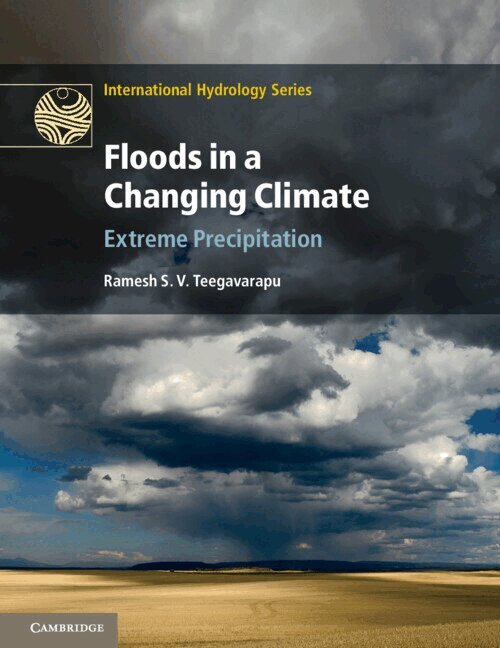
Measurement, analysis and modeling of extreme precipitation events linked to floods is vital in understanding changing climate impacts and variability. This book provides methods for assessment of the trends in these events and their impacts. It also provides a basis to develop procedures and guidelines for climate-adaptive hydrologic engineering. Academic researchers in the fields of hydrology, climate change, meteorology, environmental policy and risk assessment, and professionals and policy-makers working in hazard mitigation, water resources engineering and climate adaptation will find this an invaluable resource. This volume is the first in a collection of four books on flood disaster management theory and practice within the context of anthropogenic climate change. The others are: Floods in a Changing Climate: Hydrological Modeling by P. P. Mujumdar and D. Nagesh Kumar, Floods in a Changing Climate: Inundation Modeling by Giuliano Di Baldassarre and Floods in a Changing Climate: Risk Management by Slodoban Simonović.
687 kr
Skickas inom 7-10 vardagar
Measurement, analysis and modeling of extreme precipitation events linked to floods is vital in understanding changing climate impacts and variability. This book provides methods for assessment of the trends in these events and their impacts. It also provides a basis to develop procedures and guidelines for climate-adaptive hydrologic engineering. Academic researchers in the fields of hydrology, climate change, meteorology, environmental policy and risk assessment, and professionals and policy-makers working in hazard mitigation, water resources engineering and climate adaptation will find this an invaluable resource. This volume is the first in a collection of four books on flood disaster management theory and practice within the context of anthropogenic climate change. The others are: Floods in a Changing Climate: Hydrological Modeling by P. P. Mujumdar and D. Nagesh Kumar, Floods in a Changing Climate: Inundation Modeling by Giuliano Di Baldassarre and Floods in a Changing Climate: Risk Management by Slodoban Simonović.
1 423 kr
Kommande
This unique compendium focuses on the use and applications of the state-of-the-art exploratory data analysis and statistical methods to understand the concept of stationarity and assessment based on hydroclimatic data. Stationarity assessment is the key for hydrologic design, particularly in the context of changing climate.The comprehensive text presents a thorough discussion of the parametric, unit root and non-parametric methods adopted for stationarity assessment with their vivid practical examples, issues and implications.This useful reference manual benefits researchers, professionals, academics and graduate students in the fields of hydrology, climate change and climatology.