Randall Guynn - Böcker
Visar alla böcker från författaren Randall Guynn. Handla med fri frakt och snabb leverans.
2 produkter
2 produkter
4 388 kr
Skickas inom 5-8 vardagar
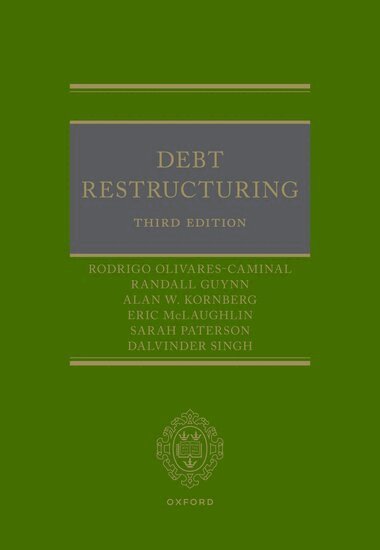
The new third edition of Debt Restructuring offers detailed legal analysis of international corporate, banking, and sovereign debt restructuring, from the perspective of creditors and debtors. It provides practical guidance to help practitioners, policy-makers, and academics in the UK and US to understand current developments in debt restructuring, and provides solutions for creditors holding distressed debt and debtor options in a distressed scenario.The Corporate Debt section includes significant changes to highlight the impact of COVID-19 on restructurings, including: potential grounds for investors/lenders to modify or terminate commitments to fund or support restructurings by invoking material adverse effect or force majeure clauses; unprecedented relief granted by insolvency courts to aid ailing retailers; and challenges facing insolvency courts in making necessary confirmation findings regarding the feasibility of reorganization plans due to market instability. This section also includes the recent adoption of the Part 26A Restructuring Plans and the EU Restructuring Directive. Amendments to the Bank Resolution section reflect decisions by the Single Resolution Board, and national authority resolution decisions notified to the European Banking Authority. A new sub-section on domestic bank insolvency and liquidation covers the developments under the Deposit Guarantee Schemes Directive, and a new chapter on insolvency law relating to Insurance Firms addresses the international debate on a special resolution regime for insurance firms. Other updates include the 2017 code of practice, the 'third country' branch model after Brexit, non-equivalence regarding depositor protection arrangements, and the Resolvability Assessment Framework.In the Sovereign Debt section, there is detailed coverage of US and UK developments, examining the increased role of sanctions and the possibility of piercing the corporate veil in SoEs (Chrystallex), as well as the increased push for domestic laws to be used to curtail litigation. It also covers developments in re-designation and the emergence of the 'pac-man technique' in the context of collective action clauses, as a result of the recent restructurings of Argentina and Ecuador. The impact of COVID-19 on the adoption of the Debt Service Suspension Initiative and the Common Framework are also analysed.
4 139 kr
Skickas inom 5-8 vardagar
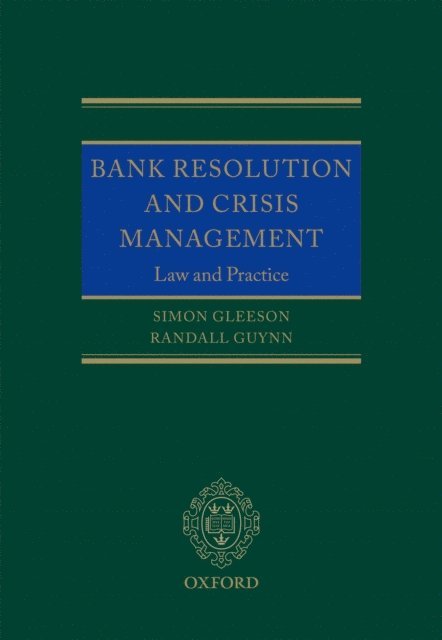
The 2008 global financial crisis ushered in the biggest explosion in new bank regulation around the world since the Great Depression. Even more so than then, this new regulation has been coordinated on a global basis and reflects global standards as well as local idiosyncracies. Although governments and regulators have sought to put measures in place to prevent the failure of banks, they have acknowledged the need for measures to address what happens when banks fail or are threatened with failure and how to resolve such failure. Bank Resolution and Crisis Management: Law and Practice deals with the measures which European, U.S. and international law and policy makers have sought to put in place to deal with the threat of financial institutions failing, including enhanced supervision, early intervention and so called 'living wills'. Measures such as 'bail-out' (protecting private shareholders and creditors against losses) and 'bail-in' (imposing losses on shareholders and long-term creditors without causing contagion among short-term creditors) are discussed. The work includes comprehensive summaries and commentary on the EU Bank Recovery and Resolution Directive, the UK resolution laws including the Banking Act 2009 and amendments to that act, the Orderly Liquidation Authority under Title II of the U.S. Dodd-Frank Act, proposed new Chapter 14 to the U.S. Bankruptcy Code, and the bank resolution provisions of the U.S. Federal Deposit Insurance Act. The book also provides detailed commentary on the provisions in the Banking Act 2009 dealing with resolution, including discussion of the stabilisation, bank administration and insolvency powers. This includes analysis of secondary legislation such as the Partial Transfers Order. Special emphasis is given to the practical effect of such measures on financial transactions and their impact on arrangements, such as netting and set-off. There is also commentary on the Financial Services Investor Compensation Scheme and its role in returning money to the depositors in a failing bank. The special position of failing investment banks is also a feature of the book. Coverage includes analysis of the legislation adopted to address the particular issues that arose in the failure of Lehman Brothers and the resulting litigation, particularly that relating to the recovery of client assets. This work will be invaluable for regulatory, transactional and insolvency lawyers and other professionals advising banks on their powers and governance processes, in structuring and documenting transactions and in dealing with banks in the course of insolvency proceedings.