Raphael Asram Vidya Order – författare
77 kr
Läs direkt efter köp
What is suggested in this small book is an operational synthesis that may be taken as the basic scheme for any possible Way to realization.
When an aspirant is stimulated to undertake the Way leading to the realization of the Self, when he or she is no longer interested in the multitude of books available on the most varied subjects and has ceased talking haphazardly of spiritual things, his consciousness demands of him a more operative and decisive action, aimed at solving his restless yearnings. At this point, from a vague wandering, a searching here and there, he will move on to the concrete application of his sādhanā (realizative ascesis) and to the choice of a Path that is most congenial to his psychological state.
For one who is ready, this operational synthesis could prove to be sufficient to raise him to the realization of that Being that is and does not become. For one who is mature, just a few indications are sufficient to enable him to put his wings back on and fly to Freedom.
If an ens (integral being) lives in conflict, in material and psychological suffering, restlessness and dissatisfaction, it means that something is not working within himself, or something is wrong in his life conduct. It may be that his way of living rests on an incorrect vision of existence, that he is following a dead-end philosophy of life, so much that he resigns himself and proceeds by force of inertia, or passively conforms to the chaotic collective unconscious, without any prospect of ever emerging from it.
Yet, without a doubt, there are optimal solutions for the restless and anguished human being. But one should be more responsive, more flexible, more humble and ready to listen to a voice which one is unlikely to run into in this world of dichotomy.
Maturity, that is often gained under the hammer of suffering, sooner or later will force us to remove the Eye of intelligence from things that are not (world of duality) and direct it toward the splendour of one''s own essential nature. Undoubtedly, this implies an overturning of values, a psychological revolution, tending no longer toward the ineffective and unfruitful horizontal line, but toward the vertical one leading to awakening, to the unveiling of marvelous potentialities, the prerogative of the human soul.
I will give you the keys to open the doors of the Temple.
In It you will find the regenerating Fire
that will expand you as much as creation,
the flaming sword to fight the binding darkness,
the resplendent and constant Truth.
Raphael
92 kr
Läs direkt efter köp
The first part of At the Source of Life is presented in dialogue form. Wherever there is a question there is a void that needs to be filled, a lack of knowledge to be met, a doubt to be clarified, and hence a truth that needs only to be revealed, because since ''all is within ourselves'', that truth, too, will be found in the depths of our being. With this certainty as his starting-point, Raphael often answers one question with another question, and with a skill akin to Socrates'' maieutic art, obliges the questioner to retreat further and further into himself, until the answer he was seeking is brought forth into the light.
Looking at the subject-matter of the text, it depicts the whole of man''s psychical and intellectual make-up, indicates his ideals, his deviations, and his weaknesses, traces his conflicts and sufferings to their causes, and at the same time iIn order to transform ourselves we must know and study ourselves, understand who our enemies are and fight them. Very often we are unable to recognize them and, sometimes, when we evaluate our mistakes, we tend to attribute to an object the importance that we should rather give to our reaction to it.
All philosophies have dealt with the problem of desire. Raphael offers a solution to the problem by identifying clearly, and above all with the aim of realization, the following steps: embracing the desire, mastering it, directing it, and transcending it: ''one who has transcended desire in all its forms is with the gods.''
Throughout the book there is continuous mention of the mind; one whole chapter is dedicated to the complexity of the mental processes, and the mind is seen as a limited tool for perceiving external data. Being unable to turn to face the knowing subject (''Nobody can dance on his own shoulders''), the mind begins its work of projection and creates the ego, time, space and causality, thus preventing us from knowing the Ultimate Reality. This is why we must reduce the mind to silence, but we are hindered by the crystallized subconscious accumulations which the past has produced within us. These are the ''wandering spectres'', the ''ghosts which smell of death'', from which we must liberate ourselves by means of a ''rectification'', which will give us the possibility of eliminating all that makes us slaves of the past, and of correcting those discordancies and disharmonies that have distorted the harmony of our rhythms.
The questions and answers come to an end with the exhortation to remember that we are the Absolute and with the mention of Art as being the means to the transformation of ideas into colours, words, sounds etc. The less they are qualified by the ego, the closer they will be to perfection.
The second part of the book is entitled the ''Pathway of Fire'' and contains a series of sūtras or aphorisms, each of which is permeated by a vibrating and penetrating force which is far more than the beauty of its expression, for it aims to shake the reader out of his inertia and awaken him from his lethargy.
Raphael understands that only those who possess the necessary qualifications can undertake this path, since there are other paths that are well-suited to people''s different individual qualifications. Yet he continues to repeat that today it is imperative to ''transform oneself''.
One must not think that these aphorisms are lyrical flights of fancy expressed in a poetical form which is an end in itself. This is the style of pure metaphysical realization, which aims at teaching you to observe the dying out of the last central Fire into which all the others have dissolved.
92 kr
Läs direkt efter köp
This book is a collection of topics which Raphael has presented in the form of short articles over a number of years. Although the topics vary, they are all concerned with the subject of traditional Knowledge, and they have been brought together with the aim of being useful to all of those who take a practical interest in the Way of Realisation. In the course of the book there are repetitions, but since we are dealing with writings which stimulate self-comprehension, the repetitions, seen from a traditional perspective, have their place.
The three sections of the book - Fire of the Philosophers, Fire of Ascent, Fire of Awakening - refer to ''Fire'', and since Raphael often speaks of the ''Way of Fire'' in his writings, it is good to emphasise that we are not dealing with a new teaching or with something personal or individual, or with a syncretistic teaching, but with the ''universal Way'' to realise our own Essence, because, fundamentally, every traditional Branch reveals itself as a ''pathway of fire''. Let us quote some words of Raphael: ''He who is writing, having received the Asparśa and Advaita Vedānta teaching, at a certain point during his sādhanā was told to light the Fire, to burn himself with the Fire and to resolve himself into Fire.'' We also find a reference to this Fire in the Kaṭha Upaniṣad (I, I, 13-14): ''O Yama, thou who knowest the Fire which leadeth to Heaven, do thou reveal it unto me, who am full of faith.'' ''I shall teach thee that Fire, O Nachiketas, which will exalt thee to Heaven.''
In the kali yuga, it seems that Raphael wishes to present us, especially in the West, with the traditional Teaching from a purely metaphysical point of view.
In a world where the various traditional or initiatory Branches clash with each other through blind incomprehension, Raphael indicates how to transcend all types of ''dogmatic sectarianism'' by helping us to recognise that the different Branches are nothing but formal expressions of a single Reality which underlies every genuinely traditional Teaching. The outward diversity of the Teaching can be resolved only through a metaphysical Vision, a vision which synthesises the apparent facets which operate exclusively at the level of the sensible world.
This vision, especially in the West, is deficient for a number of reasons which it would take too long to explain. We would simply say that the West in general is more empirical, pragmatic, dogmatic, and so more individualistic, paying little attention to the Sacred and extensively developing the discursive or dianoetic mind. This extreme individualism can be noted in various fields such as those of politics, literature, and religion. In the West - with some exceptions - it is a very difficult undertaking to get three people to agree with each other; and if one were to succeed, it would immediately give rise to ''currents'' or factions, alternatives with so much ''innocence''.
It is only through a metaphysical conception in which all possible points of view are synthesised that the West would be able to rediscover agreement, tolerance, and the possibility of effecting the influence of the Greater Mysteries, or paravidyā, the lack of which has caused the ''fall'' into the cul-de-sac of materialism.
Thus, by placing himself in the metaphysical Vision, Raphael is able to verify that Parmenides, Plato, Plotinus, Gauḍapāda, and others have expounded the same nucleus of principles of the single Teaching, the same goal which the individual must attain.
92 kr
Läs direkt efter köp
The universe is life at many dimensions, many systems of co-ordinates, and the individual combines or synthesises the various systems within his own nature.
The human being is not merely a physical and functional compound: he is thought and also spirit, however threadbare and vague this term may be.
That the universe has many dimensions is a fact which science itself has acknowledged. That the individual has ''faculties'' which extend beyond the physical is also something which is coming to the surface in practical ways. On the other hand, to think of a human being as a mere function, a glandular secretion and excretion strikes us as an unreasonable distortion. Restricting the being to its exclusively unilateral and horizontal condition of action strikes us as a levelling-down of its totality, a metallising of consciousness and intelligence on a mere grid of co-ordinates.
This book shows the unfolding of a psychological crisis, an ascent, and a self-discovery. It takes the form of a dialogue: and a dialogue is the meeting of two hearts, an osmosis of waves set in motion by experiences; it is self-bestowal; it is the life-force which creates growth.
A dialogue which is an end in itself is not a dialogue but a release of emotion, a mode of expression, a parade of erudition.
In the dialogue there is no rivalry, no desire, no release of tension.
This realisative dialogue between Raphael and Antonio unfolded over a number of years. It has been adapted to make a complete book, but in actual fact it contained pauses, simple considerations, interventions - sometimes long ones - on the part of Antonio, and periods of silence on the part of Raphael. However, they both have two aims in common: to seek and find, and to withdraw into oneself.
It is worth stating that this book is not scholarly. If the dialogue touches on points of Vedānta philosophy, it is merely expressing the Teaching on which realisation must be based. Throughout the text there is some hint of this.
On the other hand, Antonio''s particular mind-set and the specific Teaching of Vedānta gave rise to a dialogue which was at times focused on metaphysical principles; and however protracted the themes were, it was thought right to put together these parts which might be more directly useful to the Western reader.
To all who read this text we offer our hope that they will seek and find fullness within themselves and be able to give it to others who are open to receive it.
77 kr
Läs direkt efter köp
The Author of this book acknowledges that he has merely touched the surface of the issue of the Sacred Mysteries and the events that have characterised the life of Orpheus. On the other hand, it is not his task to expatiate on a problem that would not provide any advantage but would simply serve to satisfy empirical intellective curiosity.
To say that the Philosophy of Pythagoras, Parmenides, Plato, and so on, belongs to the Philosophia perennis because it is not, in fact, individual and limited by time is not to detract from their personality. Far from it, for this is to acknowledge them as ''mediators'', ''divine transmitters'', or avatāras, as they would be called in the East.
If one could comprehend the Philosophy of Plato in its essence and realise it in practice, one would undoubtedly reach the point of transfiguring one''s own being.
Plato''s Philosophy is Metaphysics based on a supra-ontological Principle, a theology, an ontology, a mysticism, and an ethic which is both individual and social: all of which take practical form in an authentic teaching which is initiatory in the widest sense of the word.
And Orpheus? What can we say of this great Sage, Magus, Theologian, Innovator, Rectifier; this ṛṣi, to use the word from Vedānta? As the following pages will seek to show, Orpheus is another mediator/bridge, a great avatāra, who rectified the cult of Dionysus which had deteriorated and had become superstition; revealed Truth of an intelligible and Apollonian order; devised a science of Rite and Number by means of music; instituted the Mysteries, both the Lesser and the Greater; left behind him, under the aegis of Apollo [ἀ-πόλλων = not many], an impression, a vibration, an influence of such magnitude that they can still be felt today. Furthermore, he exerted a considerable influence on the minds of the philosophers of ancient Greece and therefore on all subsequent philosophers.
The present era in the history of humanity is characterised by an intense numbness of consciousnesses and a strong focus of attention upon the sphere of the physical and sensible: these absorb all the energies.
The human being, as such, must acknowledge that he is composed of two elements: the titanic (to use an Orphic word) and the divine. It is for each consciousness to establish whether to unite with the divine or with the titanic.
But fortunately this ambiguity is not absolute, because the titanic element is only a ''superimposition'' on pure Reality, although this superimposition can assume such a thickness and consistency that it is taken to be real. No one will ever be able to destroy the Divinity which is within the human being, for it is an intrinsic part of his nature.
At the present time humanity lives so completely under the stamp of this false nature as to be its defenceless prisoner. Truth has been turned on its head: what appears is real, and what really is is false.
Those who feel a sense of responsibility, who hear the call of the Soul to a life of transfiguration, who are deaf to the allurements of worldly power, erudite opinion, criticism for exalting or demolishing others, who truly wish to strip themselves of their egoic trappings, are undoubtedly able, if they also feel humble and trusting, to prepare themselves for the time when traditional Truth will arise.
Essence and Purpose of Yoga
Initiatory ways to the Transcendent
187 kr
Skickas inom 5-8 vardagar
122 kr
Läs direkt efter köp
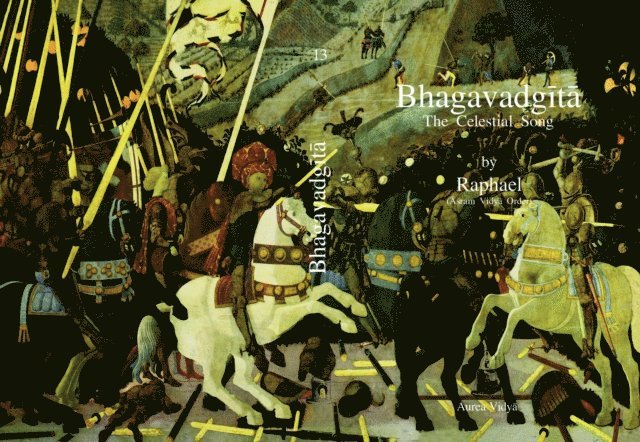
The Bhagavadgītā belongs to the VI book of the Mahābhārata, the great Indian epic attributed to the legendary Vyāsa. It is a poetic and philosophical work which in time is placed in the V century B.C. Together with the Brahmasūtra and the classical Upaniṣads it constitutes the Praśthānatraya, the "Threefold Science" of Vedānta.
The Bhagavadgītā came to light in a moment of both contrasts and new inner requirements of the Indian people. It contributed to the vitality of the upaniṣadic flame of Knowledge, while it pacified the prevailing philosophical and spiritual debates of the times. The Gītā clarified the unity of Truth in its multifarious aspects, and in so doing it provided everybody, in a wise and enlightened way, the opportunity to follow without doctrinal conflicts the most appropriate path for everyone.
In the "Preface" to the book, Raphael indicates four points which are essential to the comprehension of the text in the appropriate dimension:
- Traditional comprehension of the concept of the Divine.
- Comprehension of the moment and event that determined the birth of the Gītā.
- Traditional comprehension of the social orders.
- Comprehension of the right approach to the various ways leading to the Divine.
The value of the Gītā is paramount, if one just thinks that it hinges on action, which is at the base of life and which cannot be avoided or relinquished by anyone, as it reveals, in a world permeated with movement and conflict, the secret of "action without action". Under this perspective it can be of fundamental importance to the Westerners who are essentially more in favor of action than of contemplation.For one who is on the plane of action, not to become enslaved and dominated by activism, it is necessary to comprehend perfect acting devoid of the imprisoning attachment-desire, and to transcend individual qualifications. In fact, where the individual separating ego rules, there also are revealed its aberrant attributes which cause conflict and pain; and, sooner or later, the individual who places itself in such a condition cannot but find, like Arjuna, its battlefield (kurukṣetra) or the field of discipline and energetic re-education (tapahkṣetra).
Raphael''s commentary unfolds along a psychological, philosophical and initiatory thread with specific reference to the kṣatriya (the lawmakers and warriors social order) initiation. Raphael points out that under certain aspects we are all kṣatriyas, because we are all engaged in a struggle, at times unequal, between knowledge-vidyā and ignorance-avidyā. The Bhagavadītā, as all authentic traditional teachings, is not indicating quietistic or finalistic attitudes, nor possible flights, but it nails us down to our responsibilities ("Forced by karma - inherent in your nature - despite your will, one day you will do that which, being now at a loss, you refuse to do", XVIII, 60) and to our unavoidable duty-dharma: that of comprehending, transforming and transcending ourselves.
Awakening
232 kr
Skickas inom 5-8 vardagar
107 kr
Läs direkt efter köp
The ''Way of Fire'' expounded by Raphael is that via operativa which leads to the kindling of the Fire, the mastering and directing of the Fire, and the solution of this Fire.
This process of realisation, in harmony with the initiatory Tradition, is made practical through three lines of work, suiting each person''s qualifications:
1. Realisation according to Alchemy
(Section I, Chapter I)
2. Realisation according to the Love of Beauty
(Section I, Chapter II)
3. Realisation according to Traditional Metaphysics
(Section I, Chapter III).
What does Raphael understand by Alchemy?
He understands the transmutation of ''lead'' into shining, radiant Gold, the transmutation of all our individualised psychosomatic powers into universal Powers. This involves a profound rectification and distillation of our individualised earthly fire, so that it becomes Fire which interpenetrates everything, illumines everything, and resolves everything.
The second chapter of the first section is devoted to Realisation according to the Love of Beauty. It is the way for those who are sensitive to ''transcendental Aesthetics'' as Harmony/Accord with the intelligible world.
According to Coomaraswamy, Brahman, or the supreme Being, may be appreciated as Beauty, Truth, or Perfection, according to whether it is considered from the viewpoint of aesthetics, epistemology, or ethics.
Art is an expression of Beauty; science, in its broad meaning, of Truth; ethics, of Perfection; while the philosophia perennis, or traditional metaphysics, embraces all three. This shows that these three expressions are nothing but a unity: Beauty contains Truth and Perfection; Truth contains Beauty and Perfection; and Perfection cannot but contain Beauty and Truth.
The third chapter is devoted to the ''metaphysical Way''. It is useful for all who, putting to one side the limited discursive mind, wish to enter the domain of pure Intellectuality (nóesis). In this dimension the two previous roads merge, because all quantities (number) and all qualities (tones) resolve themselves in the One-without-a-second.
The chapters of the second Section complement and assist the three chapters of the first section, touching on specific points of guidance for spiritual discipline/ascesis. For example, the chapter devoted to ''Superimposition'' is relevant and complementary to the third chapter of the first section. In the same way, ''Desirelessness'', ''The empirical ego'', and so on, complement the first chapter, while others assist all three chapters.
92 kr
Läs direkt efter köp
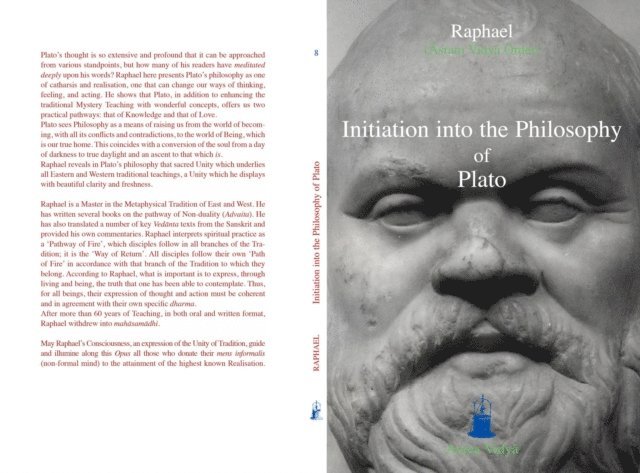
In these pages Raphael gives just a simple introduction to the Teaching of Plato, sending the seeker back to direct meditation on the texts.
According to Giovanni Reale, so much has been written and continues to be written about Plato - and in all the main languages - that it is now quite impossible to master all these writings. It is therefore understandable why a number of scholars have for some time been postulating the need to cut back on all this literature and get on with reading Plato himself without having to go through these writings, or with a relative independence from them.
A further consideration is that every commentator expounds his own point of view, which may sometimes be quite the opposite of the viewpoint held by other commentators. Think, for example, of the different interpretations given to the concepts of philía, Eros, the Demiurge, χώρα (chóra), and so on.
However, although people may have read and even studied Plato extensively, we believe that there are few who have meditated deeply, and without scholarly preconceptions, on the Platonic Teaching, extracting its essence and its deeply ''ascetic'' and realisative content.
In the course of time the concept of Philosophy has taken on a meaning that is completely different from what it was originally, to the point of becoming a merely conceptual pastime which can offer only opinions and not the Truth.
The Philosophy of Plato is of an initiatory order. It is a turning towards Being. It is Initiation into the supreme Good. This is not our idea: it is Plato''s. In order to comprehend it, therefore, it is not enough to speak about it: it has to be integrated into our consciousness. In other words, it has to be lived.
Platonism was held in high regard even by the Church Fathers (Ambrose, Augustine, John of Damascus, Anselm of Canterbury, and others) and until the twelfth century its teaching received the approbation of the Church.
Later, in the Renaissance, Platonism received a fertile positive impulse through the Florentine Academy (Marsilio Ficino, Pico della Mirandola and his nephew Gianfrancesco Pico, together with many others), and later still through the Cambridge Platonists (Henry More, Thomas Gale, John Norris, and others).
The Philosophy of Plato is characterised by a deep yearning for a better society, a vision of life which embraces humanity in its totality and not in its phenomenal, sensible state of fragmentation. It also encourages a method of learning which involves a step-by-step appropriation of noetic intuition rather than merely formal logic. But its most outstanding feature is its firm and unshakeable confidence in man''s capacity to comprehend and realise noetic Truth and to model his life and affairs on the principle of this truth.
In addition to supplying numerous extracts from modern writers who confirm the thesis presented in this book, Raphael draws a succinct parallel with Śaṅkara, the codifier of Advaita Vedānta, which takes its inspiration from the Vedas. Between these two Teachings, which were codified by two divine Masters and which are apparently distant or different from each other, those who have comprehended the single, universal Tradition of the Mysteries will find only ''adaptations'' that are required by time and space.
92 kr
Läs direkt efter köp
Yoga is now a household word, but what does it really denote? What are its philosophical, spiritual, and practical aspects?
The essence of yoga is the absorption of individualised consciousness into universal consciousness. It is an experiential vision, with theoretical and practical aspects which need to be integrated to give the right result.
Raphael here presents a cognitive and operative synthesis of the various paths of yoga, because seekers of truth need to know their own constitutions and dominant energy complexes in order to be able to choose the most congenial type of yoga and enjoy maximum benefits from yogic training.
This, then, is a valuable book, both for those who recognise the need to be correctly informed about the essence and purpose of yoga and for those who feel the ''call'' to self-comprehension. Yoga is the science of knowing oneself in order to be.