Raphael Schwitter - Böcker
Visar alla böcker från författaren Raphael Schwitter. Handla med fri frakt och snabb leverans.
2 produkter
2 produkter
Del 64 - Millennium Studien/Millennium Studies
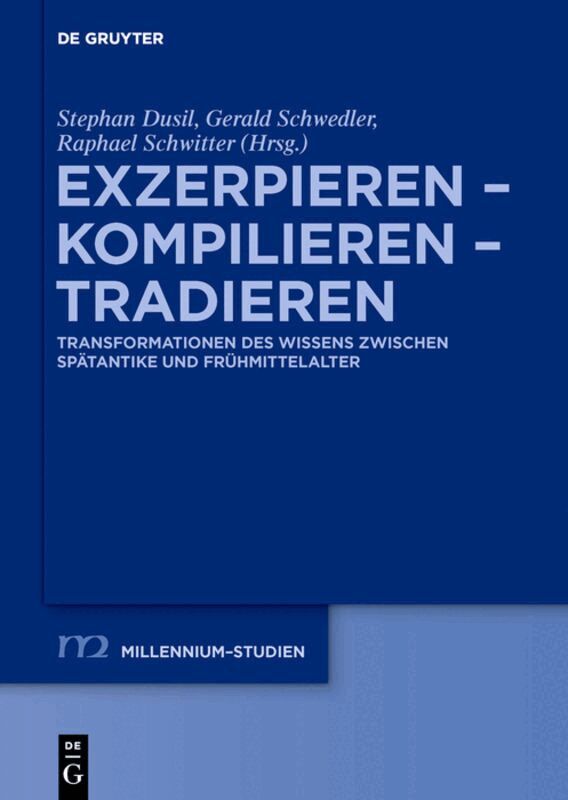
Exzerpieren - Kompilieren - Tradieren
Transformationen des Wissens zwischen Spätantike und Frühmittelalter
Inbunden, Tyska, 2016
1 578 kr
Skickas inom 5-8 vardagar
Millennium transcends boundaries – between epochs and regions, and between disciplines. Like the journal Millennium-Jahrbuch, the Millennium-Studien pursues an international, interdisciplinary approach that cuts across historical eras. The editorial and the advisory board represent a broad spectrum of disciplines: contributions from the fields of art and literature are just as well represented as historical, theological and philosophical contributions, and studies on Latin and Greek cultures as well as North African and Near Eastern cultures. In addition to offering a forum for monographs and edited collections on diverse topics, Millennium-Studien publishes commentaries and editions. Publication languages are primarily German and English; French, Italian and Spanish studies may be included. Series editorsWolfram Brandes, Frankfurt, Germany (Byzantine Studies and Early Middle Ages): brandeswolfram@gmail.comLaura Carrara, Pisa, Italy (Greek language and literature): laura.carrara@unipi.itDennis Pausch, Marburg, Germany (Latin language and literature): dennis.pausch@uni-marburg.deRene Pfeilschifter, Würzburg, Germany (Ancient History): Rene.Pfeilschifter@uni-wuerzburg.deKarla Pollmann, Tübingen, Germany (Early Christianity and Patristics): karla.pollmann@uni-tuebingen.de If you want to submit a manuscript for the Millennium Studies please send it to the series editor from the most relevant discipline. All manuscript submissions will be reviewed by the series editor and one outside specialist (single-blind peer review). Editorial Board:Phil Booth, University of Oxford, UKPatricia Ciner, National University of SanJuan, ArgentiniaBabett Edelmann-Singer, Freie Universität Berlin, GermanyPhilip Forness, Katholieke Universiteit Leuven, BelgiumLea Niccolai, Trinity College, University of Cambridge, UKClaudia Rapp, Universität Wien, AustriaVerena Schulz, Katholische Universität Eichstätt, GermanyChiara Tommasi, Università di Pisa, Italy Lieve Van Hoof, Ghent University, Belgium
Del 484 - Mnemosyne, Supplements
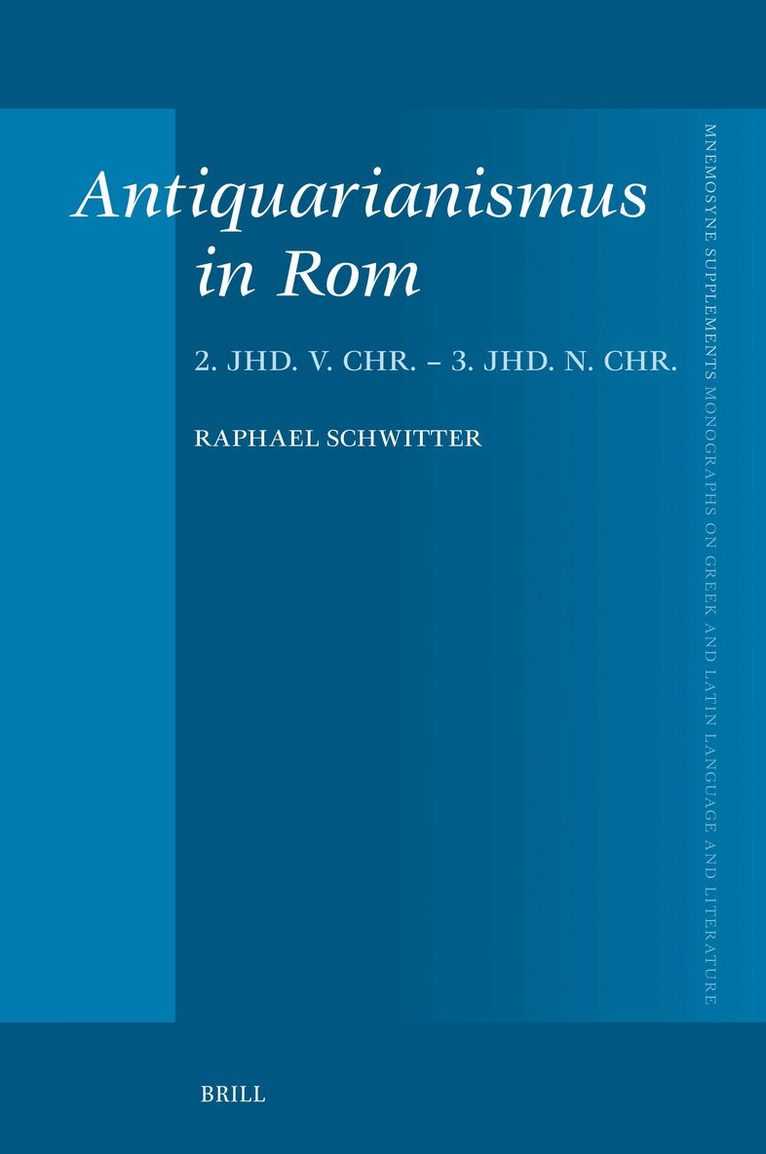
Antiquarianismus in Rom
2. Jhd. v. Chr. - 3. Jhd. n. Chr.
Inbunden, Tyska, 2024
2 529 kr
Skickas inom 3-6 vardagar
The open access publication of this book has been published with the support of the Swiss National Science Foundation. Die vorliegende Monographie entwirft eine literaturgeschichtliche Gesamtdarstellung des römischen Antiquarianismus vom 2. Jahrhundert v. Chr. bis zum 3. Jahrhundert n. Chr. Ausgangspunkt ist die begrifflich-konzeptuelle Neuprofilierung des Phänomens. Dieses wird als ein epistemologisches Modell gegenwartsbezogener Vergangenheitsanalyse aufgefasst, die mit den Denkfiguren der Etymologie, Aitiologie und Genealogie operiert, um die hinter der erfahrbaren Lebenswelt liegenden Kausalitäten freizulegen. Anhand der überlieferten Fragmente und Testimonien wird die Entwicklung der heute verlorenen antiquarischen Fachliteratur Roms in ihren unterschiedlichen medialen Formaten, Darstellungsformen und Wirkungskontexten nachgezeichnet.This volume provides an account of Roman antiquarianism from the 2nd century BC to the 3rd century AD, reconstructing its textual manifestations and analysing the mechanisms of transmission. It is based on a new conceptualisation of antiquarianism as an epistemological mode of understanding the present by uncovering its origins in the past. Etymology, aitiology and genealogy were the tools used to explore the causalities that underpin the perceptible world. Antiquarianism, represented by a wide range of texts and genres throughout antiquity, is traced as an autonomous branch of literature. Fragments and testimonies are used to identify a lost corpus of treatises, lexica and handbooks that formed the scholarly basis of Augustan poets, historiographers and imperial litterateurs.