
Rebecca McNamara – författare
Visar alla böcker från författaren . Handla med fri frakt och snabb leverans.
4 produkter
4 produkter
Häftad, Engelska, 2023
508 kr
Skickas inom 5-8 vardagar
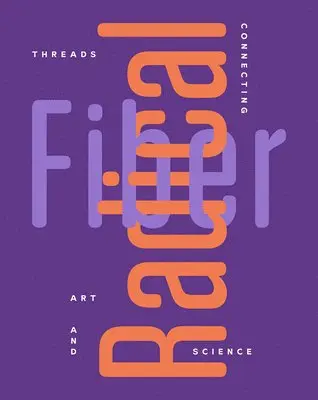
Can crochet explain the complexities of non-Euclidean geometry? How does the 1804 Jacquard loom relate to modern computing? Radical Fiber celebrates the overlap between art, science, interdisciplinary creativity and collaborative learningPublished with Tang Museum.For centuries, fiber arts have influenced sciences as diverse as digital technology, mathematics, neuroscience, medicine and more. Radical Fiber explores this relationship through contemporary art and historical artifacts that address five key themes: shape, machine, body, brain and community. How did the accidental discovery of synthetic mauveine dye in 1856 pave the way for modern pharmaceuticals while also generating toxic waste? Why do we respond differently to a woven photograph than a printed one? These and other questions reframe the fiber/science intersection and ask how the medium can be used to improve our world for the future.Radical Fiber features a new artwork created by amateur and professional makers around the globe: the Saratoga Springs Satellite Reef, part of the Crochet Coral Reef project by Christine and Margaret Wertheim and the Institute For Figuring. Alongside numerous unidentified artists, additional artists and creators include: Lia Cook, Brock Craft, Veronica Dry, Anna Dumitriu, Ellis Developments, Hanne Kekkonen, Kintra Fibers, Elaine Krajenke Ellison, Karen Norberg, William Henry Perkin, Helen Remick, Dario Robleto, Daniela Rosner, Samantha Shorey, John Sims, Soft Monitor (Victoria Manganiello and Julian Goldman), Daina Taimina, Cecilia Vicun?a and Carolyn Yackel.

Inbunden, Engelska, 2025
396 kr
Skickas inom 5-8 vardagar
Wilson invokes her own Black biracial identity in her mixed-media pieces, inspired by art historical traditions as much as the plants outside her doorPublished with Tang Museum.This first major monograph features nearly two decades of work by American artist Paula Wilson (born 1975), who frequently intermixes her identity as a Black biracial artist, living in a rural desert town in New Mexico, with narratives and motifs across time and place.Toward the Sky’s Back Door documents her wide-ranging career with essays by leading scholars Taylor Renee Aldridge, Ebony Y. Rhodes and Stephanie Sparling Williams, and a new interview with the artist. Wilson embraces a both/and approach to art and living, using the same techniques, materials and motifs to make rugs and clothing as she does for art on the gallery wall. Throughout her work, little to nothing is discarded, with scraps from one artwork recycled into another, reflecting both a practice of eco-sustainability and a model for creating something new from fragments left behind. This volume presents paintings, sculpture, prints, collages and videos, with different mediums frequently intermixed in a single work, ranging in scale from small paper-mosaic work to beyond-life-size female figures.
E-bok
Engelska, 201641 kr
Läs direkt efter köp
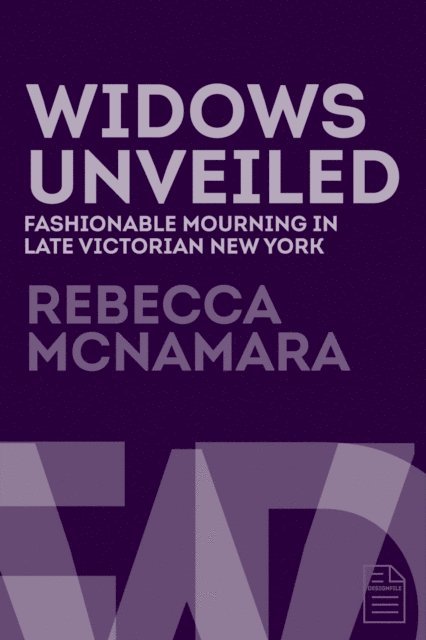
Somber black crepe gowns, long black veils, a strand of Whitby jet beads or a bracelet braided from a loved one’s hair, black-edged handkerchiefs—these were just some of the trappings of late nineteenth- and early twentieth-century mourning. Middle- and upper-class Americans of this era were expected to follow strict etiquette guidelines in all aspects of their lives, including—perhaps especially—following a loved one’s death. Sustained by advice writers, newspapers, and the retail and manufacturing industries, mourning culture was prevalent in daily urban life. Prescriptive guidelines were most extreme for the widow, who was expected to mourn her lost husband for at least two years, including one in seclusion from society. Filled with nuanced requirements for how to live and what belongings to live with, these customs would have been difficult, if not impossible, for most women to follow—especially those suddenly impoverished by their widowhood. Widows Unveiled illuminates American mourning practices between the Civil War and World War I through an investigation of the textual, material, and visual culture of New York widowhood.Illustrated with images of period costumes, jewelry, accessories, drawings, and photographs, Widows Unveiled analyzes mourning etiquette and its accouterments, interprets the abundant negative stereotypes of widows in visual culture, and explains the slow, uneven demise of mourning practices in the twentieth century. Author Rebecca McNamara demonstrates that material mourning was far more complex and confusing than is generally acknowledged and that its purpose went beyond superficial consumption: indeed, the black-crepe-enrobed and -veiled woman, as she navigated a society critical of and even hostile to widows, was both demonstrating an ideal feminine role—loyal, doting wife—and signifying a continued independent presence in polite society.

Inbunden, Engelska, 2015
443 kr
Tillfälligt slut
"Flicking through the book... you'll discover all manner of vintage cigarette holders, ranging from cheap promotional items given away by New York nightclubs to extravagant versions crafted by the likes of Tiffany, Fabergé, Cartier and Van Cleef & Arpels." South China Morning PostThe book offers an unprecedented look at cigarette holders through a selection of approximately 125 pieces from the collection of Carolyn Hsu-Balcer. Its introductory essay is both a social history of that world-changing leaf, tobacco, and a design history of its accoutrements. It examines the history of smoking from its pre-Columbian roots in the Americas through to the present-day worldwide e-cigarette craze, taking the reader on a journey from tobacco smoking as a sacred ritual, through the controversies of its worldwide spread, and the machine-rolled cigarette's role in the world wars and as a tool for European and American women's equality.Following the illustrated essay is a luxurious catalogue of newly commissioned photography that makes these diminutive objects pop off the pages with brilliant colour and form. The collection includes cigarette holders in their simplest incarnations - the disposable promotional holders given away at trendy New York nightclubs - to their most exquisite - the work of Fabergé, Cartier, Tiffany, Van Cleef & Arpels and other renowned jewellers of the late nineteenth- and twentieth-centuries.Contents:Foreword by Carolyn Hsu-Balcer; Introduction; Chapter 1: Tobacco's Journey from the New World to the Old: Medicine and Pleasure; Chapter 2: The Rise of Cigarette Culture: The Nineteenth and Early Twentieth Centuries; Chapter 3: Smoking, Sociability, and a New Modern Era: From the First World War to the Second; Chapter 4: The Cigarette Holder's Peak and Fall: A New Culture of Smoking; Catalog; Appendix: Materials Used in Cigarette Holders; Acknowledgments; Photo Credits.