Reshef Tenne - Böcker
Visar alla böcker från författaren Reshef Tenne. Handla med fri frakt och snabb leverans.
2 produkter
2 produkter
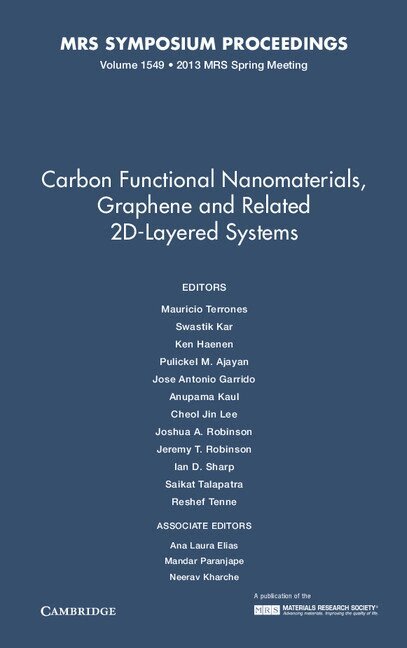
Carbon Functional Nanomaterials, Graphene and Related 2D-Layered Systems: Volume 1549
Inbunden, Engelska, 2014
955 kr
Skickas inom 7-10 vardagar
For almost two decades now, the carbon nanomaterial (CNM) system has persistently provided researchers the opportunity for spectacular new discoveries, significant advances in fundamental and applied science, and the development of disruptive technologies and applications. The rich allotropicity of carbon bonding can explain the broad use of carbon-based materials such as carbon nanotubes (CNT), diamond, fullerenes, and more recently graphene. Today's research community continues to discover and harness new low-dimensional carbon allotropes, perhaps at a historically unprecedented rate. These exciting developments and others are covered in this volume and will be relevant and useful when carrying out fundamental research in the areas of carbon nanoscience and 2D systems.
Del 5 - World Scientific Series in Nanoscience and Nanotechnology
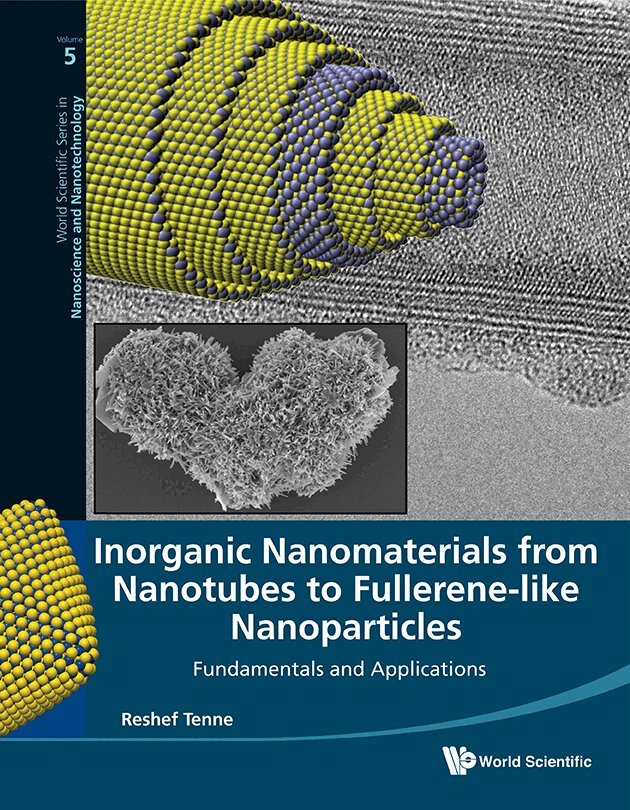
Inorganic Nanomaterials From Nanotubes To Fullerene-like Nanoparticles: Fundamentals And Applications
Inbunden, Engelska, 2013
1 812 kr
Skickas inom 5-8 vardagar
Following the striking discovery of carbon fullerenes and carbon nanotubes, it was realized by the author and his teammates in 1992 that such nanostructures are not unique to carbon. In fact, hollow closed structures are common to probably most if not all inorganic compounds with layered structures, like WS2, MoSe2, BN, NiCl2, Cs2O and many others. These highly anisotropic compounds suffer from inherent instability when prepared in nano-sizes and close on themselves to form hollow closed structures in the form of inorganic fullerene-like (IF) nanoparticles or nanotubules (INT).The book takes the reader from the discovery stage, where some fundamental ideas in this field were developed, through the systematic effort to synthesize IF and INT in larger amounts and elucidate their structure. In a few cases, like BN nanotubes and WS2 IF nanoparticles, new strategies permitted synthesis of macroscopic amounts and subsequently systematic study of their properties, offering thereby numerous applications. The reader is taken through this never-ending evolutionary process with a few recent examples demonstrated. The field stands in the crossroads between solid state inorganic chemistry, nanotechnology, materials chemistry and nanomechanical engineering.